Extending Museum beyond Physical Space: A Data-Driven Study of Aldo Rossi’s Analogous City as a Mobile Museum Object
Rodighiero, Dario. 2022. “Extending Museum beyond Physical Space: A Data-Driven Study of Aldo Rossi’s Analogous City as a Mobile Museum Object.” International Journal for Digital Art History. https://doi.org/10.11588/DAH.2021.6.77681.
Aldo Rossi composed the famous collage known as Analogous City for the Venice Biennale in 1976. This text presents a visual study of the collage through both physical and digital means: a mobile app works in conjunction with a reprint of the Analogous City in the format of a city map. Forty years after its creation, the collage’s original elements are finally identified and collected, and the mechanisms of composition are disclosed thanks to Fabio Reinhart’s contribution. The map of the Analogous City is analyzed in both historical and museum viewpoints, focusing on the reflections that emerged when exhibiting in Maastricht, Milan, Lausanne, Bergamo, and Rome. Although the map was designed as an interactive installation for these exhibitions, it has turned out to be also an educational tool useful outside museums. If Aldo Rossi created an artwork to think about the reconstruction of the city, likewise, the map of the Analogous City helps to rethink museums by designing their objects in a way they can leave the exhibition for a second life in the city.
An issue of accessibility
The introduction of the printing press to Europe in the mid-1400s was not a complete cultural revolution as it is often made out to be. Johannes Gutenberg’s books were novelty items that only wealthy collectors could afford. The real revolution took place fifty years later in Venice, where the publisher Aldus Manutius introduced typographic and editorial innovations that led to the creation of the paperback (Marzo Magno 2020). In the late fifteenth century, Manutius printed a small book of about sixty pages entitled De Aetna, which radically changed the way of reading. Readers were previously forced to handle heavy books, but the paperback was mobile, increasing the book’s context and reach. Books were purged from glosses and formatted using the italic type, an innovation introduced by the font designer Griffo which entirely revolutionized typography. The combination of these innovations lowered the price of books, making them accessible to a wider audience (Davies 1999, 42). Manutius’ story teaches us how the revolution does not take place with the printing press but with the later wider access to literary works. Contextualizing this teaching in museums, it can be said that the real revolution is not found in new architectures or digital infrastructure but in the concept of accessibility understood as the circulation of collections, in their multiple possible forms.
Museum accessibility originates from private collections often veiled by an exotic and mysterious aura, called cabinet of curiosities. Those exercises of personal curatorship were initially aimed at providing a sense of amazement and aesthetic satisfaction for the sole collector, but over time their audience shifted toward a general public (Cellauro 2012). Today museums extend the concept of the cabinet of curiosities in the form of institutions, making valuable objects that would be otherwise hidden accessible to the public (Anderson and Malouf 2018). Once exhibited, these objects become a form of cultural commons at the disposal of the members of society, so that knowledge can be assessed by a larger public than a few elected individuals as it used to be in the past.
More recently, the notion of museum has been further developed when Franco Russoli, the director of Pinacoteca di Brera, developed the concept of living museum. Initially introduced by his forerunner Fernanda Wittgens, the living museum is premised on the idea that institutions must address a larger public to create a relationship with the city through education and learning (Russoli 2017). The museum is a living organism not limited to the building itself, but extends beyond it, making the objects of the collection reachable by a wide audience.
Following this concept, André Malraux, as other intellectuals of the same period, created a traveling exhibition composed of copies of the most famous artworks, called the imaginary museum (Malraux [1952] 1997). The goal was to exhibit copies of the most famous artworks in more peripheral cities (Rowley and Völlnagel 2020, 23) by subverting Walter Benjamin’s theory, which claims reproduction deprives artworks of the authenticity of their presence, or aura (Benjamin [1968] 2007). Today, aura has lost its relevance, leaving space to artworks’ circulation through sophisticated techniques of reproduction, which Adam Lowe refers to as digital materiality (Lowe 2020). As implicitly stated in the writings of Antoine Hennion and Bruno Latour (1996) or Salvatore Settis (2015), reproduction has always existed and there is no harm in the technique itself. It is the responsibility of society to charge an object with an aura through celebrations, stories, and spaces.
This article embraces the idea of an age of digital reproductions (Davis 1995), relying on a research project about Aldo Rossi’s Analogous City to amplify the work of museums in the city through digital and physical objects. If social networks (Vrana et al. 2021) and digital collections (Snydman, Sanderson, and Cramer 2015) have already opened up institutions on digital reproduction, the map of the Analogous City is a museum object capable of living after the exhibition, like a virus that finds the way of flourishing through transmission. Museum objects can be reinvented in new forms to circulate just like Aldus Manutius’ paperback or Adam Lowe’s digital materiality: the digital and the material forms can be designed as a sole object for education, preservation, and reproduction.
The Five Dimensions of Analogy
The seventies were a period in which architects appropriated the collage, an expressive technique already explored by artists and painters (Braghieri 2019; 2020). For the 1976 Venice Biennale, Aldo Rossi deliberately employs such a technique to talk about the reconstruction of the city (Lampariello 2017). By doing so, he molded a visual representation of analogy, a concept that he already developed in the second edition of The Architecture of the City (Rossi [1966] 1982). Together with those he considered more like friends than colleagues — Eraldo Consolascio, Bruno Reichlin, and Fabio Reinhart — Rossi composed an imaginary city by expanding upon and in some ways diverging from the work that Vitruvius developed on analogy in antiquity (Ortelli 2015; Cache 2018). The collage was composed in Zurich by photocopying images from the private library of Werner Oechslin, the director of ETH architecture department, when the library was still located in the city center.
The authors were inspired by the painting Capriccio with Palladian buildings (Canaletto 1756) in which Canaletto arranges three Andrea Palladio’s buildings in a fictional Venice, in such a credible way to fool citizens at the time (Algarotti 1759). The composition is created using three forms of analogy, discussed by Peter Eisenman in the editor’s introduction of The Architecture of the City (Rossi [1966] 1982). One analogy is temporal: elements from different times cohabit the same space; although they belong to different periods, the Palladian Basilica and Palazzo Chiericati appear together in that overlapping of buildings that architects call a palimpsest. The second analogy is spatial, whereby Canaletto relocates different monuments to Venice. The basilica of Vicenza, for example, appears on the banks of the Grand Canal with gondolas sailing around. The third analogy is operational, as the architectural tension between planning and construction represents two different stages of the design process (De Michelis 2014). Andrea Palladio’s Rialto Bridge, at the center of the composition, was never selected to replace the old wooden bridge over the Grand Canal, and thus portrays built and never-built buildings.
Peter Eisenman also discusses a fourth analogy of scale that is attributed to Capriccio but is explicitly expressed in the technology used for the collage (Rossi [1966] 1982). There is no doubt that the topographical scale is related to the act of reassembling buildings from distant places, but the photocopier allowed Rossi and his friends to play also with the physical scale. The photocopier, a tool also used for artistic experimentation (Urbons 1991), was for them a means of experimenting with relationships of scale between the elements. The analogy becomes scalar by transforming the Analogous City into the imaginary place where architecture plays out of the rules. In an evident conflict of scale, the Notre-Dame du Haut by Le Corbusier (Boesiger and Girsberger 1967) is placed inside one Como’s courtyard, drawn by Gianfranco Caniggia (1963). The analogy lies in the tension between architecture and urban scale (Campanile 2020), but also between reality and imagination as written by Aldo Rossi himself (Rossi 1976). Just like the playfulness that characterizes Aldo Rossi’s drawings, the Duomo of Milan becomes an interior furnishing (Celant and Huijts 2015), and the colored pencil becomes a postmodern building (Venturi, Izenour, and Scott Brown 1977). In the Analogous City, the authors reuse the analogy as a tool to reinvent the city through a creative process that recalls Gianni Rodari’s arbitrary association ([1974] 2010).
Yet, there is still a fifth dimension that is visible but barely examined, which can be called the analogy of reverse. Although Aldo Rossi already investigated the relationship between inside and outside of the house in Spazio chiuso, interno (Savi 1976), the Analogous City developed it further. The most valuable example is represented by the Laurentian Medicean Library. While Michelangelo brings the exterior facade inside the library’s entrance (Murray 1971), Rossi draws a garden inside the library, displacing an external element to an interior environment. Although this detail might seem small, it tells a lot about the approach to the collage, both theoretical and playful.
Fabio Reinhart’s Interpretation
As in all complex objects, we undertake a path of deconstruction to understand the Analogous City. The occasion presents itself with the exhibition curated by Ton Quik on the initiative of the Bonnefanten Museum in Maastricht, called Aldo Rossi: The Window of the Poet (Celant and Huijts 2015). The map represents the scientific contribution of the École Polytechnique Fédérale de Lausanne (EPFL), coordinated by the Archizoom gallery and the digital humanities laboratory, respectively directed by Cyril Veillon and Frédéric Kaplan. The project was brought to light thanks to various authors, including Fabio Reinhart whose contribution is essential in order to fully understand the Analogous City. Forty years later, two precious texts (Reinhart 2015a; 2015b) complete the original thoughts expressed by Aldo Rossi (1976) and Manfredo Tafuri (1976), previously published on Lotus International during Venice Biennale 1976. The city is an object that needs to be read through buildings, urban plans, drawings, images, and architectural projects. As stated by Cameron McEwan, these elements “were understood as ‘texts’ linked within a discursive chain connected to thought and ideology made ‘readable’ by critique” (McEwan 2020). In the years of the semiotic revolution guided by Umberto Eco, the interpretation of a text had to be extended to a large variety of artifacts, including the collage of the Analogous City.
In his first text, entitled “Captions for the Analogous City,” Reinhart (2015a) invites visitors to enter the city through its three entrances. The main entrance can be reached by following Lake Maggiore’s waters through the walls of Castelgrande in Bellinzona (Reichlin and Reinhart 1969). The metaphysical entrance is indicated with a gesture by David (Tanzio da Varallo 1625) whose outstretched arm, redrawn by Reinhart himself, replaced Goliath’s head. The third entrance, the intimate one, hides within the walls of Bellinzona in a tortuous path originating from the drawings of Scandicci’s town hall (Rossi, Fortis, and Scolari 1970), taken up in turn from Karl Friedrich Schinkel’s work for Charlottenhof Palace (Whyte 2000).
Reinhart also describes the collage of the Analogous City as a mechanical machine, inspired by Jean Tinguely’s mechanisms (Isgro 2020), which pivots on three gears placed at the center of the composition. These gears correspond to the Monument to Moncenisio by Giuseppe Pistocchi (Godoli 1974), the Vitruvius’ ideal city by Giovanni Battista Caporali (1536), and the plan of the San Cataldo Cemetery by Aldo Rossi and Gianni Braghieri (Savi 1976).
In addition, Reinhart explains how the Analogous City is organized into four semantic areas that correspond to four types of cities: the topographical city by Guillaume-Henri Dufour, which represents an area of Ticino (1865), the urban city mapped by Gianfranco Caniggia, which illustrates Como’s urban structure (1963), the ideal city by Vitruvius, which is described in De Architectura (Caporali 1536), and the mnemonic city by Giovanni Battista Piranesi, which recalls an imaginary Rome (1913).
Fabio Reinhart’s reflections are historically interesting because it is the first time that one of the authors of the Analogous City recorded their reflections regarding the composition. The semantic areas of the collage have richer meaning when combined with the entrances, which delineate the passages between areas. Furthermore, the three gears moving the entire mechanism make the viewer think of a complex machine moving heavily and loudly, almost to the point of listening noise. These two views express the notion that the city is an intricate and complex mechanism, also for those who designed and built it.
Deconstructing the Analogous City
Deconstructing the Analogous City means collecting the original references used by Rossi and his friends to compose the collage in order to explore their visual culture. The work had already been set up by Reinhart, who identified more than thirty references (Figure 1), a majority of which were extracted from the series directed by Pier Luigi Nervi, Storia universale dell’architettura (Universal History of Architecture) and includes volumes such as Architettura del Rinascimento (Architecture of the Renaissance) by Peter Murray (1971) and Architettura contemporanea (Modern Architecture) by Manfredo Tafuri and Francesco Dal Co (1976). Other references included Aldo Rossi’s projects, such as the housing unit in the Gallaratese district of Milan (Rossi, Fortis, and Scolari 1970), part of the apartment complex Monte Amiata by Carlo Aymonino, or the San Rocco housing unit designed in collaboration with Giorgio Grassi (Savi 1976).
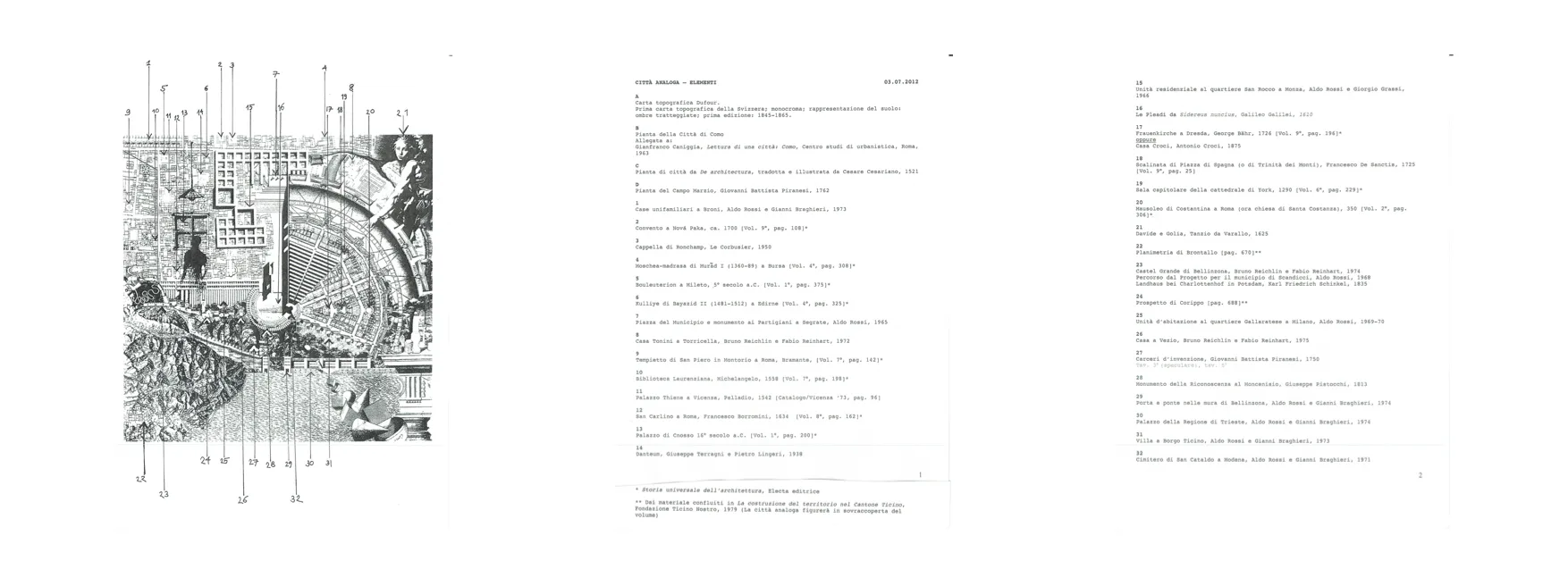
It is worth noting that some references stand for the authors’ regions of origin, located between Milan, the Lake Maggiore, and Ticino. Among them, the house by Bruno Reichlin and Fabio Reinhart in Vezio (Fera and Conti 2007), David and Goliath by Tanzio da Varallo in Varallo Sesia (1625), Casa Croci by Antonio Croci in Mendrisio (Fera and Conti 2007), the monument to the partisans by Aldo Rossi in Segrate (Rossi, Fortis, and Scolari 1970), and the floor plan by Max Bosshard, Eraldo Consolascio, and Orlando Pampuri in Brontallo (Rossi, Consolascio, and Bosshard 1979). This demonstrates that their visual choices were deeply rooted in their culture, and therefore strongly related to the territories where they were born and lived.
The collection of the original references was made possible thanks to the support of the EPFL library, which owns an extensive section of architecture, and the collection of E-rara, a Swiss digital platform that houses a large number of old prints. Research on physical and digital archives was a moment of great interest but also of frustration due to the references difficult to find. For example, the geometric solids by Augustin-Charles d’Aviler (D’Aviler 1738) and the Doric column by Andrea Palladio (Palladio 1786) were incredibly challenging to identify because of the large number of versions, often being too similar to be distinguished. The correct version of d’Aviler’s geometric solids was identified by using a magnifying glass to count the shading lines of the cone (Figure 2), while Andrea Palladio’s Doric column was recognized in the version drawn by Ottavio Bertotti Scamozzi through a process of comparison (Figure 3). It is worth noticing that the image was not created by Palladio’s historical collaborator Vincenzo Scamozzi but by his heir Ottavio Bertotti Scamozzi.
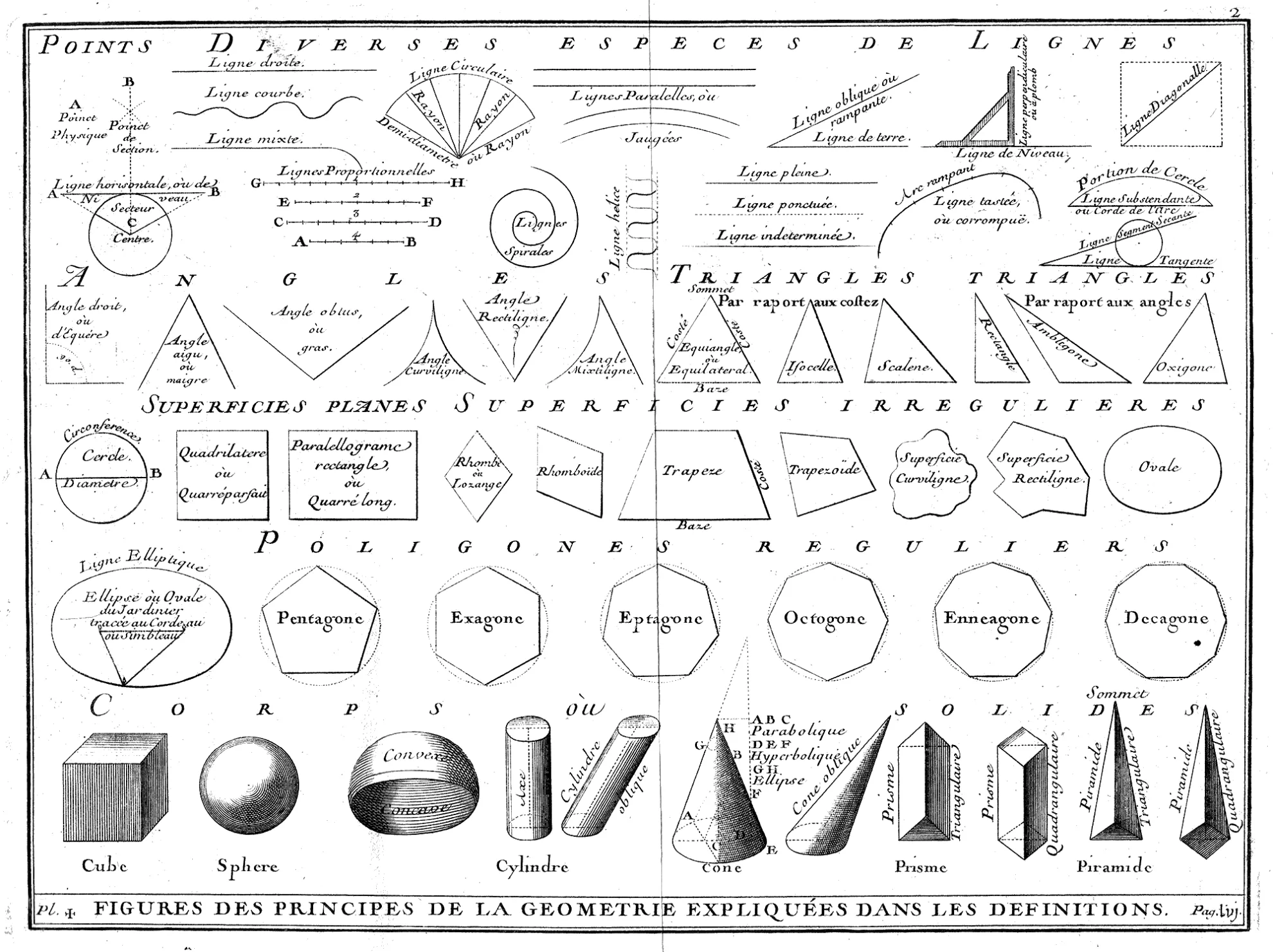
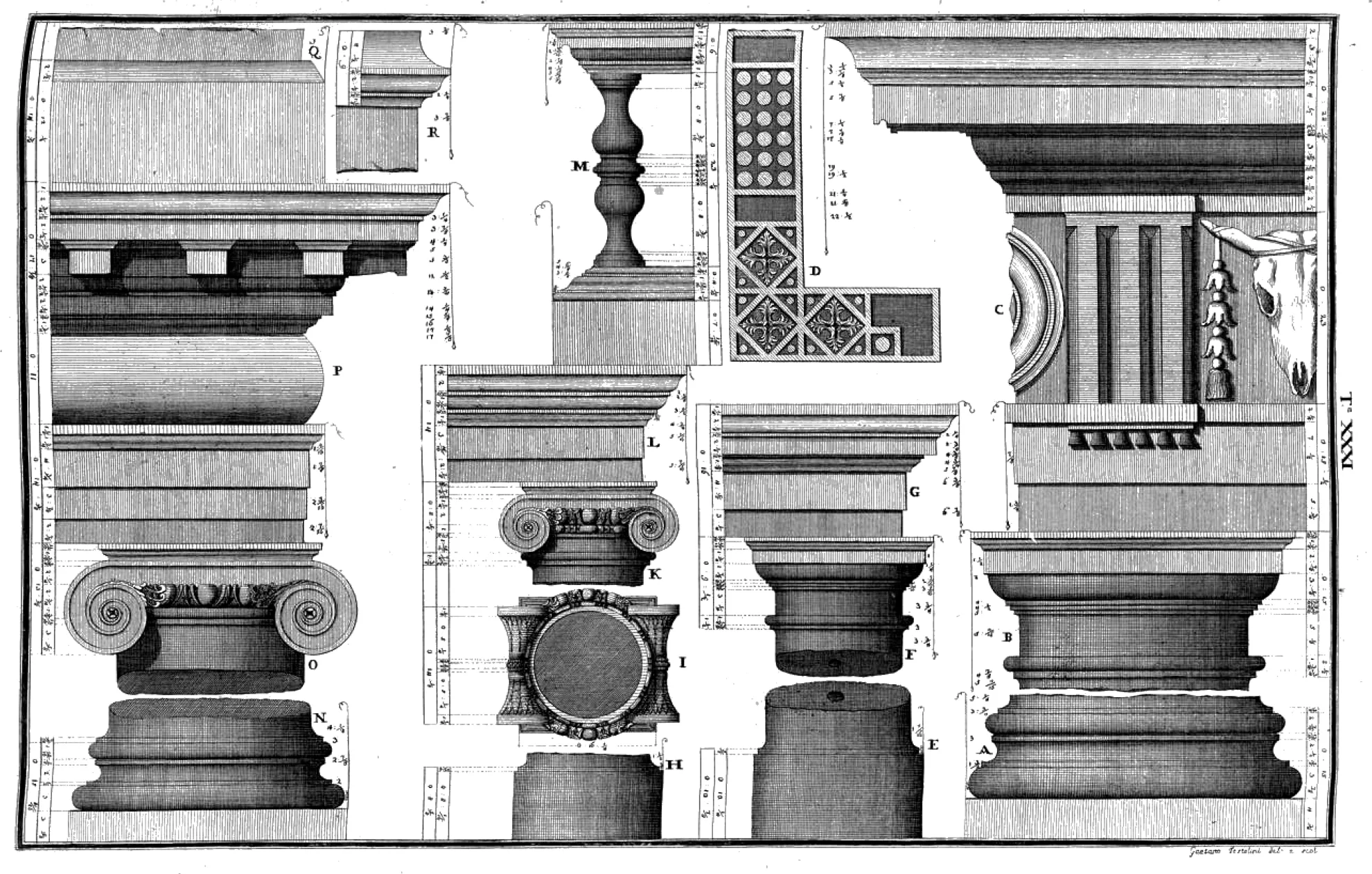
On the other hand, the coffee maker was the latest reference to be found thanks to the personal archive of Beatrice Lampariello; the Spanish magazine Construcción de la ciudad had dedicated to Aldo Rossi two volumes that were difficult to find (Rossi 1975a; 1975b). It is curious to observe how, in the context of a study on Aldo Rossi’s graphic work, the most difficult item to find was the drawing of a coffee maker, an object that Rossi loved to represent most.
The final list includes 45 references in all that have been summarized in two visuals. Figure 4 shows all the references as they appear in the collage in separated squared frames, making it possible to identify there the most extensive elements that characterize the semantic areas: the mnemonic city by Piranesi (first row, last column), the ideal city by Vitruvius (second row, first column), the urban city by Caniggia (second row, fourth column), and the topographical city by Dufour (second row, last column). In Figure 5, all the squared frames are reassembled in a unique image that unequivocally recalls the Analogous City.
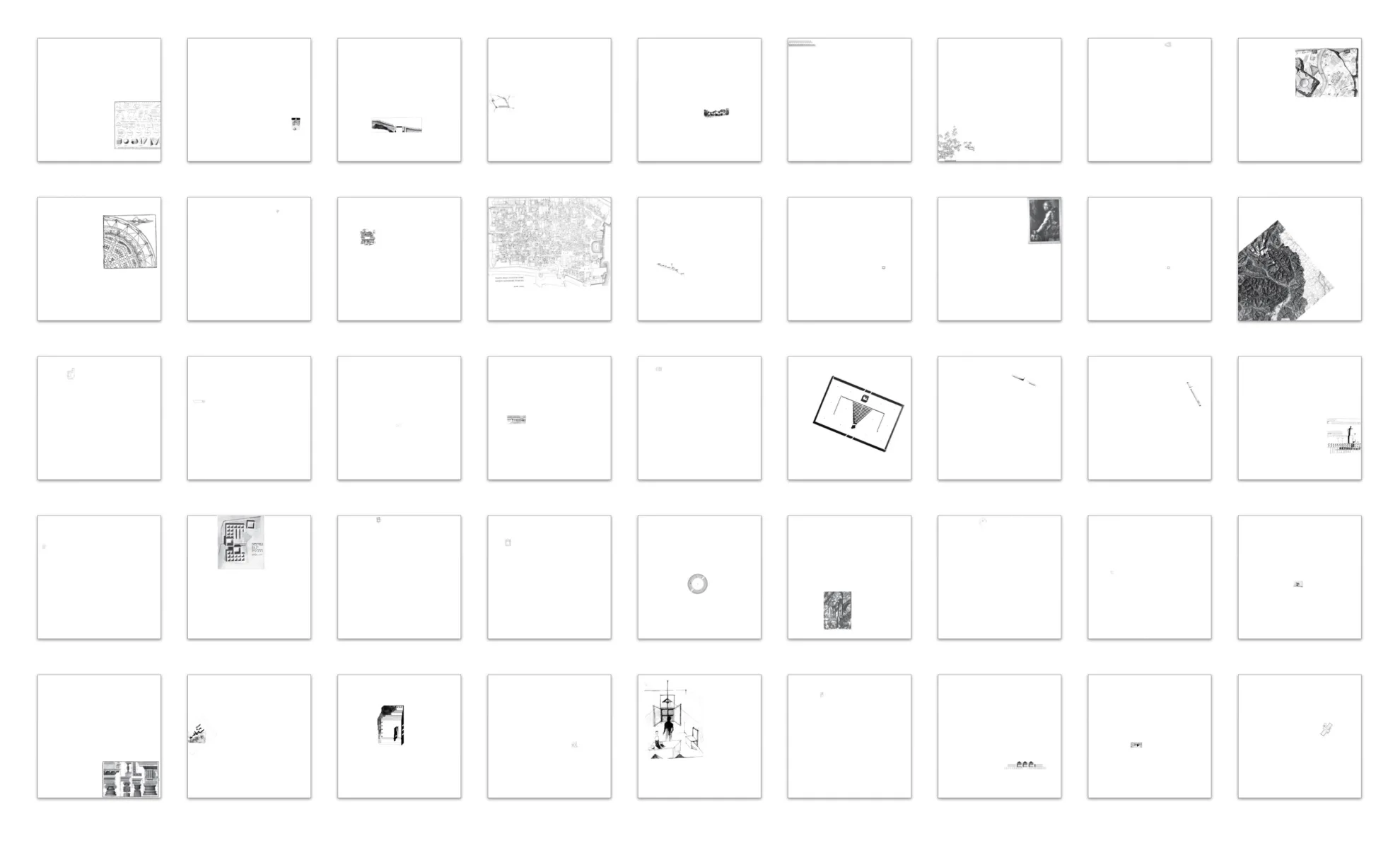
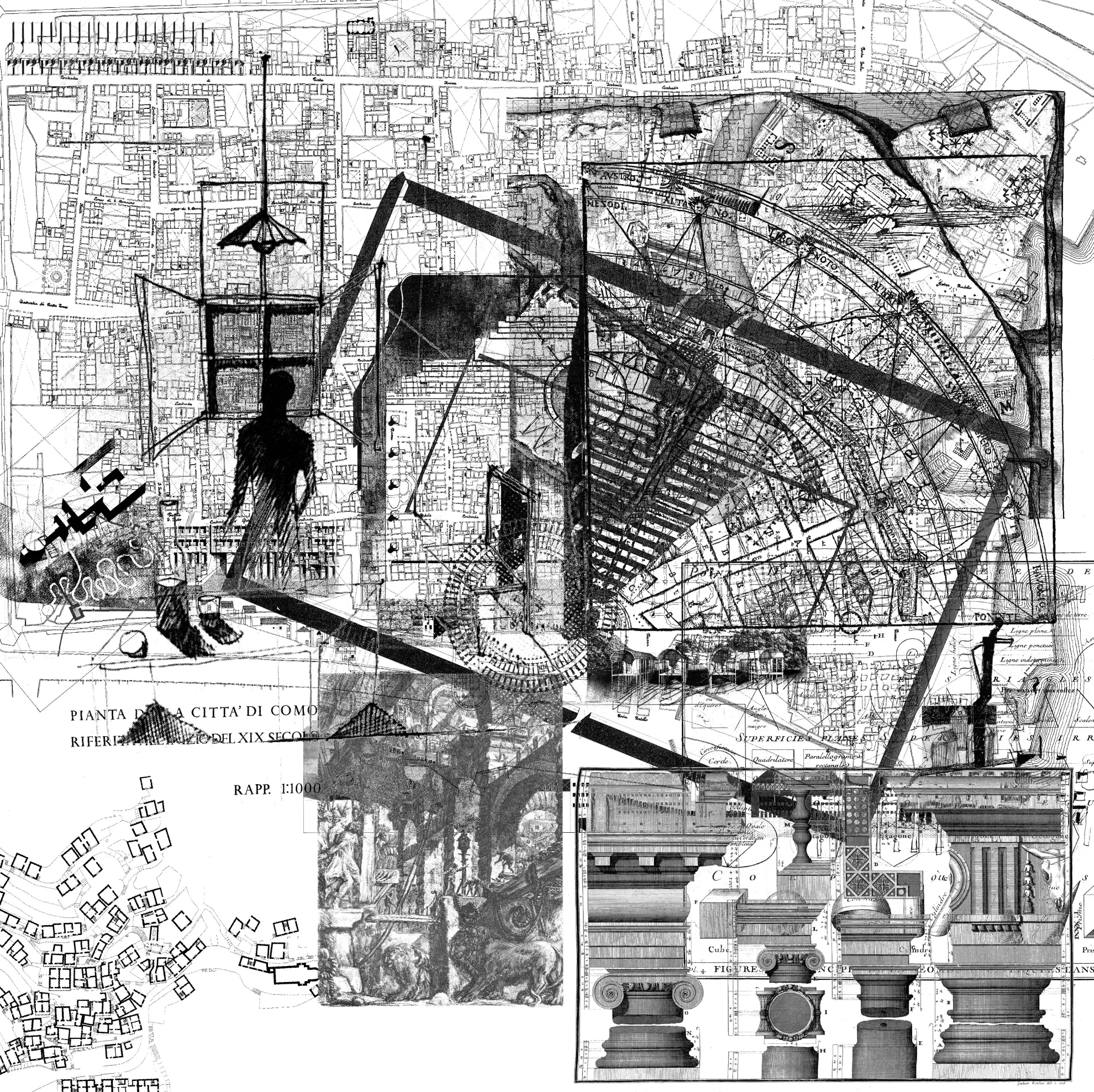
Recovering the elements of the Analogous City was an investigation into the visual culture of Aldo Rossi and his friends. The final list of references is a sort of visual bibliography that authors left behind, which gives importance to the visual representation as an alternative to writing. When the Analogous City is dissected and deconstructed, we are met with an utterly intimate representation of the city thanks to the personal experiences, origins, and biases of its authors. Tracing the elements that compose the collage is a historical work that gives a deeper understanding of the intellectual context in which the work was created.
Transformation Into a City Map
Scientific research often takes shape in articles, but recently researchers have been experimenting with new formats of communication (Gorman 2020). The Swiss typographer Adrian Frutiger, for example, printed a map about the evolution of signs and symbols (Frutiger 1997). Frutiger’s experiment is interesting given that maps — objects falling somewhere between books and posters — are characterized by a high portability despite their large printing surface. Although the spread of portable devices has forced these artifacts into disuse, they have been reborn through their satisfying rediscovery, further giving us an innovative perspective.
Reflecting on the possible ways to publish the study about the Analogous City, one idea came to mind: what better way to orient yourself in a city than a city map? The city that was transformed into a picture panel for Venice Biennale undergoes a second transformation into a city map as Fabio Reinhart brilliantly underpins, “The map is an interpretation of the picture panel, a sort of re-invention within the framework of a new social and cultural reality: of identical content, but materially and dimensionally mutant” (Reinhart 2015b).
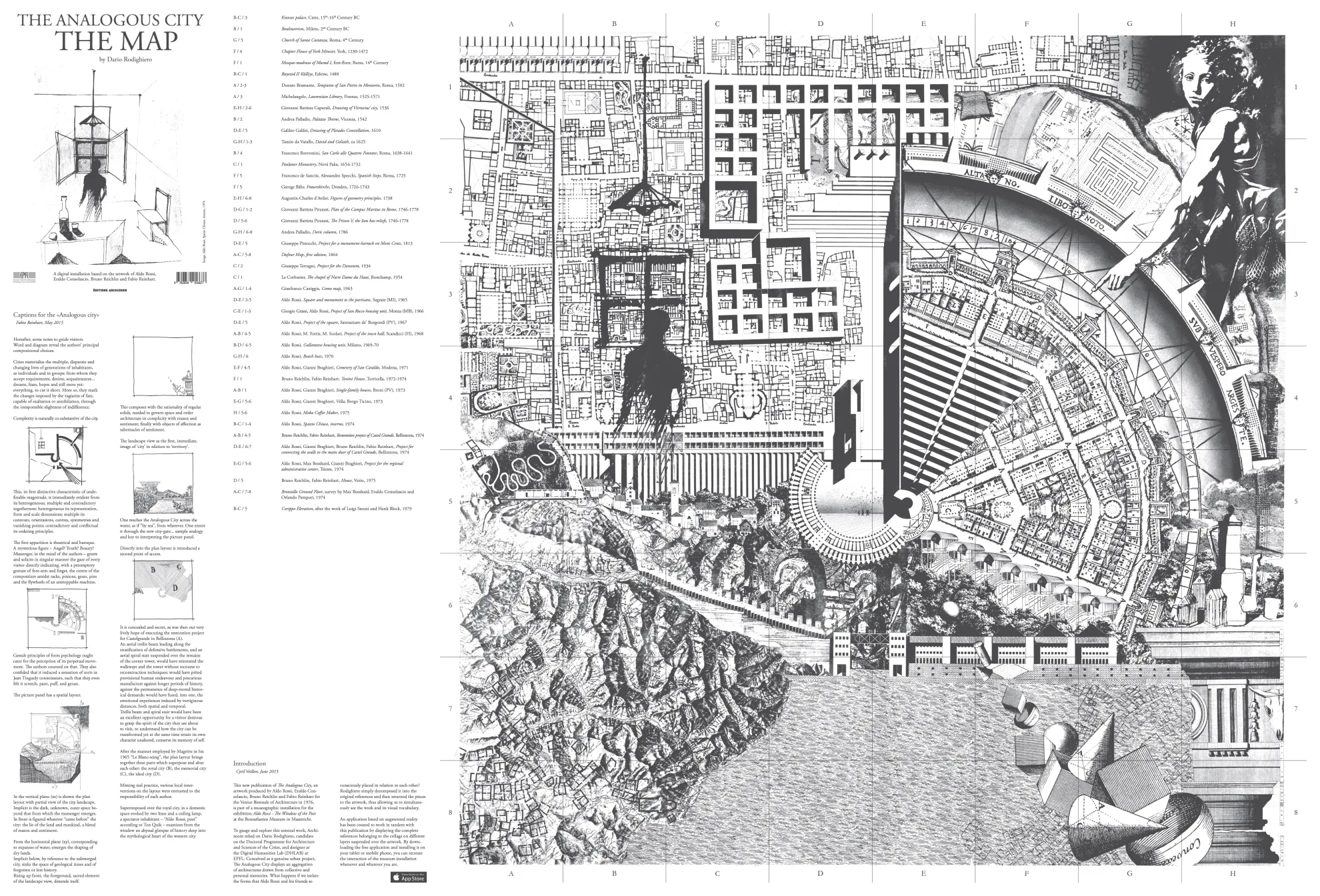
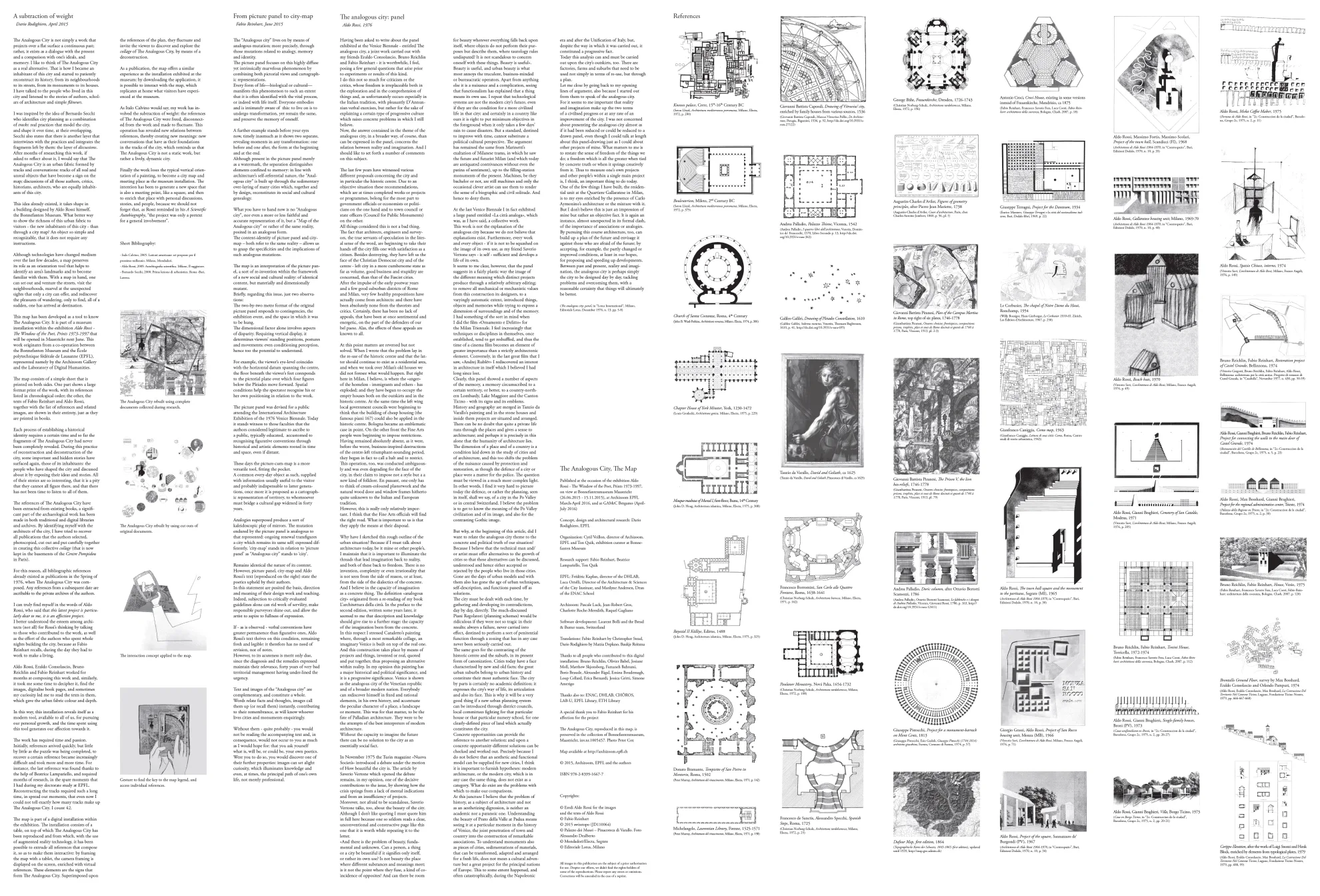
Taking up Adrian Frutiger’s idea, the Analogous City was reprinted as a map (Rodighiero 2015). On the front side, the Analogous City is printed as a city map divided into sectors. The map’s format is appropriate at first glance as the large surface allows the viewer to grasp more detail compared to any book (Figure 6a). Next to it, references appear in alphabetical order with their spatial coordinates, which allow the viewer to identify images in the map, while the introductory text by Reinhart illustrates the proper interpretation of the collage (2015a). The backside hosts the collage’s elements in their wholeness, together with full bibliographic references (Figure 6b). The original article by Aldo Rossi (1976) is also included on the back side, in addition to the second text authored by Fabio Reinhart (2015b), and two introductory texts by Cyril Veillon and Dario Rodighiero. Developing creative or unconventional formats for this research on the Analogous City paves the way for a new perspective, and new possibilities for user interaction.
The Exhibitions
The map of the Analogous City must be contextualized within the exhibition Aldo Rossi: The Window of the Poet, organized by the Bonnefanten Museum in Maastricht and hosted later by the GAMeC of Bergamo and the Archizoom in Lausanne. Out of this exhibition, the digital installation has been also presented in Triennale di Milano and MAXXI in Rome.
The map of the Analogous City makes use of augmented reality with the idea of developing a digital humanities project. The application called The Analogous City — freely available for tablets and smartphones on Android and iOS — captures the camera video and recognizes the artwork to return an augmented version of it on the screen. In augmented reality, the elements of the Analogous City are indicated by blue circles floating on the map. By clicking them, the visitor identifies the proper bibliographic reference and the photograph when available. In addition, the uncut images of references are visualized in their wholeness, perfectly aligned in terms of size and rotation with the collage, in order to make the viewer aware about eventual cutout portions and modifications of the original image.
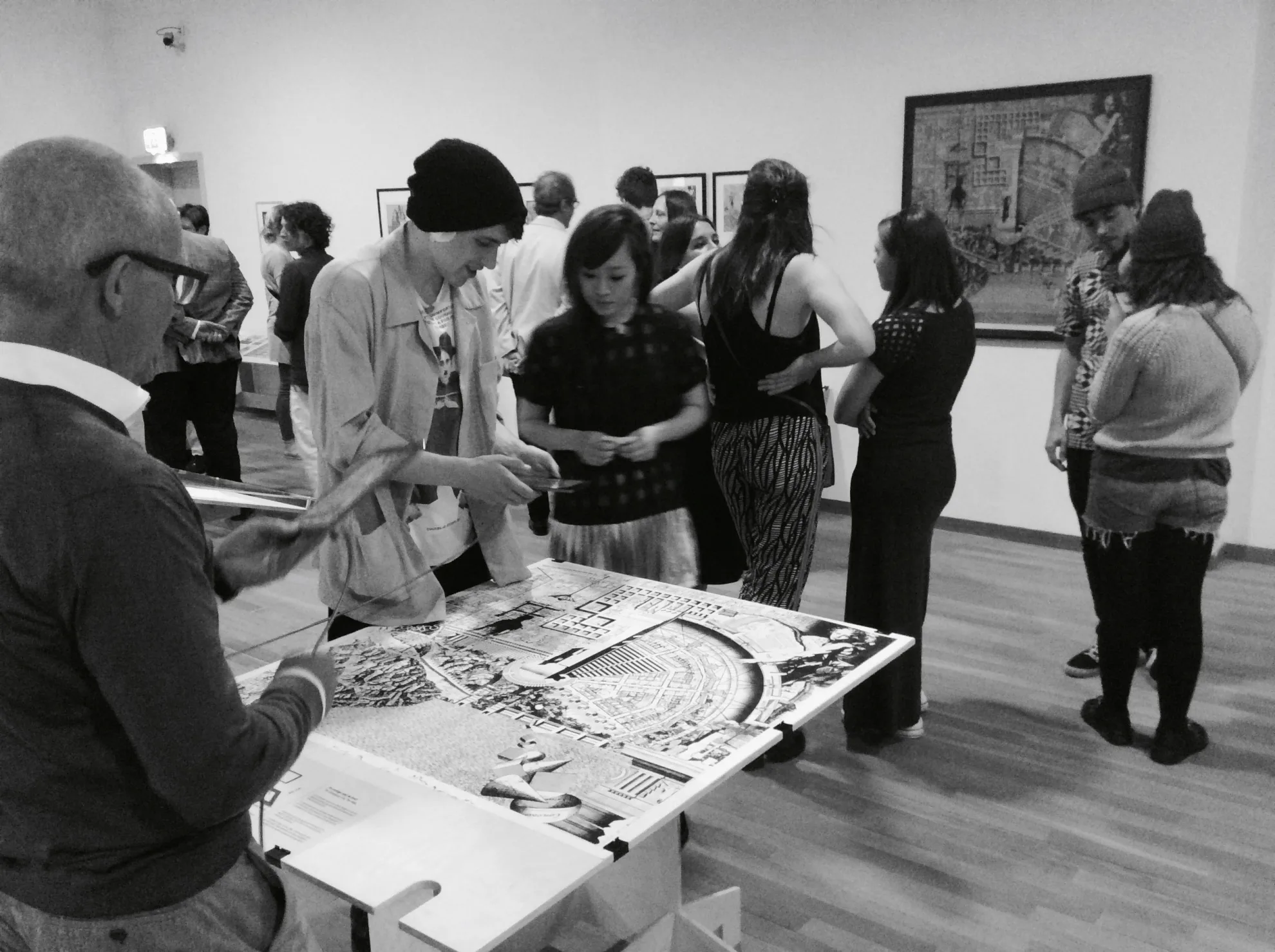
The map of the Analogous City thus becomes part of the exhibition, both physically and digitally. In Maastricht and Bergamo, the map is displayed on a wooden table equipped with two tablet computers. The horizontal surface allows visitors to approach the map from multiple sides, creating a participatory space of interaction in which people can talk to each other (Figure 7). Although the application had been conceived to work with the map, some of the visitors started using the tablet with the original artwork, pointing to the Analogous City hanging on the wall, probably attracted by its aura. The map, which was supposed to act as a link between the artwork and the visitor, disappears like the perfect mediator by bringing the visitor even closer to the Analogous City.
Once any interactive project comes to exhibition space, it is the unexpected uses that intrigue designers and architects. During the exhibition in Lausanne, where the museum surface at our disposal was smaller compared to that of Maastricht, visitors were invited to interact directly with the original artwork and the map was excluded from the exhibition — the idea was suggested thanks to observing these previous experiences. Needless to say, the experiment was successful as the interaction was clear even without the map working as a mediator between the artwork and the visitors. To reaffirm the centrality of the visitor in the museum, a father encouraged his daughter to use the tablet with a smaller print of the Analogous City, showcased at a more appropriate height for her (Figure 8). What is interesting about this image-recognition algorithm is that it works at different scales, as the image it receives through the camera does not bring any information about scale but simply one flat video recording. Once again, the visitor had changed the rules of the game.
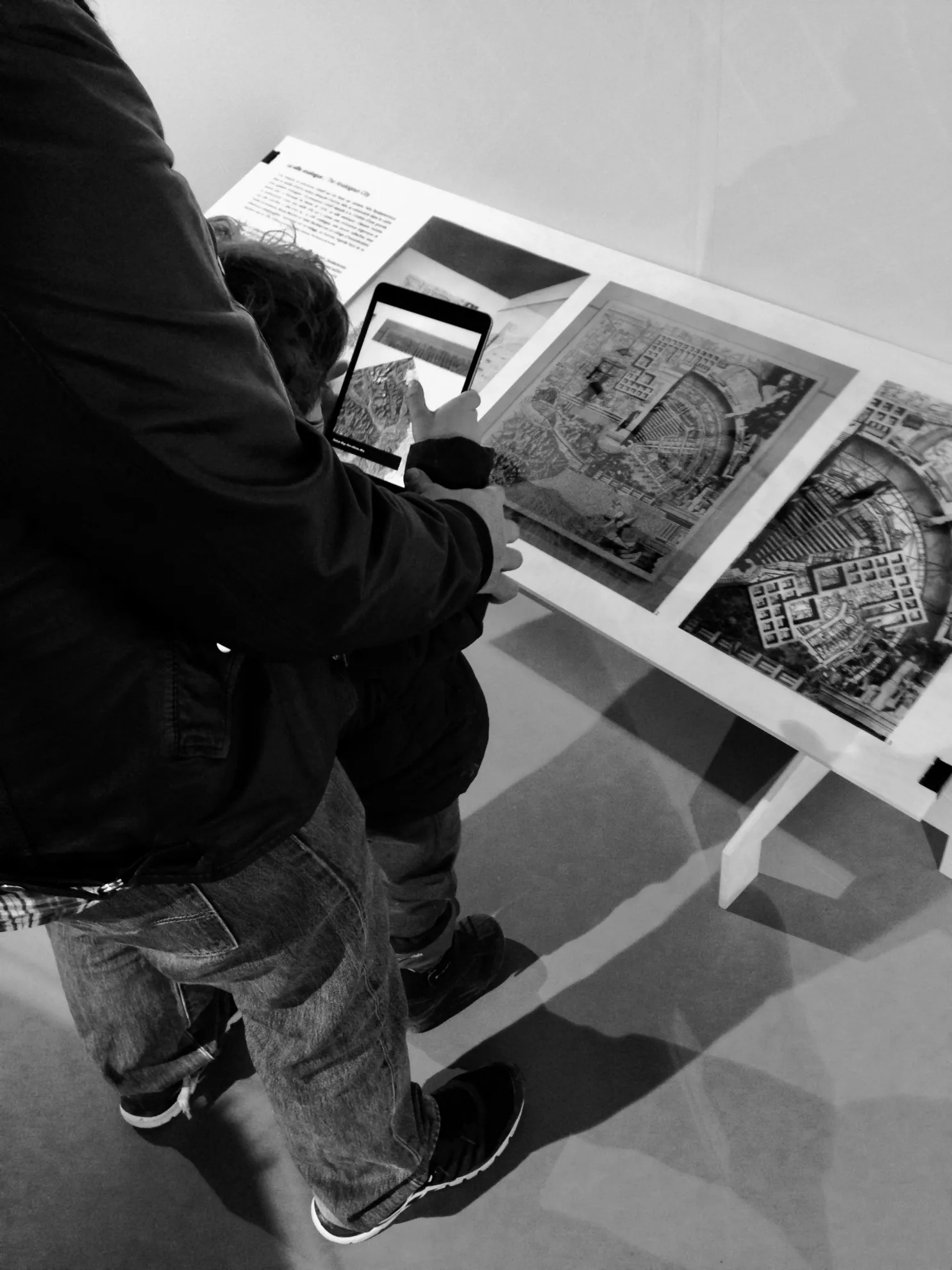
The same no-map configuration was presented at Triennale di Milano in the exhibition Comunità Italia (Ferlenga and Biraghi 2015) and at the MAXXI in Rome during a personal exhibition dedicated to Aldo Rossi (Ferlenga 2021). In Milan, the Analogous City was hanging too high to allow a comfortable interaction because the artwork appeared extremely delicate during its unpacking: the two sleeves that compose the collage were evidently unglued, meaning that the piece was at risk for severe damage. In Rome, the Analogous City was displayed in a vast space; however, the interaction was weakened by the anti-theft cable that secured the tablet. Although this system works properly on a table, it was far from ideal for viewing from afar, especially when the Analogous City was exhibited in its 2-meter original format, obliging the viewers to pull the cable repeatedly.
The presence of design in museum projects brings a certain dose of creativity that shines through when the physical constraints of the exhibition need adaptive capabilities. Adjustments to the digital installation become an opportunity to experience new variations on the theme and stimulate the visitors differently from which changes in their behavior can be observed.
The Map as Educational Tool
Descartes once said that things must always be seen in the past, the present, and their future. If we think about the map of the Analogous City in these terms, the past would be the study, the present is the exhibition, and the future is the education. The idea of extending the museum beyond the physical space becomes more concrete when the publication has been distributed. In that sense, the map is a flexible object that the visitor can buy after the exhibition to relive the experience at home or can be bought or downloaded on the Internet without entering the museum.
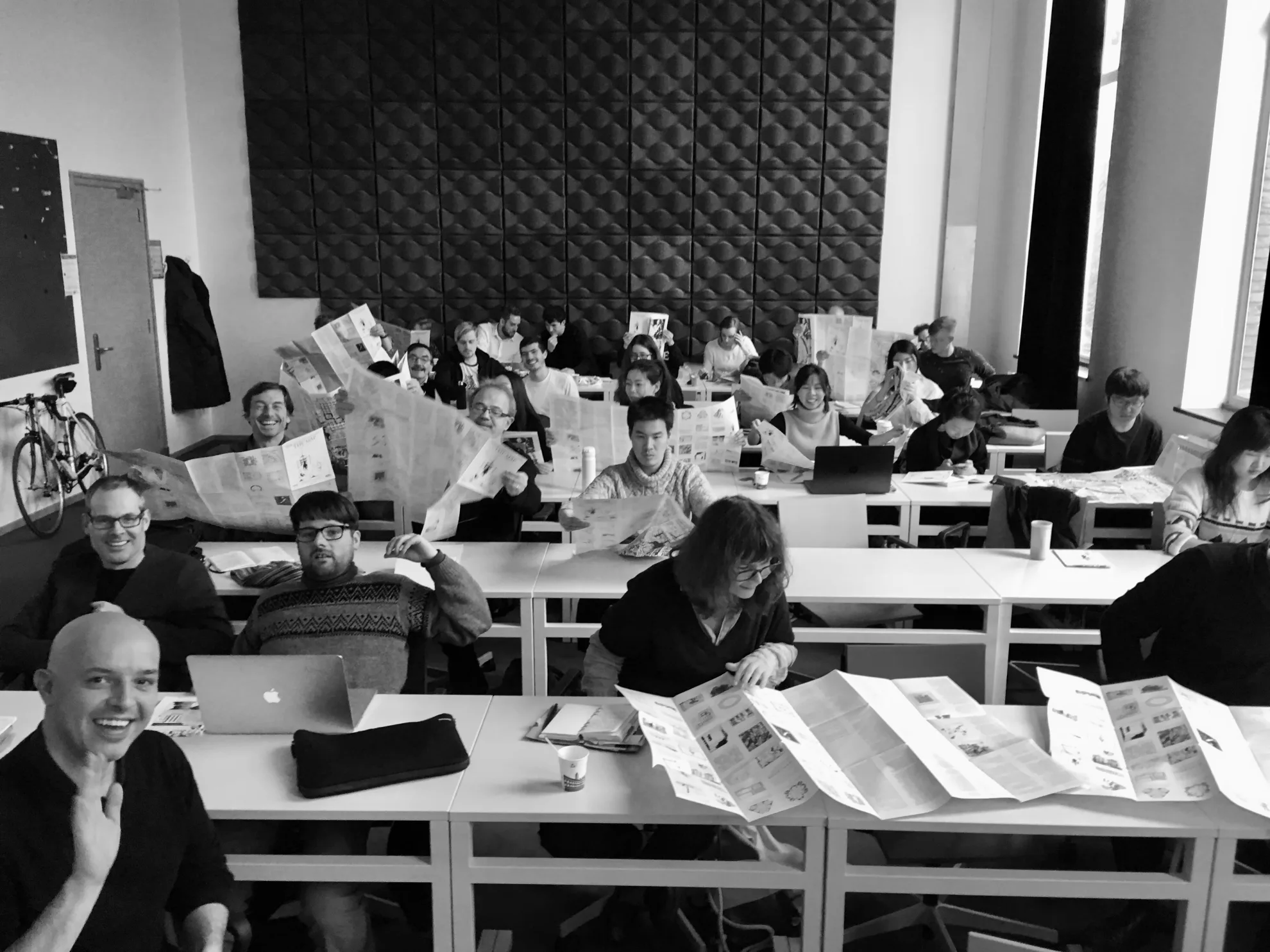
Yet the map also proved to be an excellent teaching tool, as demonstrated during a lecture given at the Technical University of Delft in December 2017. The organizers were enthusiastic about how an architectural study was delivered to scholars and architects. Each student and researcher attending the lesson was gifted with a copy of the map. After an introductory frontal lesson that was roughly based on the content of this text, attendees were invited to open their maps in a collective gesture that fostered a creative atmosphere, perfect for a workshop (Figure 9). While examining the collage’s images is a suitable exercise for individuals, the workshop was more appropriate in identifying the position of single elements starting from images shown through the projector. Once an element is projected for the class, the first question for the attendees was to think about the semantic collocation of it, including if a specific reference belongs to the city of memory. Questions like the latter helped narrow down the area of research. The workshop was also the right moment to show details such as the garden within the Laurentian Medicean Library and the David with his outstretched arm redrawn by Reinhart. Such traits are barely noticed, yet tell a lot about the technical and creative process behind the Analogous City. Similar details and questions were able to resurface when the map was explored in an educational environment.
Conclusions
The map of the Analogous City is an interdisciplinary project in which aspects of design and typography have been blended with architecture and museology, according to the approach that characterizes digital humanities. The project results in a hybrid object that adheres to digital materiality, a notion in which the boundary between digital and physical is blurred and often crossed by using reproduction techniques. If the city map is a publication that brings to readers the opportunity to look at the Analogous City in detail, it is also worth noticing how the “original” artwork is itself a copy created from an actual collage kept in the archives of Centre Pompidou.
Walter Benjamin’s aura is nothing but a cultural construction of society, which future generations will see increasingly applied to digital objects, as it is happening today with the recent attention to non-fungible tokens (NFTs). When charged with auras, objects of digital materiality can be seen differently and take on a life of their own, like Adam Lowe’s reproduction of Wedding at Cana, which makes more sense in San Giorgio Maggiore, its birthplace, rather than in front of Leonardo’s Mona Lisa at the Louvre Museum.
Objects of digital materiality have the capacity of moving in space to find their personal aura. As Wedding at Cana leaves Paris to come back to Venice to be relocated in its original context, museum objects — already charged with aura by institutions (Alpers 1991) — can likewise be moved to new environments that may increase or modify their aura. For example, some scholars were fond of hanging the map of the Analogous City like a poster so as to decorate their working environment. During the study at EPFL, Frédéric Kaplan used to have a copy of the map in his office. This copy is still charged with the story of how the original elements were collected and transformed into an exhibition.
Examining these examples clarifies how Franco Russoli’s concept of the living museums can be reversed toward a living museum object, capable of being reproduced, multiplied, and distributed out of the museum building itself without losing its aura. In this hybrid form of digital materiality, the object can leave the museum for its second life, without forgetting the museum as a point of origin where the object is empowered with a charge of aura that can increase or diminish during the displacement, according to each personal object’s trajectory (Rigal and Rodighiero 2015).
Returning to Aldus Manutius’ story, knowledge and circulation spark the actual revolution. Bruno Latour refers to objects, such as maps, using the term immutable mobile (Latour 1986), expressing the idea that the intellectual revolution happens through the circulation of objects capable of comparing different cultures. In this context, the digital age resets time and costs related to the displacement, which can happen instantaneously so that museum objects become a form of cultural commons at the disposal of society.
The role of museums is to facilitate the circulation of knowledge, and digital objects represent perfect mediators to connect knowledge with society. Accessibility, in this sense, is a property that establishes connectivity with the territory, like a network whose ramifications extend the museum to the city itself and beyond. Supporting and developing objects of digital materiality has to be seen at this point as the key to adding a new life and value to museums, by extending the reach, relationships, and interactions that were previously impossible.
References
- Algarotti, Francesco. 1759. “Lettera a Prospero Pesci.” September 28, 1759. https://complessopilotta.it/opera/capriccio-con-edifici-palladiani/.
- Alpers, Svetlana. 1991. “The Museum as a Way of Seeing.” In Exhibiting Cultures: The Poetics and Politics of Museum Display, edited by Ivan Karp and Steven D. Lavine, 25–32. Washington: Smithsonian Institution Press.
- Anderson, Wes, and Juman Malouf. 2018. Spitzmaus Mummy in a Coffin and Other Treasures. Edited by Sabine Haag and Jasper Sharp. Stuttgart: Verlag der Buchhandlung Walther König.
- Benjamin, Walter. (1968) 2007. “The Work of Art in the Age of Mechanical Reproduction.” In Illuminations, edited by Hannah Arendt. Reprint. New York: Schocken Books.
- Boesiger, Willy, and Hans Girsberger. 1967. Le Corbusier 1910–65. Zurich: Les Editions d’Architecture.
- Braghieri, Nicola. 2019. “Alcune indagini e riflessioni intorno a City of Composite Presence.” Piano b. Arti e culture visive 4 (2): 61–87. https://doi.org/10/ghqbdg.
- ———. 2020. MA2020 — Architettura e Collage. Mantova Architettura 2020.
- Cache, Bernard. 2018. “Vers une encyclopédie vitruvienne contemporaine.” Presented at the Leçons inaugurales des Professeurs Emmanuel Rey et Bernard Cache, EPFL, April 9.
- Campanile, Nicola. 2020. “The Appropriate Form. The Analogy between the Architectural and Urban Scale.” In From Mega to Nano: The Complexity of a Multiscalar Project, 10–27. Palermo: Palermo University Press.
- Canaletto, Giovanni Antonio. 1756. Capriccio with Palladian Buildings. Parma: Parma’s National Gallery.
- Caniggia, Gianfranco. 1963. Lettura di una città: Como. Roma: Centro studi di storia urbanistica.
- Caporali, Giovanni Battista. 1536. Archittetura. Bigazzini. https://doi.org/10.3931/E-RARA-27122.
- Celant, Germano, and Stijn Huijts, eds. 2015. Aldo Rossi: Opera Grafica: Etchings Lithographs Silkscreen Prints. Cinisello Balsamo: Silvana Editoriale.
- Cellauro, Louis. 2012. “Venice and the Origins of the Art-Historical Tradition of Display of the Modern Museum.” Konsthistorisk Tidskrift/Journal of Art History 81 (2): 94–122. https://doi.org/10/ghqbdc.
- D’Aviler, Augustin-Charles. 1738. Cours d’architecture. Paris: Chez Jean Mariette. https://doi.org/10.3931/E-RARA-5.
- Davies, Martin. 1999. Aldus Manutius: Printer and Publisher of Renaissance Venice. 2nd printing. Tempe: Arizona Center for Medieval and Renaissance Studies.
- Davis, Douglas. 1995. “The Work of Art in the Age of Digital Reproduction (An Evolving Thesis: 1991–1995).” Leonardo 28 (5): 381. https://doi.org/10/btp8xd.
- De Michelis, Giorgio. 2014. “What Design Tells Us about Objects and Things.” Design and Culture 6 (2): 187–202. https://doi.org/10/gc8z22.
- Dufour, Guillaume-Henri. 1865. “Topographic Map of Switzerland.” Switzerland: Swiss Confederation. https://map.geo.admin.ch.
- Fera, Francesco Saverio, and Luca Conti. 2007. Fabio Reinhart: architettura della coerenza. Bologna: CLUEB.
- Ferlenga, Alberto. 2021. “Aldo Rossi: The Architect and the Cities.” MAXXI – Museo Nazionale delle Arti del XXI Secolo. https://www.maxxi.art/en/events/aldo-rossi-larchitetto-e-le-citta/.
- Ferlenga, Alberto, and Marco Biraghi. 2015. Comunità Italia: architettura, città, paesaggio 1945–2000. Cinisello Balsamo: Silvana Editoriale.
- Frutiger, Adrian. 1997. Symbols and Signs: Explorations. Cham: Syndor Press.
- Godoli, Ezio, ed. 1974. Giuseppe Pistocchi (1744–1814) architetto giacobino. Faenza: Rotografica Fiorentina.
- Gorman, Michael John. 2020. Idea Colliders: The Future of Science Museums. Cambridge, MA: MIT Press. https://doi.org/10.7551/mitpress/11019.001.0001.
- Hennion, Antoine, and Bruno Latour. 1996. “L’art, l’aura et la technique selon Benjamin.” Les Cahiers de médiologie 1 (1): 235–41. https://doi.org/10/gd4vq2.
- Isgro, Marina. 2020. “Modernism in Motion: Jean Tinguely’s Meta-Mechanical Reliefs, 1954–59.” Art Journal 79 (2): 6–23. https://doi.org/10.1080/00043249.2020.1765550.
- Lampariello, Beatrice. 2017. Aldo Rossi e le forme del razionalismo esaltato. Dai progetti scolastici alla “città analoga”, 1950–1973. Macerata: Quodlibet.
- Latour, Bruno. 1986. “Visualisation and Cognition: Thinking with Eyes and Hands.” Edited by Henrica Kuklick. Knowledge and Society Studies in the Sociology of Culture Past and Present 6: 1–40.
- Lowe, Adam, ed. 2020. The Aura in the Age of Digital Materiality: Rethinking Preservation in the Shadow of an Uncertain Future. Cinisello Balsamo: Silvana Editoriale.
- Malraux, André. (1952) 1997. Le musée imaginaire. Paris: Gallimard.
- Marzo Magno, Alessandro. 2020. L’inventore di libri: Aldo Manuzio, Venezia e il suo tempo. Roma: Laterza.
- McEwan, Cameron. 2020. “Architecture, Multitude and the Analogical City as a Critical Project.” Architecture and Culture, 1–16. https://doi.org/10/ghqbdd.
- Murray, Peter. 1971. Architettura del Rinascimento. Edited by Pier Luigi Nervi. Milano: Electa Editrice.
- Ortelli, Luca. 2015. “Analogies.” In Architectura Ludens, edited by Alexandre Blanc. EPFL Magma & Principes / Manslab.
- Palladio, Andrea. 1786. Le fabbriche e i disegni di Andrea Palladio. Vicenza: Giovanni Rossi. https://doi.org/10.3931/E-RARA-12411.
- Piranesi, Giovanni Battista. 1913. Oeuvres choisies: frontispices, compositions: prisons, trophées, plan et vues de Rome dessinés et gravés de 1746 à 1778. Paris: Vincent.
- Reichlin, Bruno, and Fabio Reinhart. 1969. Bellinzona: architettura per la città antica. Casabella.
- Reinhart, Fabio. 2015a. “Captions for the ‘Analogous City.’” In The Analogous City, the Map. Lausanne: EPFL Archizoom. https://infoscience.epfl.ch/record/209326.
- ———. 2015b. “From Picture Panel to City-Map.” In The Analogous City, the Map. Lausanne: EPFL Archizoom. https://infoscience.epfl.ch/record/209326.
- Rigal, Alexandre, and Dario Rodighiero. 2015. “Trajectoire d’une représentation cartographique en réseau.” Edited by Armelle Couillet and Jasmine Desclaux-Salachas. Cartes & Géomatique 225: 33–41. https://infoscience.epfl.ch/record/214582/.
- Rodari, Gianni. (1974) 2010. Grammatica della fantasia: introduzione all’arte di inventare storie. Torino: Einaudi Ragazzi.
- Rodighiero, Dario. 2015. The Analogous City, the Map. Lausanne: EPFL Archizoom. https://infoscience.epfl.ch/record/209326.
- Rossi, Aldo. 1975a. Construcción de la ciudad: Aldo Rossi 1 Parte. NovoGraphos.
- ———. 1975b. Construcción de la ciudad: Aldo Rossi 2 Parte. NovoGraphos.
- ———. 1976. “La città analoga: tavola.” Lotus International, no. 13 (December): 4–9.
- ———. (1966) 1982. The Architecture of the City. Edited by Peter Eisenman. American edition. Cambridge, MA: MIT Press.
- Rossi, Aldo, Eraldo Consolascio, and Max Bosshard. 1979. La costruzione del territorio nel Cantone Ticino. Lugano: Fondazione Ticino Nostro.
- Rossi, Aldo, Massimo Fortis, and Massimo Scolari. 1970. “Architettura di Aldo Rossi 1964–1970.” Controspazio 10.
- Rowley, Neville, and Jörg Völlnagel, eds. 2020. Between Cosmos and Pathos: Berlin Works from Aby Warburg’s Mnemosyne Atlas. Berlin: Deutscher Kunstverlag.
- Russoli, Franco. 2017. Senza utopia non si fa la realtà: scritti sul museo (1952–1977). Edited by Erica Bernardi. Milano: Skira.
- Savi, Vittorio. 1976. L’architettura di Aldo Rossi. Milano: Franco Angeli.
- Savinio, Alberto. 1976. Alberto Savinio. Milano: Electa Editrice.
- Settis, Salvatore. 2015. “Supremely Original.” In Serial / Portable Classic: The Greek Canon and Its Mutations, edited by Salvatore Settis, Anna Anguissola, and Davide Gasparotto, 51–72. Milano: Fondazione Prada.
- Snydman, Stuart, Robert Sanderson, and Tom Cramer. 2015. “The International Image Interoperability Framework (IIIF): A Community & Technology Approach for Web-Based Images.” In Archiving 2015 Final Program and Proceedings, 16–21. Springfield, VA: Society for Imaging Science and Technology.
- Tafuri, Manfredo. 1976. “Ceci n’est pas une ville.” Lotus International, no. 13 (December): 10–13.
- Tafuri, Manfredo, and Francesco Dal Co. 1976. Architettura contemporanea. Edited by Pier Luigi Nervi. Milano: Electa Editrice.
- Tanzio da Varallo. 1625. David and Goliath. Varallo Sesia: Pinacoteca Civica.
- Urbons, Klaus. 1991. Copy art: Kunst und Design mit dem Fotokopierer. Köln: DuMont.
- Venturi, Robert, Steven Izenour, and Denise Scott Brown. 1977. Learning from Las Vegas: The Forgotten Symbolism of Architectural Form. Cambridge, MA: MIT Press.
- Vrana, Vasiliki G., Dimitrios A. Kydros, Evangelos C. Kehris, Anastasios-Ioannis T. Theocharidis, and George I. Kavavasilis. 2021. “Top Museums on Instagram: A Network Analysis.” In Research Anthology on Strategies for Using Social Media as a Service and Tool in Business, edited by Information Resources Management Association, 1029–55. Hershey, PA: IGI Global. https://doi.org/10.4018/978-1-7998-9020-1.ch052.
- Whyte, Iain Boyd. 2000. “Charlottenhof: The Prince, the Gardener, the Architect and the Writer.” Architectural History 43: 1–23. https://doi.org/10/dxm6kd.