Dario Rodighiero

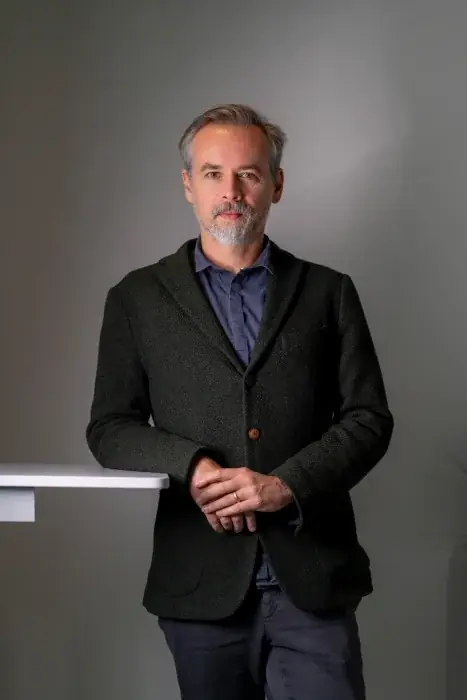
Dario Rodighiero is an Assistant Professor of Science and Technology Studies at the University of Groningen, where he is involved in programs that bridge data science with society. Based at the interdisciplinary faculty Campus Fryslân, he coordinates the minor Data Wise and teaches data and visual literacy within the Data Science and Society Bachelor’s program. He maintains active collaborations with Harvard University, where he is a faculty associate at the Berkman Klein Center for Internet & Society and a principal at metaLAB—a research and teaching laboratory dedicated to experimenting with digital technologies in the arts and humanities.

Combining computational techniques with design, Dario investigates how complex information can be revealed. Grounded in Science and Technology Studies, his research focuses on the mapping of science: he is the author of Mapping Affinities: Democratizing Data Visualization, which proposes new ways to design organizational charts. His work further engages with digital cultural archives, exploring questions of representation and interpretation. Visualization is approached as a method for knowledge design, bridging critical inquiry and design practice to foster reflection and dialogue by opening new visual modes of understanding.

Dario holds a PhD from the École polytechnique fédérale de Lausanne (EPFL), where he attended the doctoral program Architecture and Sciences of the City. He has held research and teaching positions at MIT, the European Commission, Paris-Sorbonne University, and Sciences Po. The collaboration with Bruno Latour at the médialab shaped his engagement with digital platforms as tools for philosophical inquiry and collective exploration. He lectured at venues such as CERN and Ars Electronica, and exhibited his work at the MAXXI and Harvard Art Museums, reflecting a sustained commitment to public engagement and interdisciplinary collaboration.

Handbook of Digital and Computational Research Methods
2026

Four Guiding Principles for Rethinking Organizational Charts

Rodighiero, Dario
https://hdl.handle.net/11370/6021c844-43e3-4fe8-b3c2-b8afa1361872

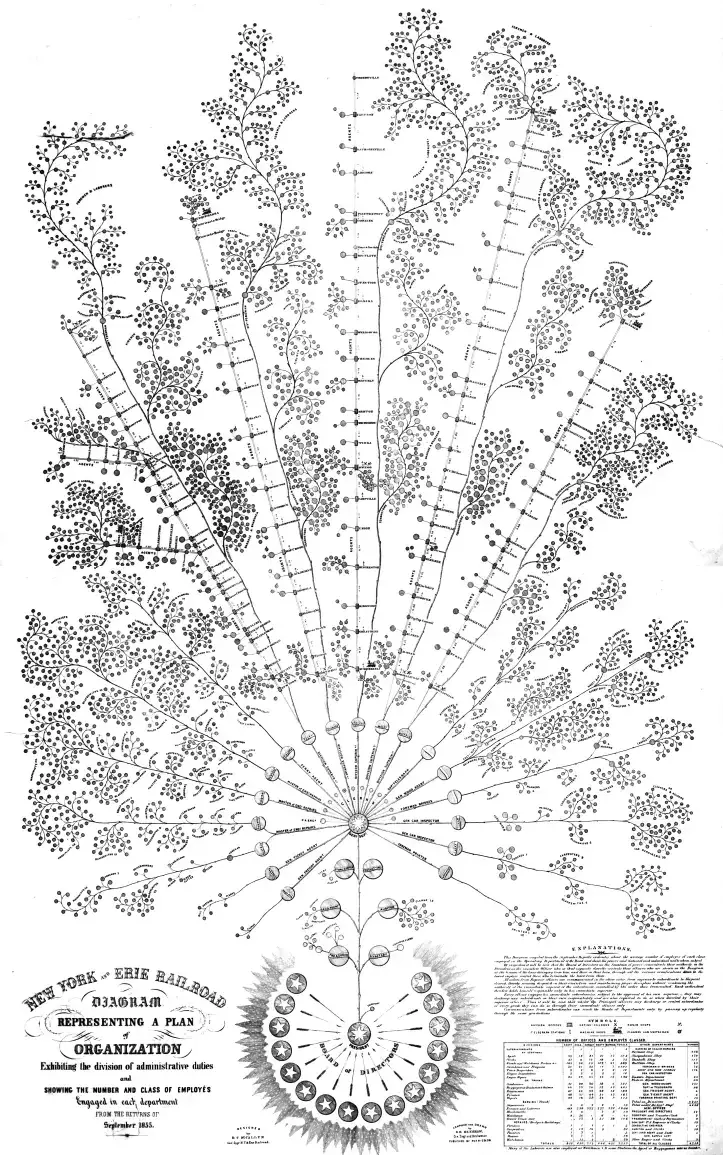
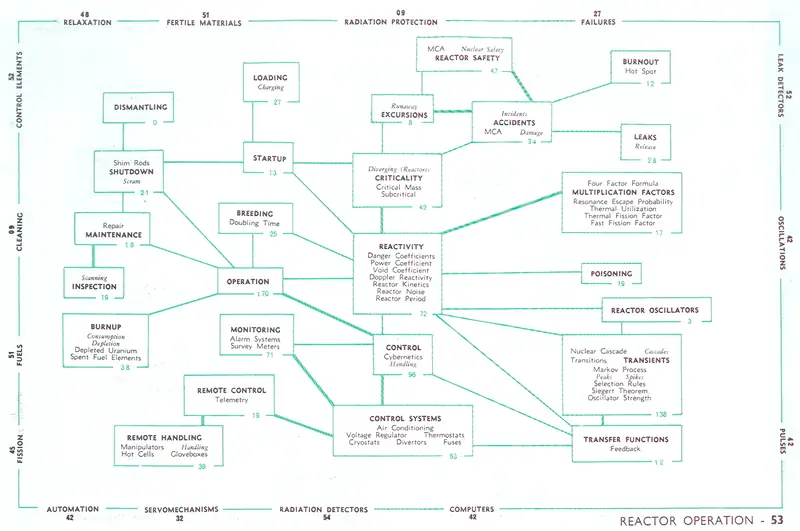
This chapter explores the transformative impact of digital tools on visualizing large organizations, highlighting the shortcomings of traditional organizational charts in capturing the interconnected nature of human dynamics. Emphasizing a respectful distance from simplistic managerial logic, it discusses four guiding principles for rethinking organizational charts with careful consideration of digital traces and the valuable information employees leave during daily practice. These principles aim to reconsider the centrality of individuals and the complex dynamics of the whole organization. The first principle stresses comprehensive representation of every employee, promoting concepts like inclusivity and irreductionism. The second principle fosters a sense of community through mutual and collective self-recognition. The third challenges traditional hierarchical structures in favor of equal representation in network-based models. The fourth underscores transparency and bottom-up collaboration in design. The chapter combines theoretical insights with practical examples, including the Affinity Map case study. This approach, in the light of opportunities offered by datafication, as described by Brinton (1939, 59-67), reimagines organizational charts to be more accurate, realistic, and useful. It serves as a guide for using digital data and computational tools to better understand and design large organizations.

Four Guiding Principles for Rethinking Organizational Charts
IEEE VIS Arts Program (VISAP)
2025

AI-Generated Images for Representing Individuals: Navigating the Thin Line Between Care and Bias

Ahrend, Julia C., Björn Döge, Tom M. Duscher, and Dario Rodighiero
https://doi.org/10.48550/arXiv.2509.03071

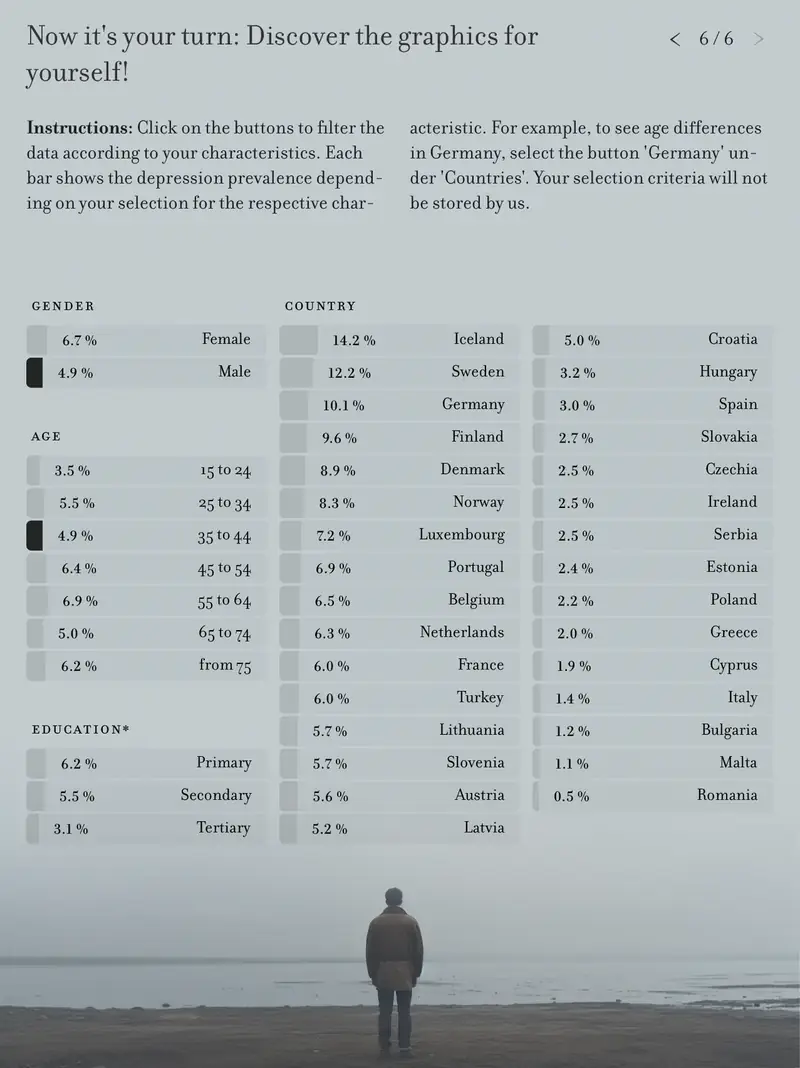
This research discusses the figurative tensions that arise when using portraits to represent individuals behind a dataset. In the broader effort to communicate European data related to depression, the Kiel Science Communication Network (KielSCN) team attempted to engage a wider audience by combining interactive data graphics with AI-generated images of people. This article examines the project’s decisions and results, reflecting on the reaction from the audience when information design incorporates figurative representations of individuals within the data.

AI-Generated Images for Representing Individuals: Navigating the Thin Line Between Care and Bias
Per–Forming Spaces
2025

Choreography, Design, and Technology: An Interview with Lins Derry from the metaLAB (at) Harvard

Derry, Lins, Dario Rodighiero
https://hdl.handle.net/11370/d7e556b3-06df-4c6d-b8fa-5c21003734af

In this enlightening interview with Lins Derry, a pioneering researcher at the intersection of dance, design, and technology, we explore the evolution of her groundbreaking work from its conception to its implementation in academia. Derry discusses her journey from professional dancer to leading figure at metaLAB (at) Harvard, emphasizing the integration of choreographic principles into interaction design. Through projects like the choreographic interface and data embodiment, she illustrates the potential of movement as a medium for interpreting and interacting with abstract data. Her work challenges traditional disciplinary boundaries, advocating for a more integrated approach to teaching and research that leverages the expressive power of the body in digital environments. This interview not only highlights Derry’s innovative contributions but also reflects on the broader implications of her work for enhancing sensory and expressive experiences with technology.

Choreography, Design, and Technology: An Interview with Lins Derry from the metaLAB (at) Harvard
Land
2025

Experiments of Network Literacy for Urban Designers: Bridging Information Design and Spatial Morphology

Rodighiero, Dario
https://doi.org/10.3390/land14091901

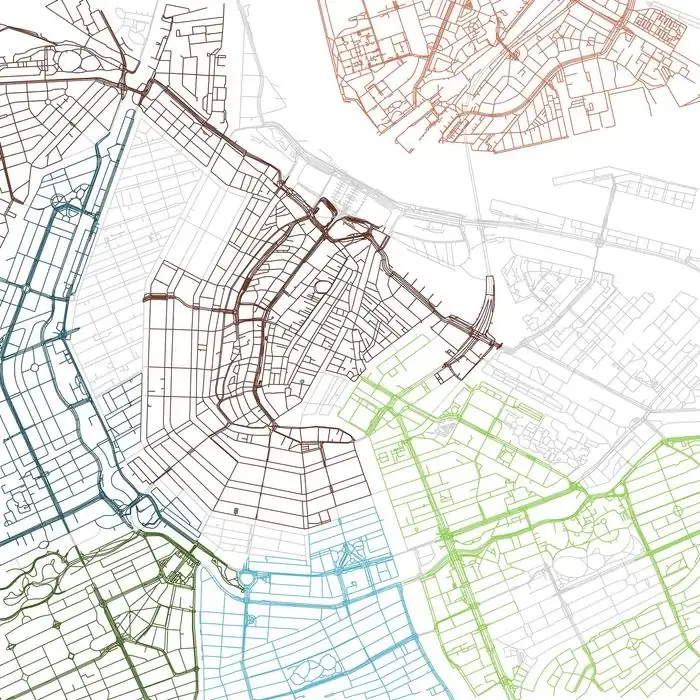
Urban morphology has long been studied through typologies, spatial configurations, and historical change, yet cities are not static artifacts but dynamic environments continually reshaped by people, infrastructures, and politics. This article brings Actor–Network Theory (ANT) into dialogue with Aldo Rossi’s notion of the locus to rethink urban design as both enduring form and relational process. Building on Manuel Lima’s taxonomy, the study develops a methodological workflow that translates street networks into visualizations, pairing embeddings with topographic maps to highlight structural patterns. Applied to a comparative set of cities, the analysis distinguishes three broad morphological tendencies—archetypal, geometrical, and relational—each reflecting different logics of urban organization. The results show how scale and connectivity condition the interpretability of embeddings, revealing both alignments and divergences between cartographic and topological representations. Beyond empirical findings, the article frames network literacy as a meeting ground for design theory, science and technology studies, and information visualization. It concludes by proposing that advancing urban morphology today requires not only new computational tools but also sustained interdisciplinary collaboration across design, urban studies, and data science.

Experiments of Network Literacy for Urban Designers: Bridging Information Design and Spatial Morphology
Revue Design Arts Medias
2025

Grounding AI Map: The Consequences of Living with the Trouble of an Irreductionist Map

Ficozzi, Matilde, Mathieu Jacomy, Dario Rodighiero, Anne Beaulieu, and Anders Kristian Munk
https://journal.dampress.org/issues/design-et-abstractions/grounding-ai-map-the-consequences-of-living-with-the-trouble-of-an-irreductionist-map

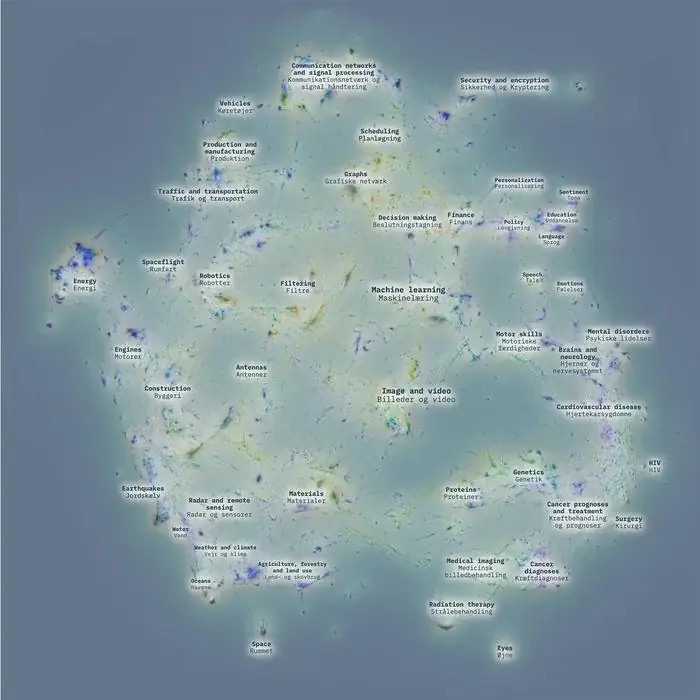
Data visualizations are often seen as tools to make expert knowledge more accessible. Yet, without careful design, they risk simplifying or misrepresenting complex ideas. This case study examines the Grounded AI Map, a 100 m² floor installation at the Danish Technical Museum that visualizes millions of scientific articles on artificial intelligence. Visitors navigate this mapped knowledge physically, aided by automated bots that summarize and interpret content using large language models. These bots serve not just as guides but as mediators, prompting users to question and reinterpret the mapped knowledge through their own perspectives. By inviting interaction and critique, the map becomes a participatory space where knowledge is co-constructed. A quali-quantitative framework assesses this mediation by analyzing app data, observing visitor behavior, and conducting interviews. The study highlights how visualization, when combined with reflexive AI tools, can create more inclusive and situated ways of engaging with scientific knowledge.

Grounding AI Map: The Consequences of Living with the Trouble of an Irreductionist Map
IEEE VIS Arts Program (VISAP)
2025

Living Library of Trees: Mapping Knowledge Ecology in Arnold Arboretum

Malmstedt, Johan, Giacomo Nanni, and Dario Rodighiero
https://doi.org/10.48550/arXiv.2509.00114

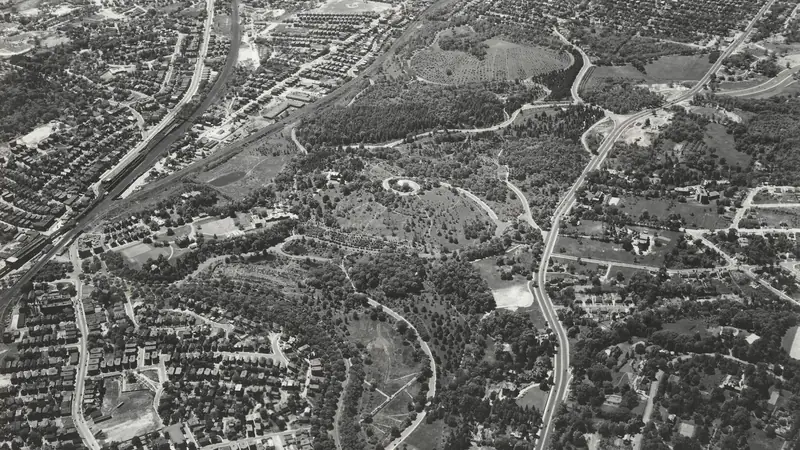
As biodiversity loss and climate change accelerate, botanical gardens serve as vital infrastructures for research, education, and conservation. This project focuses on the Arnold Arboretum of Harvard University, a 281-acre living museum founded in 1872 in Boston. Drawing on more than a century of curatorial data, the research combines historical analysis with computational methods to visualize the biographies of plants and people. The resulting platform reveals patterns of care and scientific observations, along with the collective dimensions embedded in botanical data. Using techniques from artificial intelligence, geospatial mapping, and information design, the project frames the arboretum as a system of shared agency—an active archive of more-than-human affinities that records the layered memory of curatorial labor, the situated nature of knowledge production, and the potential of design to bridge archival record and future care.

Living Library of Trees: Mapping Knowledge Ecology in Arnold Arboretum
Anthology of Computers and the Humanities
2025

Moving Pictures of Thought: Extracting Visual Knowledge in Charles S. Peirce’s Manuscripts with Vision-Language Models

Pedretti, Carlo Teo, Davide Picca, and Dario Rodighiero
https://doi.org/10.63744/fkFGJ6wSzDPV

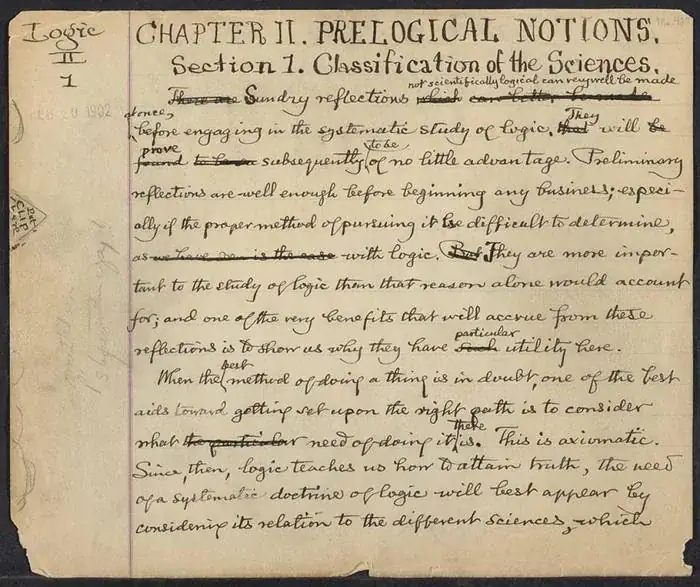
Diagrams are crucial yet underexplored tools in many disciplines, demonstrating the close connection between visual representation and scholarly reasoning. However, their iconic form poses obstacles to visual studies, intermedial analysis, and text-based digital workflows. In particular, Charles S. Peirce consistently advocated the use of diagrams as essential for reasoning and explanation. His manuscripts, often combining textual content with complex visual artifacts, provide a challenging case for studying documents involving heterogeneous materials. In this preliminary study, we investigate whether Visual Language Models (VLMs) can effectively help us identify and interpret such hybrid pages in context. First, we propose a workflow that (i) segments manuscript page layouts, (ii) reconnects each segment to IIIF-compliant annotations, and (iii) submits fragments containing diagrams to a VLM. In addition, by adopting Peirce’s semiotic framework, we designed prompts to extract key knowledge about diagrams and produce concise captions. Finally, we integrated these captions into knowledge graphs, enabling structured representations of diagrammatic content within composite sources.

Moving Pictures of Thought: Extracting Visual Knowledge in Charles S. Peirce’s Manuscripts with Vision-Language Models
Progetto Grafico
2025

Network Literacy: How to Understand, Design, and Read a Visual Relational Model

Rodighiero, Dario
https://hdl.handle.net/11370/3648f43f-5e55-48a4-b130-6537029226fc

Models help us navigate the complexity of social life, offering simplified structures that make invisible dynamics legible. Networks stand out for their ability to represent relations directly: nodes and links reduce society to actors and their connections, exposing patterns that often remain hidden in linear accounts. Since the eighteenth century, networks have evolved from mathematical curiosities to essential tools across disciplines. Early sociograms revealed classroom friendships, sociological diagrams exposed social reproduction and inequality, and computational studies now map everything from recipes to scientific collaborations. With their visual grammar, networks invite comparison, clustering, and interpretation across diverse domains. Yet their ubiquity also introduces risks: layouts may be mistaken for objective spaces, central nodes assumed to be more important, and dense graphs admired more for aesthetics than insight. To address these challenges, a new form of literacy is required. Network literacy can be defined as the ability to understand, design, and read visual relational models, combining conceptual knowledge of complex systems with practical skills of visualization and critical interpretation. This paper develops the notion of network literacy as a civic and professional competency, bridging traditions of data literacy and visual literacy. It traces the history of networks from their mathematical and sociological origins to their integration into digital media and design, showing how they reconfigure the codex into a relational mode of reading. It then explores three dimensions: design choices that shape meaning, spatial thinking that guides interpretation, and experimental projects that turn visualization into performative practice. By situating networks at the intersection of information design, critical inquiry, and cultural practice, the paper argues that cultivating network literacy is essential for engaging responsibly with the relational fabric of contemporary knowledge.

Network Literacy: How to Understand, Design, and Read a Visual Relational Model
IEEE
2025

VISAP 2025 Catalog

Çay, Damla, Dario Rodighiero, Weidi Zhang, Martina R. Fröschl, Peter Mindek, and Beatrice Gobbo
https://visap.net/2025/downloads/visap-2025-booklet.pdf

Care is easy to recognize on a personal level,especially when it appears in the small, attentivegestures woven into daily life. We see it whensomeone nurses a sick friend, tends a garden,or stitches a quilt by hand. Each act is markedby presence, patience, and a quiet commitmentexpressed through attention. It takes form throughdeliberate actions that often go unnoticed yet carryenduring meaning. But what does care look likewhen it scales up across complex systems wherethe risks are greater, the people more dispersed,and the consequences harder to trace?

VISAP 2025 Catalog
Nightingale
2025

Visualizing as a Form of Collective Care

Çay, Damla, Dario Rodighiero, and Weidi Zhang
https://nightingaledvs.com/visualizing-as-a-form-of-collective-care/

Care is easy to recognize on a personal level, especially when it takes the form of small, attentive gestures woven into daily life. We see it in how someone nurses a sick friend, tends a garden, or stitches a quilt by hand. Each act, marked by presence, patience, and the quiet commitment to care through touch, time, and attention. It takes shape through quiet, deliberate acts that often go unnoticed, yet carry lasting weight and meaning. But what does care look like when it scales up—across complex systems where the risks are higher, the people more dispersed, and the consequences harder to see?

Visualizing as a Form of Collective Care
Lessico Di Etica Pubblica
2024

Ethical and Aesthetical Questions on Stock Images: The Case of AI’s Depictions

Romele, Alberto, Sabina Rosenbergova, and Dario Rodighiero
https://www.eticapubblica.it/alberto-romele-dario-rodighiero-sabina-rosenbergova-ethical-and-aesthetical-questions-on-stock-images-the-case-of-ais-depictions/

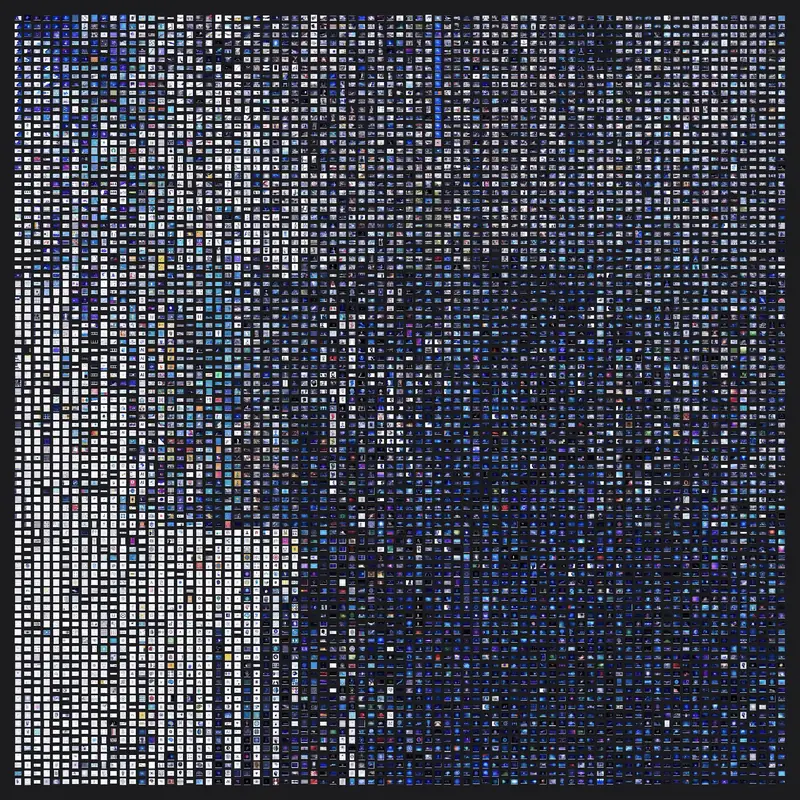
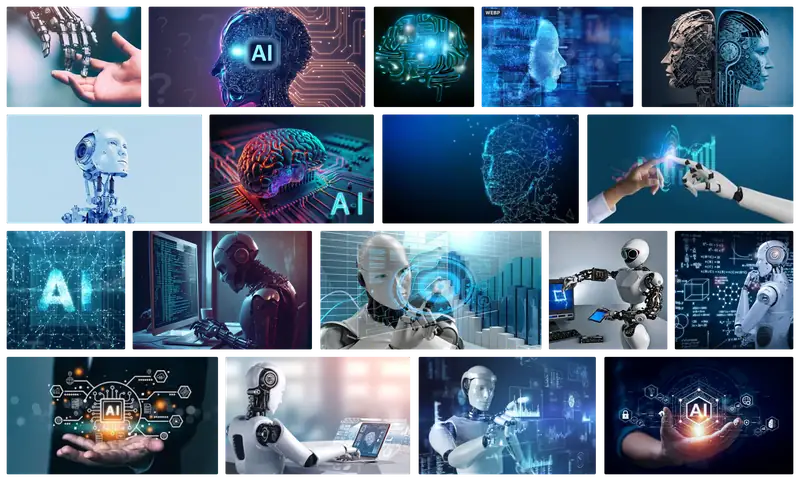
In this article, the authors deal with stock images depicting AI as a face or a body that undergoes a process of fragmentation into particles, pixels, or voxels. These images, they contend, are the symptoms of a datafied worldview. In the first section, the authors discuss stock images of AI and account for their qualitative-quantitative analyses of about 7,500 images from the online catalog of Shutterstock. These analyses have brought out datafied faces and bodies as one of the main themes among stock images of AI. In the second part, the authors elaborate on the notion of datafication of the worldview and offer some examples from architecture and design. This second section includes a methodological detour, in which the authors propose articulating Panofsky’s iconology and Didi Huberman’s “symptomatic” perspective. In conclusion, the authors reflect on an apparently marginal aspect of stock images of AI: the abundant use of blue.

Ethical and Aesthetical Questions on Stock Images: The Case of AI’s Depictions
Visual Communication
2024

In Praise of Visual Representation: An Inquiry into Text Analysis and Network Visualization for Charting Scientific Communities

Rodighiero, Dario
https://doi.org/10.1177/14703572241248408

This article provides a visual investigation into scientific communities through the lens of language. Inspired by actor-network theory, the study examines how individuals establish connections through shared vocabularies and, consequently, how communities organize themselves into linguistic groups. Using scientific texts to map the lexical dimension, the premise posits that research communities can be visually represented by their members and the words they employ, favouring the comprehension of social structures. The research draws from a decade-long personal experimentation with language-based visual models, to explore how research communities appear according to their lexicon, in which each individual is intricately intertwined. Employing cutting-edge techniques of text analysis and network visualization, the study analyses, organizes and maps scientific communities, clustering individuals into thematic groups based on their language use. The findings are presented through a series of projects that delve into the analytical power of images and unveil novel visual methods to better understand the spatial dynamics of language and communities.

In Praise of Visual Representation: An Inquiry into Text Analysis and Network Visualization for Charting Scientific Communities
Linking Theory and Practice of Digital Libraries
2024

Mapping Techniques for an Automated Library Classification: The Case Study of Library Loans at Bibliotheca Hertziana

Casey, Hannah Laureen, Alessandro Adamou, and Dario Rodighiero
https://zenodo.org/records/13862868

This paper introduces an innovative analytical method for visualising research libraries, overcoming the limitations of the assumptions made by their classification systems. The approach combines user loan data with deep mapping techniques to graphically display usage patterns and thematic clusters. Dimensionality reduction is used to visualise the catalogue by book loans, and prompt engineering with large language models is used to describe loan clusters with detailed summaries and titles. This approach was applied to the library collection owned by Bibliotheca Hertziana, a renowned research institute for art history based in Rome. The final output was assessed by a group of experts through interviews supported by an atlas providing statistical information on clusters. This yielded promising results towards a more general framework for visually mapping textual collections and capturing their transformation and usage from an interdisciplinary perspective.

Mapping Techniques for an Automated Library Classification: The Case Study of Library Loans at Bibliotheca Hertziana
Journal of Digital History
2024

Super-Vision: Tracing EPFL History Through 8,000 Doctoral Theses

Rodighiero, Dario, Philippe Rivière, and Sarah Kenderdine
https://doi.org/10.1515/JDH-2023-0004

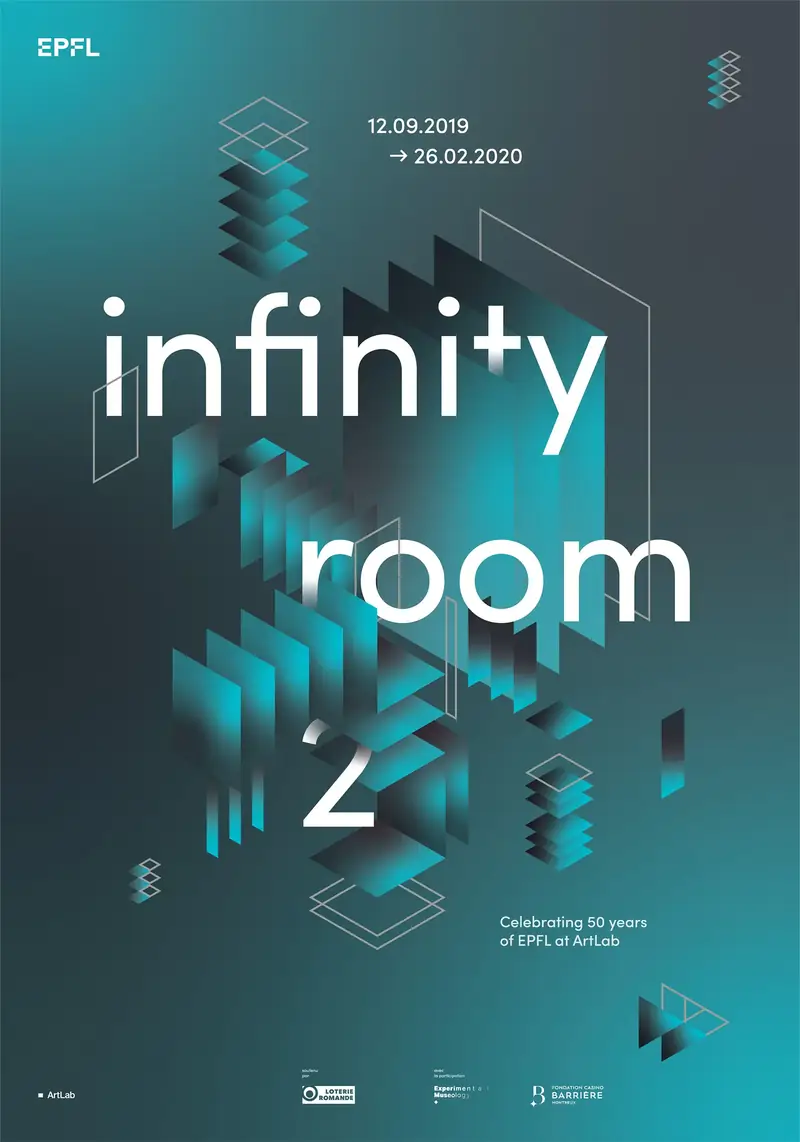
The fiftieth anniversary of EPFL (École Polytechnique Fédérale de Lausanne) offered the opportunity to retrace its history through the digital archives housed by the institute itself. Part of the exhibition Infinity Room 2, the Super-Vision project investigates the practice of academic advising by visualizing 8,000 doctoral theses in a work at the intersection of art, science, and technology. Inaugurated in September 2019 at EPFL Pavilions, Super-Vision presents a diachronic mapping that uses artificial intelligence to shed light on an institutional dataset that would be unobservable otherwise. To achieve such a goal, 8,000 doctoral theses are analysed with natural language processing and mapped with techniques of dimensionality reduction, combining language and time within in an interactive visualization accessible to the public. The project title has a twofold meaning: on the one hand, it refers to the educational practice that connects doctoral students to supervisors; on the other hand, it employs information design like a macroscope to grasp complex phenomena from a distant standpoint. The result offers EPFL employees and museum visitors an original perspective to look at the institute with different eyes.

Super-Vision: Tracing EPFL History Through 8,000 Doctoral Theses
Umanistica Digitale
2023

Advanced Interface Design for IIIF: A Digital Tool to Explore Image Collections at Different Scales

https://doi.org/10.6092/ISSN.2532-8816/17230

This article introduces a proposal for an experimental interface design that uses the International Image Interoperability Framework (IIIF) to facilitate the exploration of image collections through the navigation of relational models created by the scholarly practice of annotation. Within the project From Data To Wisdom, an innovative digital tool was designed by harnessing IIIF resources and leveraging close and distant reading on three levels of detail: micro, meso, and macro. The proposed tool integrates annotation features that enable scholars to analyze individual images and interpret broader connections and patterns across image sets. This article outlines the experimental interface’s theoretical framework, design principles, and significant advantages, highlighting the potential to support interdisciplinary research and advancements in digital art.

Advanced Interface Design for IIIF: A Digital Tool to Explore Image Collections at Different Scales
2023

Orchestrating Cultural Heritage: Exploring the Automated Analysis and Organization of Charles S. Peirce’s PAP Manuscript

Picca, Davide, Antonin Schnyder, Eri Kostina, Alessandro Adamou, Dario Rodighiero, and Jeffrey Schnapp
https://pure.rug.nl/ws/portalfiles/portal/780076742/3603163.3609066.pdf

This preliminary study introduces an innovative approach to the analysis and organization of cultural heritage materials, focusing on the archive of Charles S. Peirce. Given the diverse range of artifacts, objects, and documents comprising cultural heritage, it is essential to efficiently organize and provide access to these materials for the wider public. However, Peirce’s manuscripts pose a particular challenge due to their extensive quantity, which makes comprehensive organization through manual classification practically impossible. In response to this challenge, our paper proposes a methodology for the automated analysis and organization of Peirce’s manuscripts. We have specifically tested this approach on the renowned 115-page manuscript known as PAP. This study represents a significant step forward in establishing a research direction for the development of a larger project. By incorporating novel computational methods, this larger project has the potential to greatly enhance the field of cultural heritage organization.

Orchestrating Cultural Heritage: Exploring the Automated Analysis and Organization of Charles S. Peirce’s PAP Manuscript
2023

Weather Map: A Diachronic Visual Model for Controversy Mapping

https://doi.org/10.1515/9783111317779-017

The Weather Map is a visual model to investigate public debates onmedia. Relying on the Media Cloud archives, the visual model transforms a simplequery into a sophisticated visualization by employing the visual grammar of synop-tic weather charts. Peaks of pressure and clashes between airmasses are used to de-scribe the conflicts in media through the temporal dimension, diving into thehuman and non-human dynamics that make the controversy alive. The WeatherMap was conceived as a digital tool to help students and scholars analyze publicdebates, according to the controversy mapping field founded by Bruno Latour. Inparticular, the visual model pushes the boundaries of network visualization, explor-ing advanced techniques of graphic design. The outcome is a web-based applicationdeveloped in JavaScript and Python at the disposal of education and research.

Weather Map: A Diachronic Visual Model for Controversy Mapping
Leonardo
2022

A Visual Translation of the Pandemic

Rodighiero, Dario, Eveline Wandl-Vogt, and Elian Carsenat
https://research.rug.nl/en/publications/a-visual-translation-of-the-pandemic

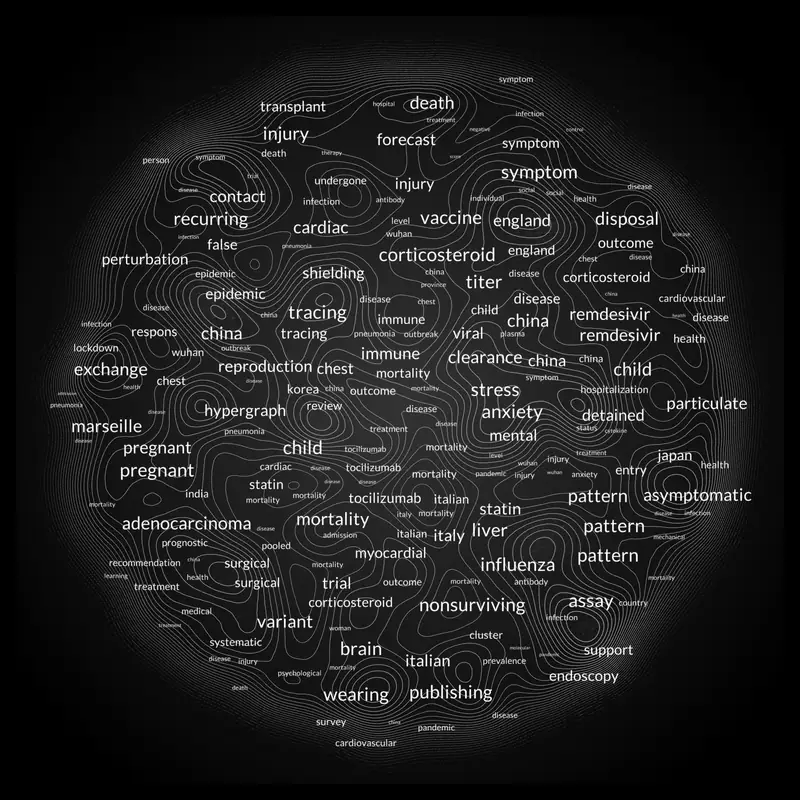
In 1923, Walter Benjamin published translations of Baudelaire’s poetry with a prefatory essay the idea that translation is therefore not only the practice of addressing foreign readerships, but rather a process of authorship in which the original text is amplified with further significance. The authors use the term translation with a meaning that is not only linguistic but also visual. They analyze the coronavirus pandemic by translating scientific literacy through the techniques of natural language processing and data visualization. The Cartography of COVID-19 results from a visual translation that invites readers to explore the current pandemic from a different point of view that extends their perception.

A Visual Translation of the Pandemic
Design Issues
2022

COVIC: Collecting Visualizations of COVID-19 to Outline a Space of Possibilities

Kahn, Paul, Hugh Dubberly, and Dario Rodighiero
https://doi.org/10.1162/desi_a_00697

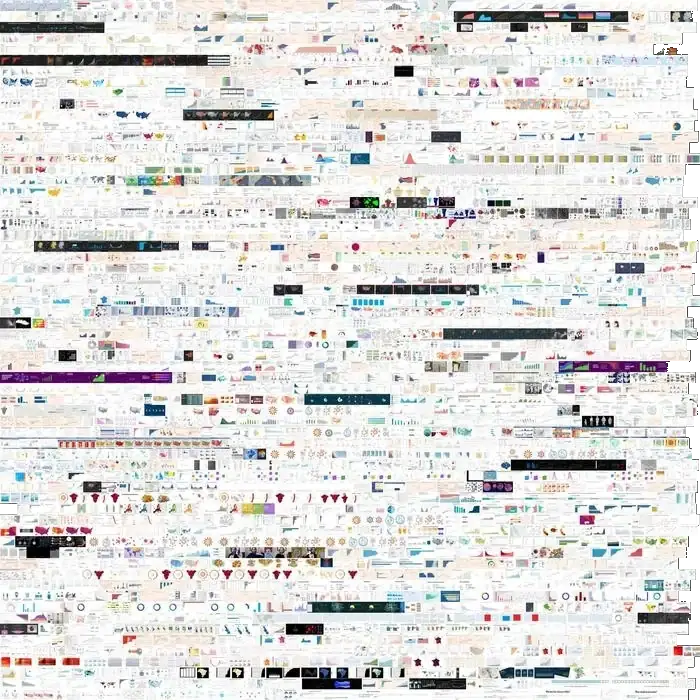
We describe the COVID-19 Online Visualization Collection (COVIC), its goals, how it came to be, and why we propose such a collection as a new path for design research. The COVIC database contains a collective visualization response to the COVID-19 pandemic gathered from approximately 3,000 articles, each containing one or more visualizations (about 12,000 in total). We have sought to create a resource for design research—a boundary object—that will be useful to any of the disciplines brought together through their response to the pandemic event.

COVIC: Collecting Visualizations of COVID-19 to Outline a Space of Possibilities
International Journal for Digital Art History
2022

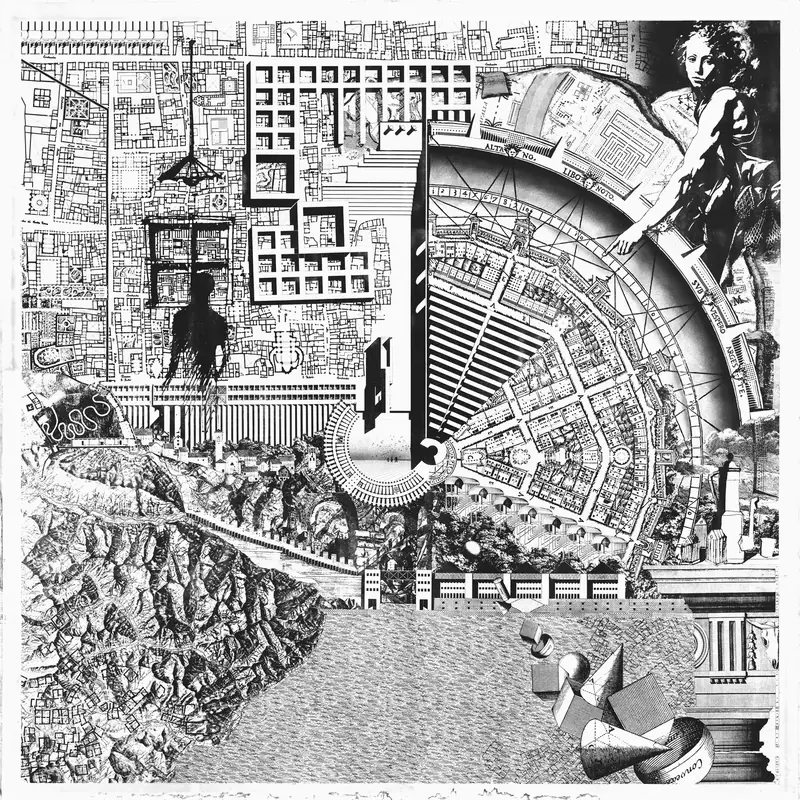
Extending Museum beyond Physical Space: A Data-Driven Study of Aldo Rossi’s Analogous City as a Mobile Museum Object

Rodighiero, Dario
https://doi.org/10.11588/DAH.2021.6.77681

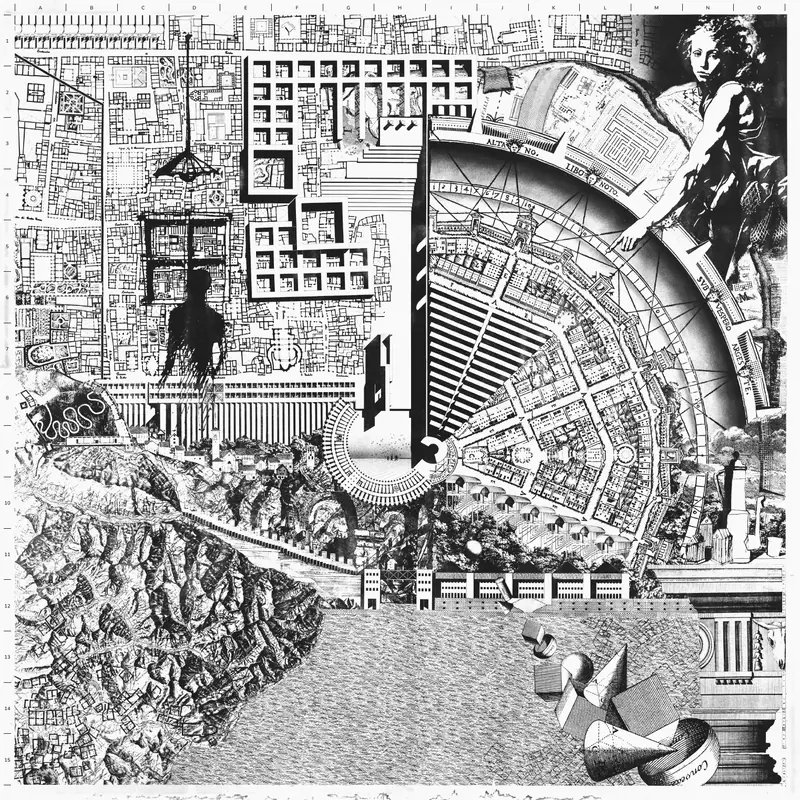
Aldo Rossi composed the famous collage known as Analogous City for the Venice Biennale in 1976. This text presents a visual study of the collage through both physical and digital means: a mobile app works in conjunction with a reprint of the Analogous City in the format of a city map. Forty years after its creation, the collage’s original elements are finally identified and collected, and the mechanisms of composition are disclosed thanks to Fabio Reinhart’s contribution. The map of the Analogous City is analyzed in both historical and museum viewpoints, focusing on the reflections that emerged when exhibiting in Maastricht, Milan, Lausanne, Bergamo, and Rome. Although the map was designed as an interactive installation for these exhibitions, it has turned out to be also an educational tool useful outside museums. If Aldo Rossi created an artwork to think about the reconstruction of the city, likewise, the map of the Analogous City helps to rethink museums by designing their objects in a way they can leave the exhibition for a second life in the city.

Extending Museum beyond Physical Space: A Data-Driven Study of Aldo Rossi’s Analogous City as a Mobile Museum Object
Porto University Press
2022

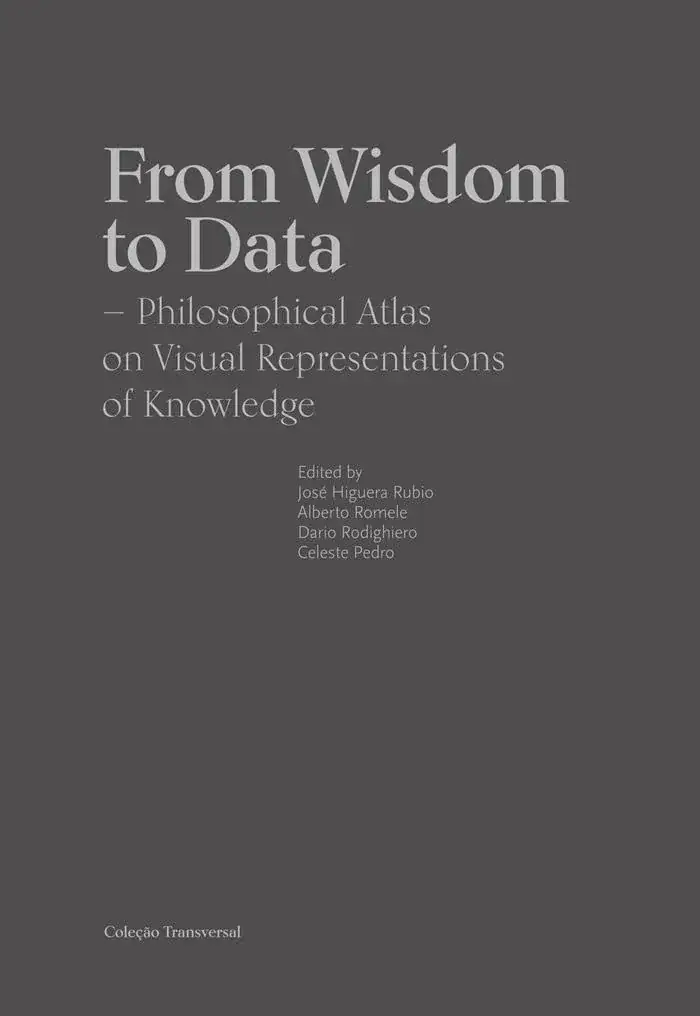
From Wisdom to Data: Philosophical Atlas on Visual Representations of Knowledge

Higuera Rubio, José, Alberto Romele, Dario Rodighiero, and Celeste Pedro, eds.

The purpose of this book is to collect in a single volume the multiplicity of approaches, perspectives, and contexts in which the research project From Data to Wisdom has been developed. One of the theoretical assumptions achieved is the idea that contemporary visualizations have abandoned the desire for absolute, synthesizing depiction in favor of a representation that is always imperfect and, so to speak, “in the making.” The very idea that data visualizations are representative, i.e., that they refer to “reality” has been widely discussed and criticized as well. Our intention, therefore, is to present a series of analogies between texts and images. In short, this book will be a mise en abyme of the always incomplete synthesis, but for this very reason richer in meaning, which in our opinion is at the heart, or at least should be, of today’s visual representations of knowledge.

From Wisdom to Data: Philosophical Atlas on Visual Representations of Knowledge
Information Design Journal
2022

Immersive Architectures for Visual Data Literacy

Rodighiero, Dario, Eveline Wandl-Vogt, Elian Carsenat, Jules Döring, Oliver Elias, Michaela Fragner, and Stepha Farkashazy
https://doi.org/10.1075/idj.22016.rod

The datafication process transforming society enables us to witness the pandemic from a global perspective. This article provides an example of immersive architecture in which coronavirus-related scientific literature was revealed during Ars Electronica 2021. Like a starry sky, a network visualization representing more than 600,000 articles was showcased in the Deep Space 8K theater, where spectators were accompanied in reading insights. The case study of 3D Cartography of COVID-19 illustrates a novel way to present data in public spaces to foster conversations and reflects on how visual data literacy can be addressed in museums.

Immersive Architectures for Visual Data Literacy
Information Design Journal
2022

Surprise Machines: Revealing Harvard Art Museums’ Image Collection

Rodighiero, Dario, Lins Derry, Douglas Duhaime, Jordan Kruguer, Maximilian C. Mueller, Christopher Pietsch, Jeffrey T. Schnapp, Jeff Steward, and metaLAB.
https://doi.org/10.1075/idj.22013.rod

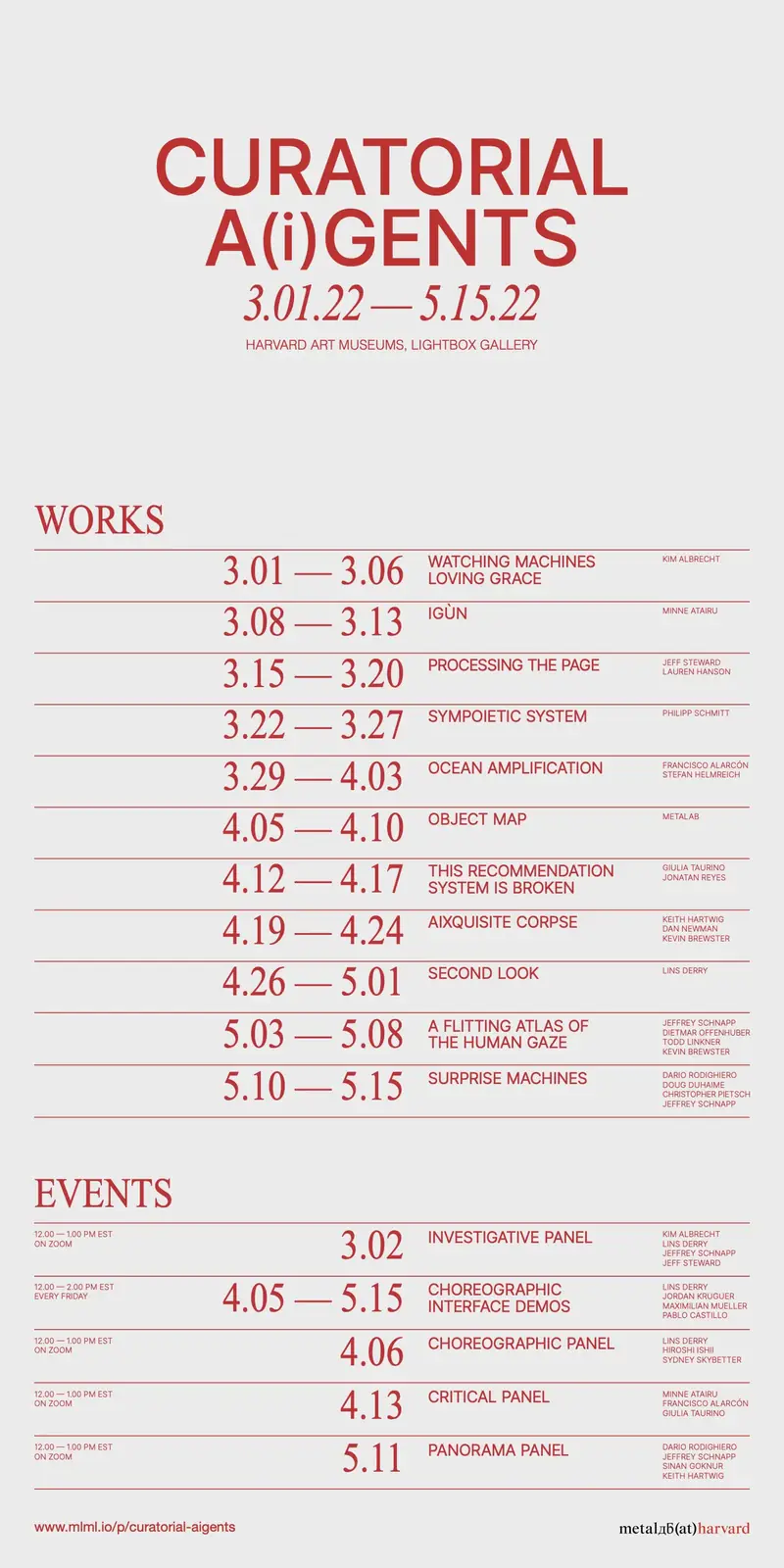
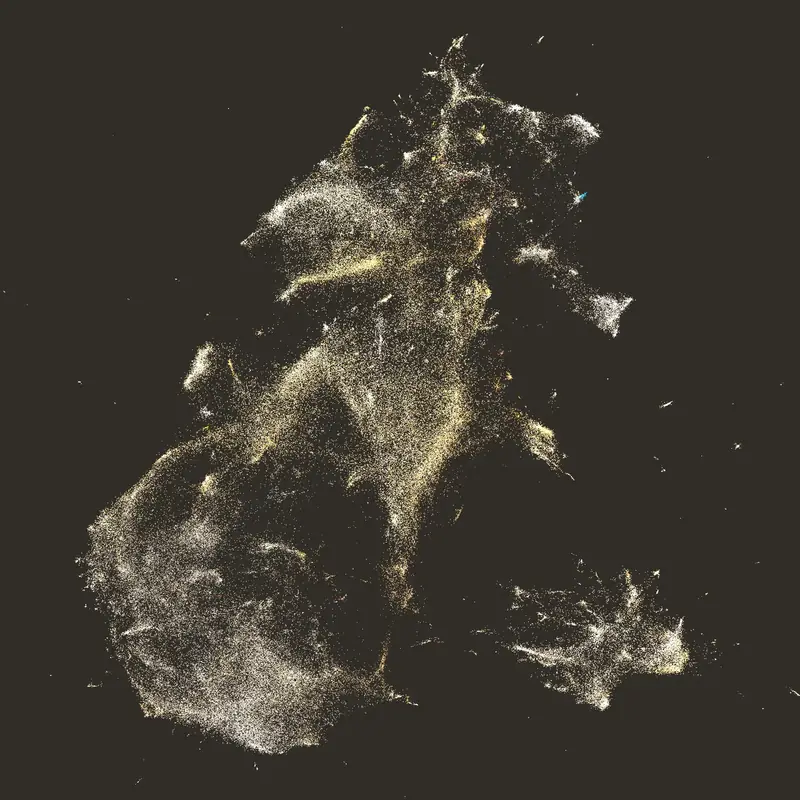
Surprise Machines is a project of experimental museology that sets out to visualize the entire image collection of the Harvard Art Museums, intending to open up unexpected vistas on more than 200,000 objects usually inaccessible to visitors. Part of the exhibition Curatorial A(i)gents organized by metaLAB (at) Harvard, the project explores the limits of artificial intelligence to display a large set of images and create surprise among visitors. To achieve such a feeling of surprise, a choreographic interface was designed to connect the audience’s movement with several unique views of the collection.

Surprise Machines: Revealing Harvard Art Museums’ Image Collection
Nightingale
2021

Ars memorativa as the genesis of information design: a conversation with Manuel Lima

Lima, Manuel, Dario Rodighiero
https://nightingaledvs.com/ars-memorativa-as-the-genesis-of-information-design-a-conversation-with-manuel-lima/

Manuel Lima is one of the most prominent figures of data visualization since the publication of Visual Complexity (Lima 2011). In this conversation, Manuel Lima traces back the origin of data visualization to Ars Memorativa, an ancient mnemonic technique to organize information and facilitate its recall. Going back to the origins is an obsession that brought him to collect and arrange into books images of information design from both physical and digital archives. By doing this, Manuel Lima tackled issues related to the digital objects and their creation, use, and preservation, with a point of view capable of combining the passion for visualizing information and the profession of UX design. This conversation, which took place between Lisbon and Milan on Wednesday 28 July, 2021, comes from a blurb that Manuel Lima wrote for Mapping Affinities (Rodighiero 2021). The discussion is part of the project From Data to Wisdom, and is supported by Fundação para a Ciência e a Tecnologia through the grant POCI-01-0145-FEDER-029717, and the Swiss National Science Foundation through the grant 194442. This text, originally created for the forthcoming book From Data to Wisdom (Higuera Rubio et al. 2022), is published as a preview for Nightingale, the journal of the Data Visualization Society.

Ars memorativa as the genesis of information design: a conversation with Manuel Lima
Visual Culture Studies
2021

Making Visible the Invisible Work of Scientists during the COVID-19 Pandemic

Rodighiero, Dario, Eveline Wandl-Vogt, and Elian Carsenat
https://doi.org/10.5281/zenodo.5115621

Despite the perceptibility of the effects they impart on their hosts, the most incredible capacity of viruses is in their invisibility. Invisibility is the most frightening side of the current pandemic, and invisible is also the work of the scientists striving to find a solution. This proposal presents a data visualization that aims to give visibility to those scientists working on COVID-19. Their scientific publications have been computationally analyzed and transformed into a relational structure based on lexical similarity. The result is a network of scientists whose proximity is given by their closeness in writing. An innovative visual method that hybridizes network visualizations and word clouds shows the scientists in a deep space, explorable through keywords. In such a space, individuals are situated according to their lexical similarity, and keywords are used to clarify their proximity. By zooming, the visualization reveals more information about scientists and their clusters. While a lot of visualizations during the pandemic focused on showing the spread of infection, causing anxiety among the readers, this visualization reveals the efforts of science in eradicating the virus. Making visible the enormous number of scientists working on COVID-19 research will contribute to coping more positively with the pandemic.

Making Visible the Invisible Work of Scientists during the COVID-19 Pandemic
Métis Presses
2021

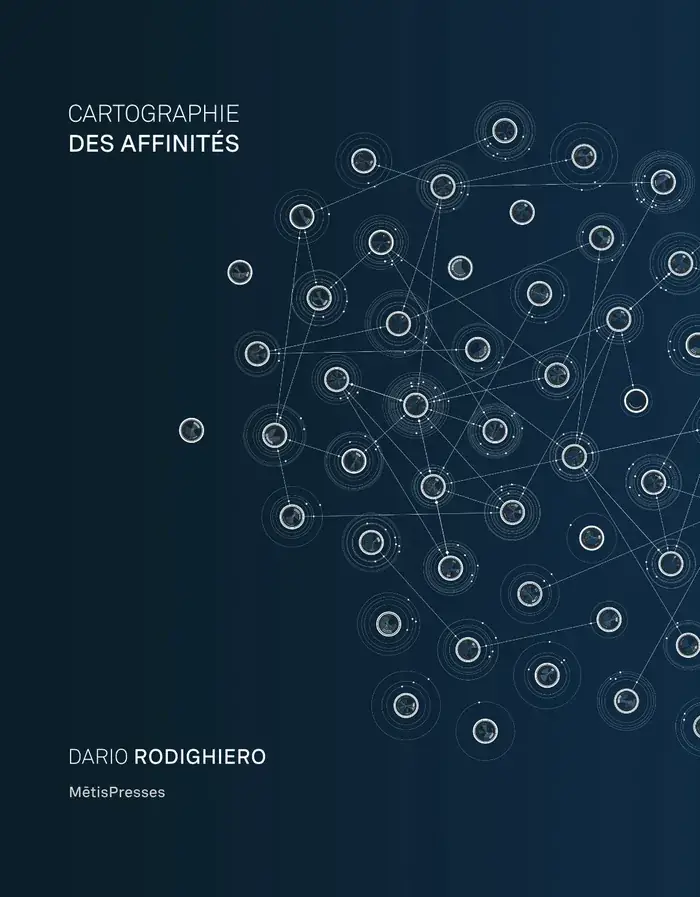
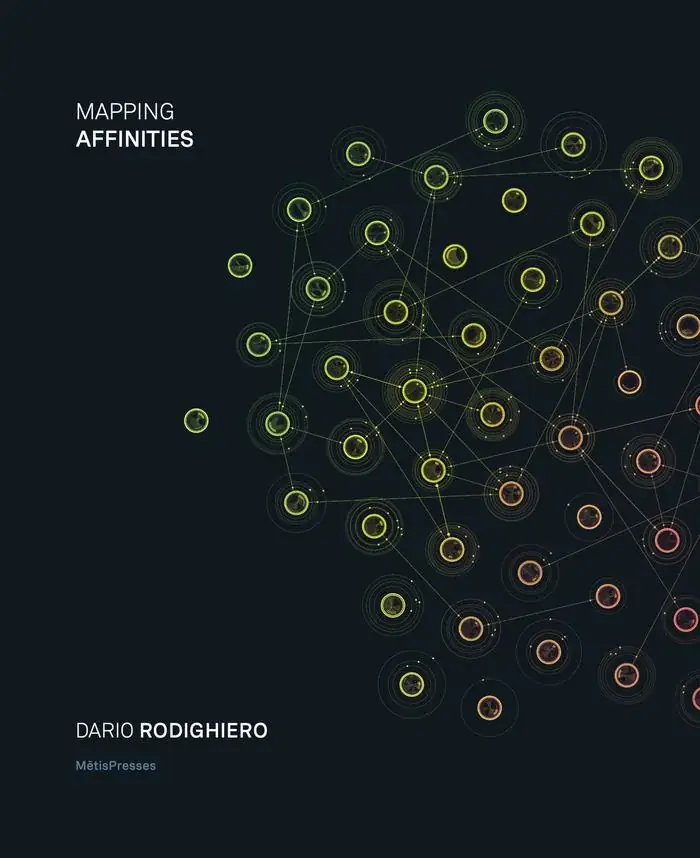
Mapping Affinities: Democratizing Data Visualization

Rodighiero, Dario
https://library.oapen.org/handle/20.500.12657/91793

Nowadays, many of our actions are transformed into digital information, which we can use to draw diagrams that describe complex operations, such as those of institutions. This book introduces us to the reading of complex systems through the concept of affinity: the alchemy that brings people together and makes them creative and productive. Affinity’s mapping is a data visualization method that allows us to observe the dynamics of an organization subdivided into complex systems: institutions, universities, governments, etc. It is a graphical tool based on the collaboration variable. Mapping Affinities is, according to the author, an instrument for deciphering complex organizations and improving them. By inserting individuals on these maps, it is also a way of helping them to understand how to evolve in life within an institution. The book tackles this problem with a case study concerning the Federal Polytechnic School of Lausanne. Data from the actions of researchers at the Lausanne institution are brought together and transformed into an innovative and attractive map.

Mapping Affinities: Democratizing Data Visualization
Frontiers
2020

Big Data and the Little Big Bang: An Epistemological (r)Evolution

Balazka, Dominik, and Dario Rodighiero
https://doi.org/10.3389/fdata.2020.00031

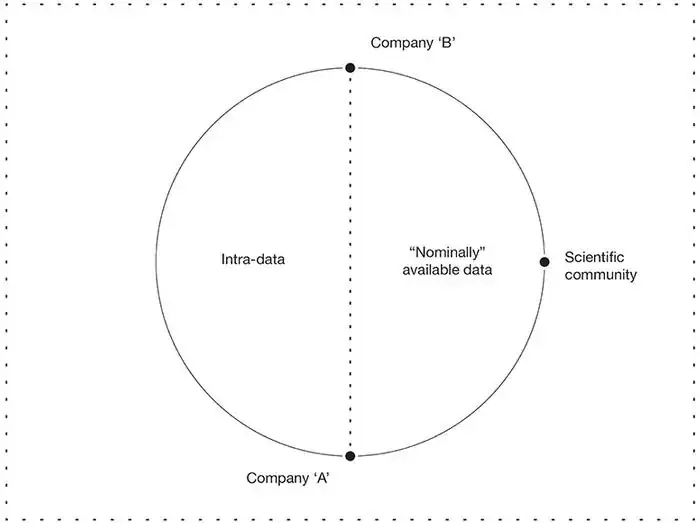
Starting from an analysis of frequently employed definitions of big data, it will be argued that, to overcome the intrinsic weaknesses of big data, it is more appropriate to define the object in relational terms. The excessive emphasis on volume and technological aspects of big data, derived from their current definitions, combined with neglected epistemological issues gave birth to an objectivistic rhetoric surrounding big data as implicitly neutral, omni-comprehensive, and theory-free. This rhetoric contradicts the empirical reality that embraces big data: (1) data collection is not neutral nor objective; (2) exhaustivity is a mathematical limit; and (3) interpretation and knowledge production remain both theoretically informed and subjective. Addressing these issues, big data will be interpreted as a methodological revolution carried over by evolutionary processes in technology and epistemology. By distinguishing between forms of nominal and actual access, we claim that big data promoted a new digital divide changing stakeholders, gatekeepers, and the basic rules of knowledge discovery by radically shaping the power dynamics involved in the processes of production and analysis of data.

Big Data and the Little Big Bang: An Epistemological (r)Evolution
HUMANA.MENTE
2020

Digital Habitus or Personalization without Personality

Romele, Alberto, and Dario Rodighiero
https://doi.org/10.5281/zenodo.3950030

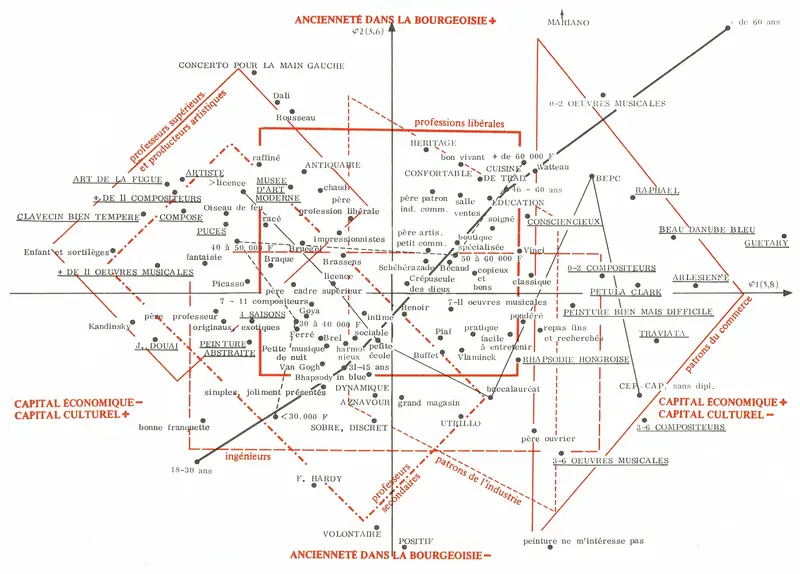
This article aims to offer an original framework to understand the ontological structure of digital media and technologies, along with their effects of subjectivation. In the first section, we confront Bourdieu’s and Latour’s social theories. Indeed, Latour and Bourdieu offered two almost opposite social theories, and both of them can be used to understand digital media and technologies. Our hypothesis is that the digital of today is less Latourian than Bourdieusian. In the second section, we introduce the concept of digital habitus. In particular, we contend that digital machines such as algorithms of machine learning are habitus machines. Although their results present a greater granularity with respect to the standard techniques of the past, these algorithms still reduce individuals to categories, general trends, classes, and behaviors. Such a reduction has flattening effects on the individuals’ self-understanding, especially in terms of identity and interaction with the social world. This is the phenomenon described as the “personalization without personality.” In the third section, we look for proof of our previous insights through a qualitative and comparative analysis between three kinds of data and information visualization. More specifically, we show that contemporary techniques for data visualization with machine learning algorithms are closer to Bourdieu’s use of correspondence analysis (CA) and multiple correspondence analysis (MCA) than to Latour-inspired network visualizations.

Digital Habitus or Personalization without Personality
Information Visualisation
2020

Drawing Network Visualizations on a Continuous, Spherical Surface

https://pure.rug.nl/ws/files/224968970/Rodighiero_2020_Drawing_Network_Visualizations_on_a_Continuous_Sp.pdf

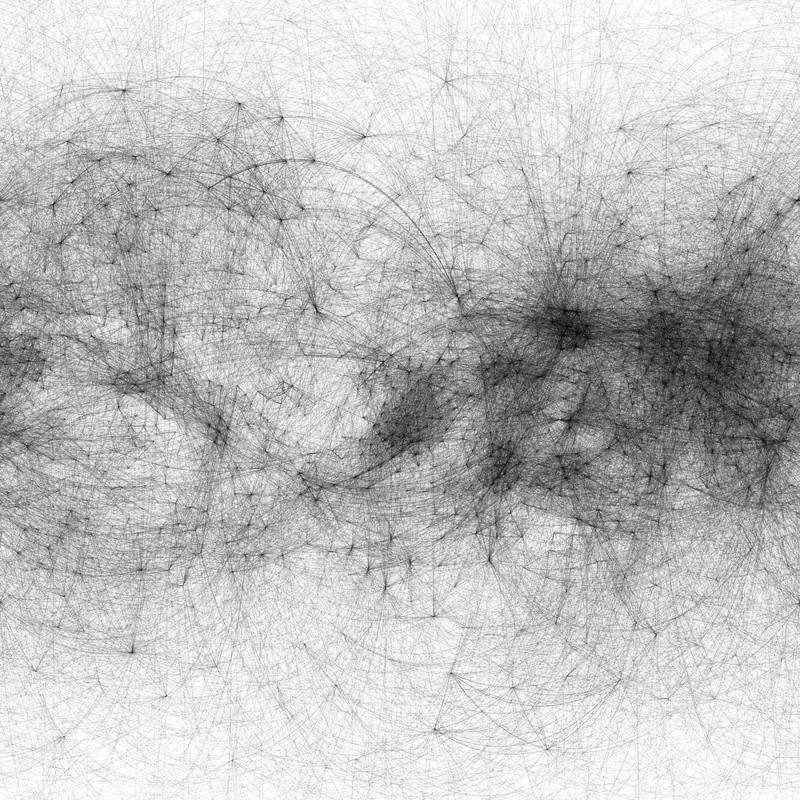
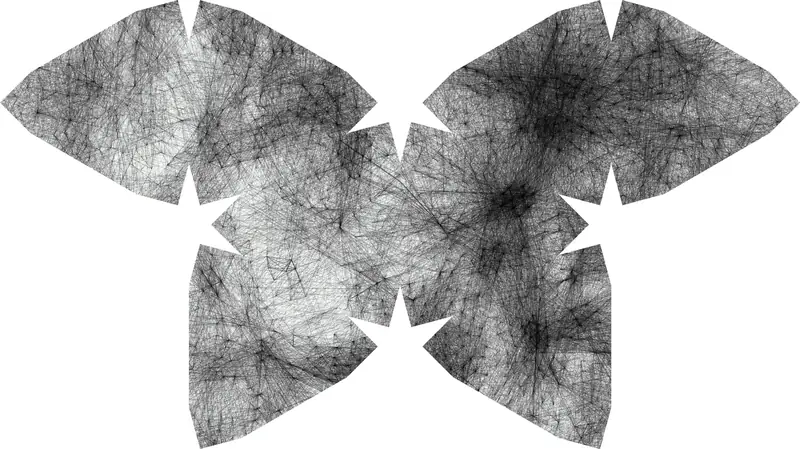
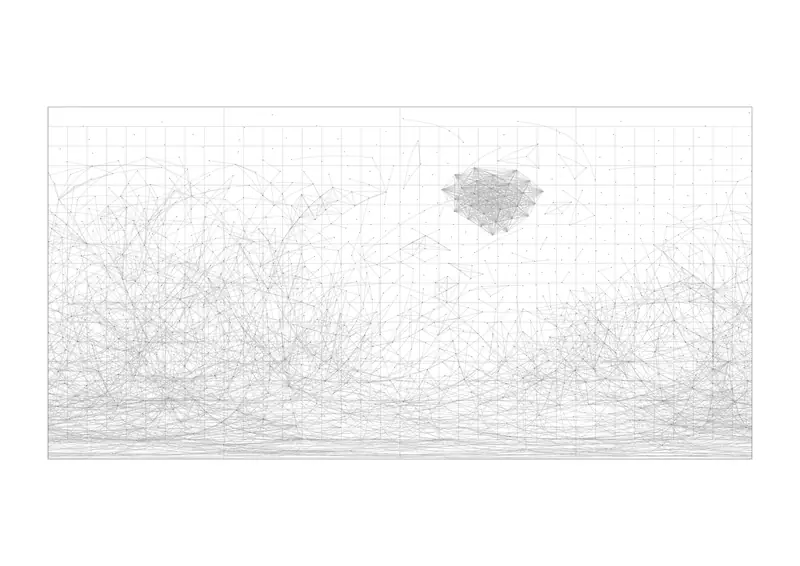
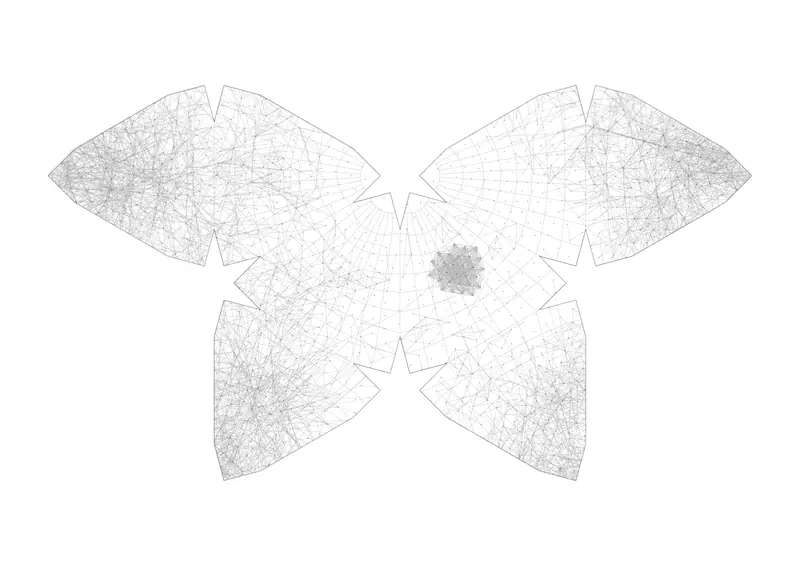
Despite the great literature regarding network visualizations, their graphic representation is hardly an object of investigation. Sometimes it deserves more attention, especially when individuals are represented. Visually translating communities in networks, for example, implies that some individuals are always situated at the borders of the representation. This assumption is clearly unfair, especially if each individual in the community is connected with everybody else. To address this lack of design justice, the community is represented on a spherical network where the surface is continuous. In that space, individuals can be situated in a sparse area, but never on the edges. The spherical network is then projected onto a flat surface to improve readability by making use of cartographic projections.

Drawing Network Visualizations on a Continuous, Spherical Surface
Antinomie
2020

Immaginare Gesti-Barriera Contro Il Ritorno Alla Produzione Pre-Crisi

Latour, Bruno. Translated by Daniele Guido, Donato Ricci, Dario Rodighiero, and Giulia Taurino
https://antinomie.it/index.php/2020/04/09/immaginare-gesti-barriera-contro-il-ritorno-alla-produzione-pre-crisi/

Potrebbe esserci qualcosa di inappropriato nel guardare all’era post-crisi quando gli operatori sanitari sono ancora “in prima linea”, milioni di persone stanno perdendo il lavoro, e molte famiglie in lutto non possono nemmeno seppellire i loro morti. Eppure, è proprio questo il momento di lottare affinché la ripresa economica, una volta terminata la crisi, non ci riporti allo stesso vecchio regime climatico contro il quale finora abbiamo tentato, senza successo, di combattere. In effetti, la crisi sanitaria è inserita in quella che non è una crisi – sempre passeggera per definizione – ma piuttosto una mutazione ecologica duratura e irreversibile. Se abbiamo delle buone possibilità di “uscire” dalla prima, ne abbiamo ben poche di “uscire” dalla seconda. Le due situazioni non sono alla stessa scala di grandezza, ma resta illuminante articolarle l’una con l’altra. In ogni caso, sarebbe un peccato non riflettere sulla crisi sanitaria per scoprire altri modi di entrare nella mutazione ecologica, piuttosto che farlo alla cieca.

Immaginare Gesti-Barriera Contro Il Ritorno Alla Produzione Pre-Crisi
AIUCD
2020

Mapping as a Contemporary Instrument for Orientation in Conferences

https://doi.org/10.5281/zenodo.3611340

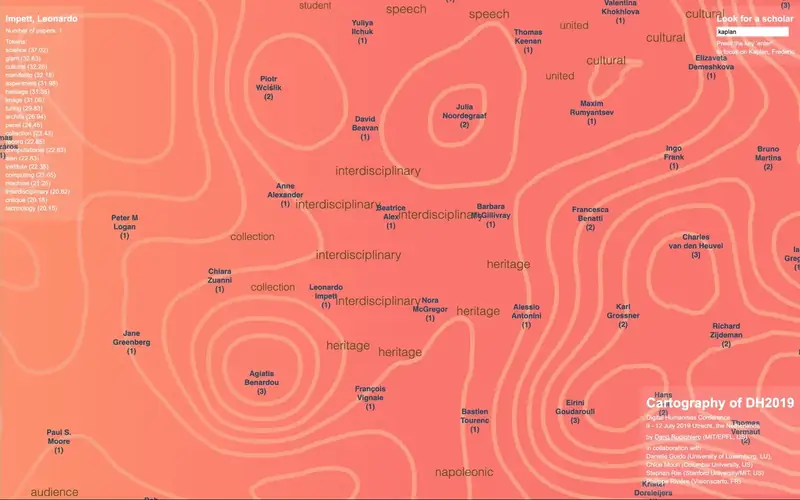
This article presents a case study analyzing submissions from the Digital Humanities 2019 conference by visualizing a network of authors situated according to their shared lexicon. This new form of summarizing a conference is an effective way to grasp the whole conference at once. The hope is that this method of visualization will not be employed merely as a retroactive way to reflect on past events, but rather as an instrument to prepare the visit and orientate the attendees during the conference.

Mapping as a Contemporary Instrument for Orientation in Conferences
Techné
2020

The Hermeneutic Circle of Data Visualization: The Case Study of the Affinity Map

Rodighiero, Dario, and Alberto Romele
https://doi.org/10.5840/techne202081126

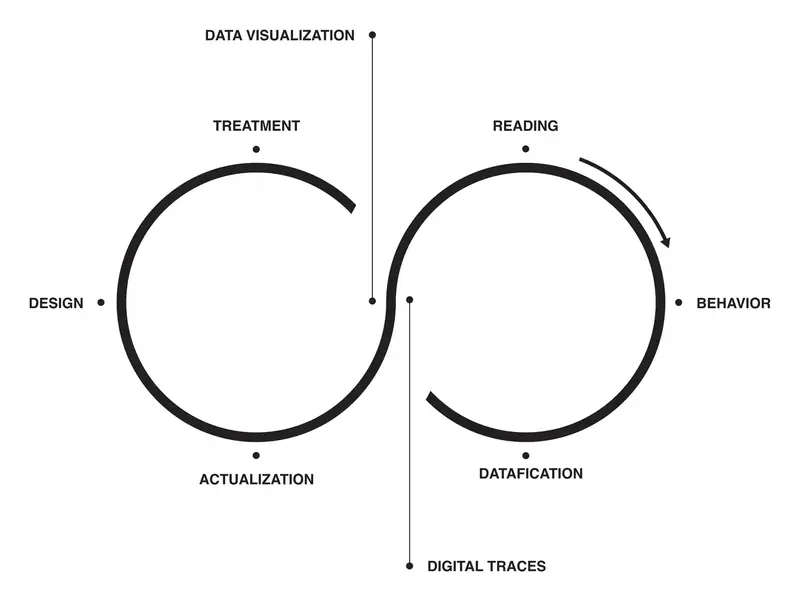
In this article, we show how postphenomenology can be used to analyze the Affinity Map: a data visualization that reveals the hidden dynamics that exist between individuals within large organizations. We make use of the Affinity Map to expand the classic postphenomenology that privileges a ‘linear’ understanding of technological mediations and introduce the notions of ‘iterativity’ and ‘collectivity.’ In the first section of the paper, we discuss both classic and more recent descriptions of humantechnology-world relations in order to transcendentally approach the discipline of data visualization. In the second section, we use the Affinity Map case study to consider three elements: 1) the collection of data and the design process; 2) the visual grammar of the data visualization, and 3) the process of self-recognition for the map ‘reader.’ In the third section, we introduce the hermeneutic circle of data visualization. Finally, we suggest that the Affinity Map, because of its ethical and political multistability, might be seen as a material encounter between postphenomenology, actor-network theory (ANT), and hermeneutics.

The Hermeneutic Circle of Data Visualization: The Case Study of the Affinity Map
EspacesTemps.Net
2019

Self-Recognition in Data Visualization: How Individuals See Themselves in Visual Representations

Rodighiero, Dario, and Loup Cellard
https://doi.org/10.26151/espacestemps.net-wztp-cc46

This article explores how readers recognize their personal identities represented through data visualizations. The recognition is investigated starting from three definitions captured by the philosopher Paul Ricœur : the identification with the visualization, the recognition of someone in the visualization, and the mutual recognition that happens between readers. Whereas these notions were initially applied to study the role of the book reader, two further concepts complete the shift to data visualization : the digital identity stays for the present-day passport of human actions and the promise is the intimate reflection that projects readers towards their own future. This article reflects on the delicate meaning of digital identity and the way of representing it according to this structure : From Personal Identity to Media is a historical introduction to self-recognition, Data Visualization for Representing Identities moves the focus to visual representation, and The Course of Recognition breaks the self-recognition in through the five concepts above, just before the conclusion.

Self-Recognition in Data Visualization: How Individuals See Themselves in Visual Representations
Frontiers
2018

Mapping Affinities in Academic Organizations.

Rodighiero, Dario, Frédéric Kaplan, and Boris Beaude
https://doi.org/10.3389/frma.2018.00004

Scholarly affinities are one of the most fundamental hidden dynamics that drive scientific development. Some affinities are actual, and consequently can be measured through classical academic metrics such as co-authoring. Other affinities are potential, and therefore do not leave visible traces in information systems; for instance, some peers may share interests without actually knowing it. This article illustrates the development of a map of affinities for academic collectives, designed to be relevant to three audiences: the management, the scholars themselves, and the external public. Our case study involves the School of Architecture, Civil and Environmental Engineering of EPFL, hereinafter ENAC. The school consists of around 1,000 scholars, 70 laboratories, and 3 institutes. The actual affinities are modeled using the data available from the information systems reporting publications, teaching, and advising scholars, whereas the potential affinities are addressed through text mining of the publications. The major challenge for designing such a map is to represent the multi-dimensionality and multi-scale nature of the information. The affinities are not limited to the computation of heterogeneous sources of information; they also apply at different scales. The map, thus, shows local affinities inside a given laboratory, as well as global affinities among laboratories. This article presents a graphical grammar to represent affinities. Its effectiveness is illustrated by two actualizations of the design proposal: an interactive online system in which the map can be parameterized, and a large-scale carpet of 250 square meters. In both cases, we discuss how the materiality influences the representation of data, in particular the way key questions could be appropriately addressed considering the three target audiences: the insights gained by the management and their consequences in terms of governance, the understanding of the scholars’ own positioning in the academic group in order to foster opportunities for new collaborations and, eventually, the interpretation of the structure from a general public to evaluate the relevance of the tool for external communication.

Mapping Affinities in Academic Organizations.
Biennial Research Transdisciplinary Imaging Conference
2018

Printing Walkable Visualizations

https://doi.org/10.6084/m9.figshare.6104693.v2

This article concerns a specific actor in the actualization process, the media. The conventional media for visualizations is the computer screen, a visual device that supports the practices of design and reading. However, visualizations also appear in other ways, for example as posters, articles, books, or projections. This article focuses, in particular, on a pretty unusual medium called floor or walkable visualization.

Printing Walkable Visualizations
EPFL Archizoom
2015

The Analogous City, the Map

Rodighiero, Dario
https://infoscience.epfl.ch/record/209326

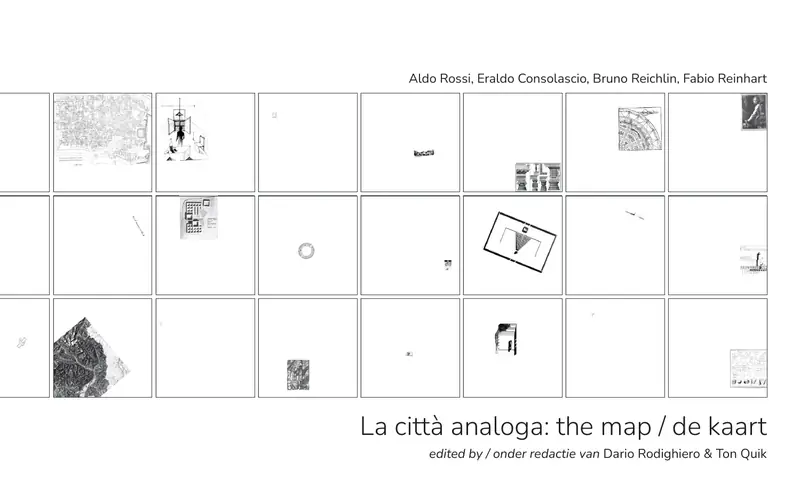
This new publication of The Analogous City, an artwork produced by Aldo Rossi, Eraldo Consolascio, Bruno Reichlin and Fabio Reinhart for the Venice Biennale of Architecture in 1976, is part of a museographic installation for the exhibition Aldo Rossi - The Window of the Poet at the Bonnefanten Museum in Maastricht. To gauge and explore this seminal work, Archizoom relied on Dario Rodighiero, candidate on the Doctoral Programme for Architecture and Sciences of the Cities, and designer at the Digital Humanities Lab (DHLAB) at EPFL. Conceived as a genuine urban project, The Analogous City displays an aggregation of architectures drawn from collective and personal memories. What happens if we isolate the forms that Aldo Rossi and his friends so consciously placed in relation to each other? Rodighiero simply decomposed it into the original references and then returned the pieces to the artwork, thus allowing us to simultaneously see the work and its visual vocabulary. An application based on augmented reality has been created to work in tandem with this publication by displaying the complete references belonging to the collage on different layers suspended over the artwork. By downloading the free application and installing it on your tablet or mobile phone, you can recreate the interaction of the museum installation whenever and wherever you are.
The Analogous City, the Map