Archives, Museums, and Installations: Aldo Rossi’s Legacy in Digital Transition
Rodighiero, Dario, Carla Zhara Buda, and Angela Parente. 2026. “Archives, Museums, and Installations: Aldo Rossi’s Legacy in Digital Transition.” Preservation, Digital Technology & Culture 55 (1): 45–53. https://doi.org/10.1515/pdtc-2025-0066.
This article offers a theoretical reflection grounded in curatorial analysis and supported by a case study. It examines how Aldo Rossi’s legacy is redefined through archives, exhibitions, and installations, with a focus on the transformations of his Analogous City. Drawing on scholarly concepts from Paul Ricœur, Bruno Latour, and Umberto Eco, the article considers how memory, mediation, and interpretation work together as a process of meaning-making in cultural heritage. It shows how this process shapes the ways Rossi’s work is preserved and reimagined across different forms of display. Rather than treating cultural heritage as static, the article presents it as a process formed through editorial choices, curatorial practices, and participatory engagement. Rossi’s case study shows how architectural memory can remain open and responsive, especially when activated through digital and spatial forms of display.
Introduction
Laurajane Smith describes cultural heritage as a process shaped by remembering, storytelling, and meaning making. It unfolds when people engage with the past to understand the present, relying on memory to make sense of society. “The real sense of heritage […] is […] in the act of passing on and receiving memories and knowledge” (Smith 2006, 2). This view resonates with historian Pierre Nora’s observation that modern societies have lost the communal settings in which memory once circulated — such as villages, religious rituals, or oral traditions (Nora 1989). In response, communities create new symbolic sites of memory that attempt to preserve what can no longer be experienced directly, such as monuments and commemorative rituals. While Smith focuses on the cultural work of remembering, Nora emphasizes the rupture that makes such work necessary. Both underscore that heritage emerges from efforts to retain meaning when memory becomes unstable. From this shared perspective, institutions play a vital role in preserving and transmitting memory. They offer frameworks where fragmented histories can be collected, reinterpreted, and kept active. “The role of preserving symbolic sites of memory is formalized through international instruments, such as UNESCO’s Convention on the Protection of the World Cultural and Natural Heritage” (UNESCO 1972). These frameworks task states and cultural bodies with identifying, protecting, and promoting heritage as a living process — one that supports identity, diversity, and knowledge over time.
The process of heritage-making is increasingly shaped by digital technologies. In 2003, UNESCO introduced the concept of “digital heritage” in its Charter on the Preservation of Digital Heritage. The document, later released in a revised online version, defines digital heritage as “resources of information and creative expression” that are “produced, distributed, accessed and maintained in digital form” (UNESCO 2009). This marks a broader transformation in cultural institutions, where digitization affects not only access but also the ways heritage is produced and consumed. As Burdick et al. (2012) argue in Digital_Humanities, digital practices challenge more widely established disciplines and roles, calling for more reflective and design-driven approaches to knowledge. Cameron and Kenderdine (2007) note that digital technologies do not simply enhance cultural capital — they reshape the internal cultures and practices of the institutions that care for it. These changes are both technological and institutional, driving shifts within organizations such as museums, libraries, and archives. As Paul (2015) observes, technological development often outpaces the critical vocabulary needed to assess it, requiring institutions to invent new ways of speaking about the social, economic, and aesthetic implications of digital work.
The shift toward digital heritage intersects meaningfully with the legacy of architect Aldo Rossi (1931–1997). Born in Milan and primarily active in Italy, Rossi shaped how memory is understood within the built environment. After receiving the Pritzker Prize in 1990, his influence expanded internationally through projects such as the Quartier Schützenstraße in Berlin and the Bonnefanten Museum in Maastricht. Rossi did not view the city as a neutral setting for modern life but as a layered structure where buildings and forms retain the memory of past meanings (Rossi 1996). His notion of the “urban artifact” highlights how certain structures — by virtue of their form, history, or symbolism — anchor collective identity. As Peter Eisenman writes in his introduction to The Architecture of the City, Rossi’s ideas continue to inform how cultural memory is revisited and reinterpreted over time (Eisenman 1996). Although this article does not follow Rossi’s theoretical model, his legacy serves as a valuable entry point for examining how heritage is shaped today. The ways his work has been archived, displayed, and transformed into installations offer a concrete perspective on the changing role of institutions in the digital age.
Rossi’s legacy provides a useful lens for examining the digital transition in cultural heritage. This article approaches the topic through three interrelated practices: archiving, curating, and displaying. Archives are where heritage begins to take form, as curators and researchers select, organize, and preserve materials, turning them into collections that support memory and interpretation. Museums build on this foundation by creating narratives that connect these materials to broader historical and cultural contexts. Installations present these narratives in spatial form, shaping how audiences encounter heritage — often through hybrid formats that combine physical display with digital interaction. Taken together, these practices show how heritage is preserved, interpreted, and reimagined in the digital age. A clear example is the work of MAXXI in Rome, which houses Aldo Rossi’s archive (Zhara Buda et al. 2020) and has recently presented both a physical exhibition (MAXXI 2021) and a digital one (MAXXI 2022) dedicated to his work. These initiatives demonstrate how a cultural institution engages archival material through conservation, exhibition, and digital reinterpretation, making Rossi’s legacy accessible and relevant to contemporary audiences (Rodighiero 2022).
The article is structured around three main sections, each corresponding to a key site where Rossi’s legacy is shaped and reinterpreted: archives, exhibitions, and installations. These are interwoven with theoretical insights from Paul Ricœur (1977), Latour (2005), and Eco (1989), whose perspectives illuminate different moments in the process of meaning-making. Ricœur helps frame how memory is assembled, Latour clarifies how mediation transforms materials as they circulate, and Eco shows how interpretation keeps the work open to new readings. Together, they support the central argument of the article. Rather than following a purely chronological order, the article moves between empirical cases and conceptual reflections, culminating in a discussion of heritage as a dynamic and mediated process.
Memory, Mediation, and Interpretation
Understanding how heritage takes shape requires attention to how memory is formed, how meanings are mediated, and how interpretation unfolds. These three dimensions — memory, mediation, and interpretation — provide the conceptual framework for exploring Aldo Rossi’s digital legacy. 1) Memory is not given in full but constructed through acts of selection and omission, especially in the collection and preservation of traces from the past. Paul Ricœur (1977) describes memory as a process of reconstruction, shaped by the needs of the present and the expectations of the future. 2) Mediation is often treated as neutral, yet it actively transforms what it conveys. It links subjects, objects, and meanings, shaping how knowledge is structured and circulated. Latour (2005) reframes the social as a network of associations, where mediation works by assembling and translating these relations. 3) Interpretation extends beyond the curator’s choices. It continues through the viewer, who brings their own position to the encounter. Eco (1989) defines the artwork as an “open work,” inviting multiple readings rather than a fixed message. Together, these perspectives allow us to understand cultural heritage as a dynamic process — curated, mediated, and interpreted.
Memory plays a central role in the construction of heritage, yet it is always partial and shaped by the conditions of its transmission. For Paul Ricœur, memory is not a retrieval of the past but a reconfiguration shaped by present concerns. In Memory, History, Forgetting, he writes that “memory remains the guardian of the ultimate dialectic constitutive of the pastness of the past, namely, the relation between the ‘no longer,’ which marks its character of being elapsed, abolished, superseded, and the ‘having-been,’ which designates its original and, in this sense, indestructible character” (Ricœur 1977, 498). This tension is not only personal but institutional, embedded in archival practices that influence what is remembered and what is left out. Ricœur underscores that memory is vulnerable — not only to loss but to distortion and manipulation — making its ethical handling essential. Archives, in this view, are not neutral repositories but sites of reconstruction, where traces are selected to serve contemporary needs. This perspective aligns with the evolving role of heritage institutions, which no longer merely preserve objects but actively shape how memory is assembled. Remembering, then, is never neutral: it demands critical awareness of how forgetting works and how narratives emerge from incomplete materials.
Mediation is often seen as a background process, a technical means of transmitting content. Bruno Latour challenges this assumption by placing mediation at the core of social life. In Reassembling the Social, he writes: “Mediators transform, translate, distort, and modify the meaning or the elements they are supposed to carry” (Latour 2005, 39). Every act of mediation alters what is being transmitted; nothing remains unchanged. For Latour, the social is not a fixed domain but a process of assembling associations among human and nonhuman actors. This view reframes heritage institutions as active agents, shaping what becomes culturally meaningful. Cataloging, digitizing, and exhibiting are all forms of mediation that alter how materials are interpreted. This perspective shifts attention away from content alone and toward the networks through which it gains form and value. Mediation is not a neutral layer between origin and reception — it is the space where meaning takes shape. Recognizing its role allows us to follow how heritage is constructed and reframed in the digital environments where memory now circulates.
Interpretation plays a central role in how heritage is experienced and understood. As Umberto Eco writes in The Open Work, “the ‘openness’ and dynamism of an artistic work consist in factors which make it susceptible to a whole range of integrations […] structural vitality is still seen as a positive property of the work, even though it admits of all kinds of different conclusions and solutions for it” (Eco 1989, 20). This openness is not arbitrary; it is guided by the internal structure and form of the work itself. In the context of exhibitions and installations, this perspective is particularly relevant. Visitors interpret meaning rather than simply receive it, bringing their own knowledge, expectations, and context to the encounter. This participatory dimension is integral to how cultural artifacts acquire significance. Interpretation happens within frameworks that allow for variation while preserving coherence, shaping how meaning unfolds across audiences and platforms.
Together, Ricœur, Latour, and Eco offer a way to understand heritage as a living process shaped by how memory is handled, how meanings are mediated, and how interpretations unfold. These dimensions are closely connected: memory depends on forms of mediation, and each mediation creates space for interpretation. Applied to the legacy of Aldo Rossi, this framework highlights how his work is continually reshaped as it moves through archives, exhibitions, and installations. In the following sections, we explore these three settings to examine how Rossi’s legacy is assembled and reinterpreted across both physical and digital environments.
Archives
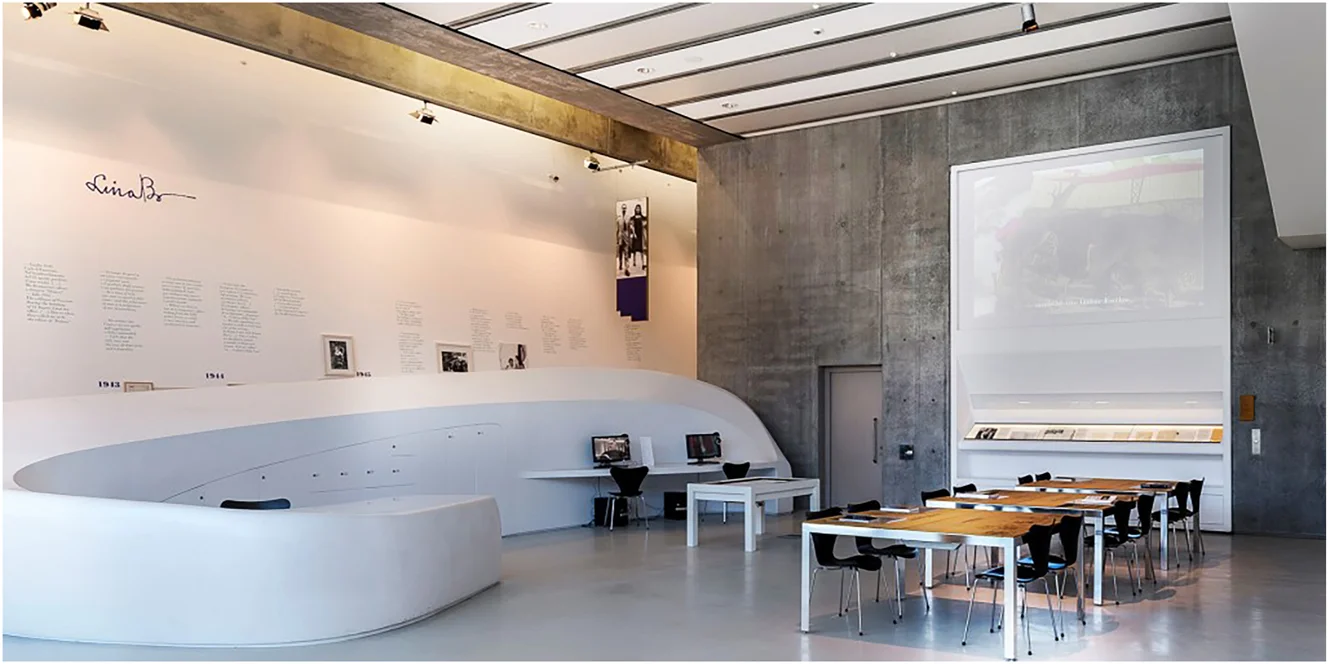
The Centro Archivi at MAXXI was created to preserve, study, and activate the documentary legacies of contemporary architects (MAXXI 2002). Unlike traditional archives that focus on classification and storage, this center functions as a living infrastructure, supporting both academic research and curatorial work. One of its first and most important acquisitions was the archive of Aldo Rossi (Zhara Buda et al. 2020). This addition contributed to shaping how post-war Italian architecture could be documented and institutionalized. Rossi left behind a wide-ranging body of material, including architectural projects, theoretical writings, and teaching documents. Housing his archive at MAXXI positioned the museum as more than a repository of objects — it became a site where architecture is studied for its cultural meanings as well as its forms. As Margherita Guccione notes, the Rossi archive helped define the research identity of the Centro Archivi from the beginning, offering a case where architecture, biography, and legacy are closely connected (Zhara Buda et al. 2020, 8). In this setting, the archive becomes more than a collection: it is a reference point for how architectural memory is curated today.
The Aldo Rossi archive was deposited at the Centro Archivi in 2001, but its development unfolded gradually over nearly two decades. Initial efforts focused on securing and partially inventorying the materials. A more systematic approach began in 2015, when a team led by Centro Archivi di Architettura undertook a full cataloging project, resulting in the 2020 publication of the Inventario Aldo Rossi (Zhara Buda et al. 2020). This work required curatorial decisions about how to represent the complexity of Rossi’s practice. The team organized the material into a series and sub-series that reflected his overlapping roles as architect, designer, writer, and teacher. Each item was documented with attention to its context, drawing on both internal references and secondary sources. As Guccione notes, the process required a balance between archival precision and interpretive care, particularly in addressing gaps and the fluid boundary between Rossi’s personal and professional life (Zhara Buda et al. 2020, 18–21). Equally important has been the network of institutions involved in the valorization of the Rossi archive — not only the Fondazione Aldo Rossi but also the Canadian Centre for Architecture in Montreal, the Getty Research Institute in Los Angeles, the Deutsches Architekturmuseum in Frankfurt, the Centre Pompidou in Paris, and the Bonnefantenmuseum in Maastricht — which has amplified the archive’s relevance through exhibitions, publications, and research collaborations. The resulting inventory offers a way to navigate Rossi’s legacy, shaped through deliberate acts of selection and organization. In this light, the archive functions as a site of historiographic interpretation.
The Aldo Rossi archive stands out for the range and variety of its materials. It contains over 13,000 items, including architectural drawings, design sketches, notebooks, correspondence, photographs, publications, and architectural models. This diversity reflects the breadth of Rossi’s work — from urban plans and buildings to furniture and theoretical writing. Many of the documents reveal his process rather than finished projects: conceptual sketches, diagrams, and handwritten notes that trace ideas over time and across media. His quaderni azzurri (Rossi 1999), a series of blue notebooks filled with reflections and drawings, are especially revealing of the fluid boundary between thinking and making in his practice. The archive also holds material from his teaching in Milan, Zurich, and Venice, offering insight into his pedagogical approach and intellectual exchanges. Importantly, the collection is not limited to canonical projects. It includes fragmentary and unfinished works that point to an evolving, open-ended body of thought. As the Inventario shows, the selection criteria aimed for coherence within each subseries while allowing overlaps that reflect the complexity of Rossi’s identity, as noted by Alberto Ferlenga (Zhara Buda et al. 2020). Rather than a static repository, the archive becomes a layered space where different aspects of Rossi’s legacy remain visible and connected.
As Paul Ricœur argues, memory is not simply a recollection of the past but a reconstruction shaped by present concerns and future aims. Archival work, in this view, is not neutral preservation — it is an active process of remembering and forgetting. The Rossi archive reflects this dynamic. Its structure reflects choices about how to represent his legacy, emphasizing particular narratives and relationships. What is remembered — through description, preservation, and access — is shaped by curatorial decisions. As Ricœur writes, archives are sites of “inscription,” where traces are fixed in ways that make them available to historical consciousness (Ricœur 1977, 120). In Rossi’s case, the Inventario (Zhara Buda et al. 2020) becomes a key tool for shaping his architectural memory and influencing future interpretations. The tension between what is preserved and what remains elusive reflects the fragility of memory itself. The archive, in this sense, is a framework that renders Rossi’s legacy legible while inevitably narrowing its complexity. It is within this tension that the significance of the archive emerges — as a curated and evolving space of cultural memory.
Today, the Aldo Rossi archive functions as more than a scholarly resource; it has become a platform for curatorial and public engagement. Its materials support research, exhibitions, educational programs, design reinterpretations, and digital initiatives. The archive’s visibility has expanded through curated selections, collaborations, and an online catalog that now serves as a reference point for architecture historians and curators (MAXXI 2023). MAXXI’s approach treats the archive as a source in active use, emphasizing circulation over storage. It serves as a practical resource for developing new narratives and engaging new audiences. By integrating Rossi’s materials into institutional programs, the archive is maintained as a living structure — adaptable to evolving questions, formats, and publics. This orientation brings archival practice closer to cultural production, where memory is not only preserved but continually enacted. It also prepares the ground for the following sections on exhibitions and installations, which trace how the archive enters the public sphere and shapes contemporary interpretations of Rossi’s work.
Exhibitions
Exhibitions have played an important role in shaping the public memory of Aldo Rossi at MAXXI. While archives preserve material traces, exhibitions bring them into view — translating drawings, models, and documents into curated narratives that engage different audiences. Since its founding, MAXXI Architettura has approached exhibitions as interpretive practices that connect historical material with contemporary reflection. Rossi’s work, both visual and conceptual, fits well within this approach. From early displays like Rossi. L’archivio personale (MAXXI 2004) to the major retrospective Aldo Rossi: L’architetto e le città (MAXXI 2021), MAXXI has returned to his work to explore new curatorial strategies, including digital formats. These exhibitions offer a way to mediate archival content and bring it into public conversation. They reflect the museum’s broader aim to preserve architectural memory while fostering new readings of its relevance. Rossi’s exhibitions, in this context, become spaces where interpretation takes shape and heritage is continually redefined.
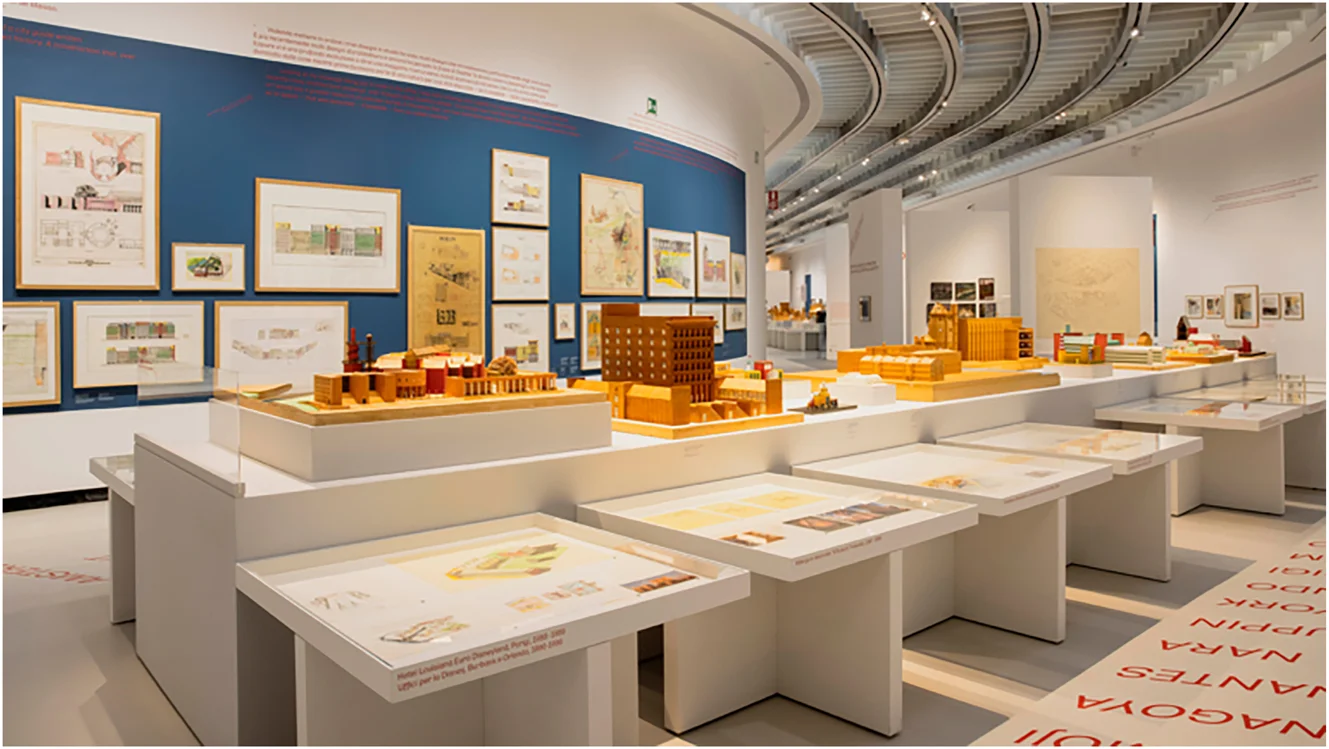
Two major exhibitions at MAXXI have recently shaped the museum’s curatorial engagement with Aldo Rossi’s legacy. The first, Aldo Rossi: L’architetto e le città (MAXXI 2021), brought together more than 800 works from his archive — drawings, models, photographs, notebooks, and letters — offering a layered view of his career. Curated by Alberto Ferlenga, the exhibition was organized thematically and chronologically, guiding visitors through key phases of Rossi’s work while allowing space for visual associations and digressions. Alongside these archival materials, the curators also included Rossi’s own words, presented in a dedicated section of the display: these fragments of text underscored how the archive brings to light ideas and reflections, foregrounding the intellectual and poetic dimensions of his work. The display echoed Rossi’s own poetics, presenting cities as accumulations of memory and form. The exhibition design emphasized continuity across time, blending architectural imagination with personal traces. Rather than presenting Rossi’s work as a static legacy, the exhibition invited viewers into an active encounter, situating his archive within a living context of interpretation.
The second initiative, Aldo Rossi Digital (MAXXI 2022), reimagined this work as an interactive online exhibition. Developed by the curatorial team that worked on both the exhibition and the inventory, with the creative agency Dinamica Studio — and then landed on MAXXI’s Know-How — the platform reorganized Rossi’s archive into thematic clusters, such as The Analogous City and Typologies, and enabled non-linear navigation across various media. Instead of replicating the structure of the physical show, the digital version made use of the web’s affordances: fluid associations, multiple pathways, and open-ended exploration. Visitors could follow their own trajectories through sketches, photographs, and texts, engaging directly with Rossi’s imagery and thought. This format emphasized accessibility and participation, opening the archive to a broader audience beyond the museum. It demonstrates how digital exhibitions can support reinterpretation by enabling multiple modes of engagement and reading.
For Bruno Latour, mediation is never neutral — it transforms what it transmits. As objects and knowledge circulate through networks, they are translated, redirected, and reshaped (Latour 2005). In Rossi’s exhibitions, mediation takes place on multiple levels. The archive is not simply moved into the gallery or online; it is reassembled through curatorial choices, exhibition design, and digital interface. Each step affects how Rossi’s work is perceived. These exhibitions act as mediating spaces, producing new associations and inviting different forms of engagement. For example, in Aldo Rossi: L’architetto e le città (MAXXI 2021), the exhibition layout turned the archive into a spatial narrative that invited active exploration. The digital version extended this further, highlighting mediation through tools like filters, thematic tags, and open navigation. In Latour’s terms, these are not secondary processes — they are central to how heritage is shaped and circulated. Rossi’s exhibitions, then, are not passive displays but sites where his legacy is continuously adapted and reinterpreted.
Taken together, these exhibitions show that Aldo Rossi’s legacy is not shaped by simply presenting archival content to the public but by the interaction of curatorial direction, exhibition design, and institutional context. The physical exhibition at MAXXI used spatial sequencing and thematic groupings to guide engagement, while the digital platform relied on modular navigation and visual links. Both created settings where heritage is experienced as an evolving process of interpretation. This combined strategy reflects changing patterns of audience engagement, offering continuity across media while adapting to different formats and rhythms. It also illustrates the role of institutions like MAXXI in shaping how memory is made accessible and meaningful. Rather than presenting a definitive image, these exhibitions treat Rossi’s work as an open collection of forms and ideas. In doing so, they frame exhibition-making as an active part of heritage work — one that contributes to the ongoing reinterpretation of the archive.
Installations
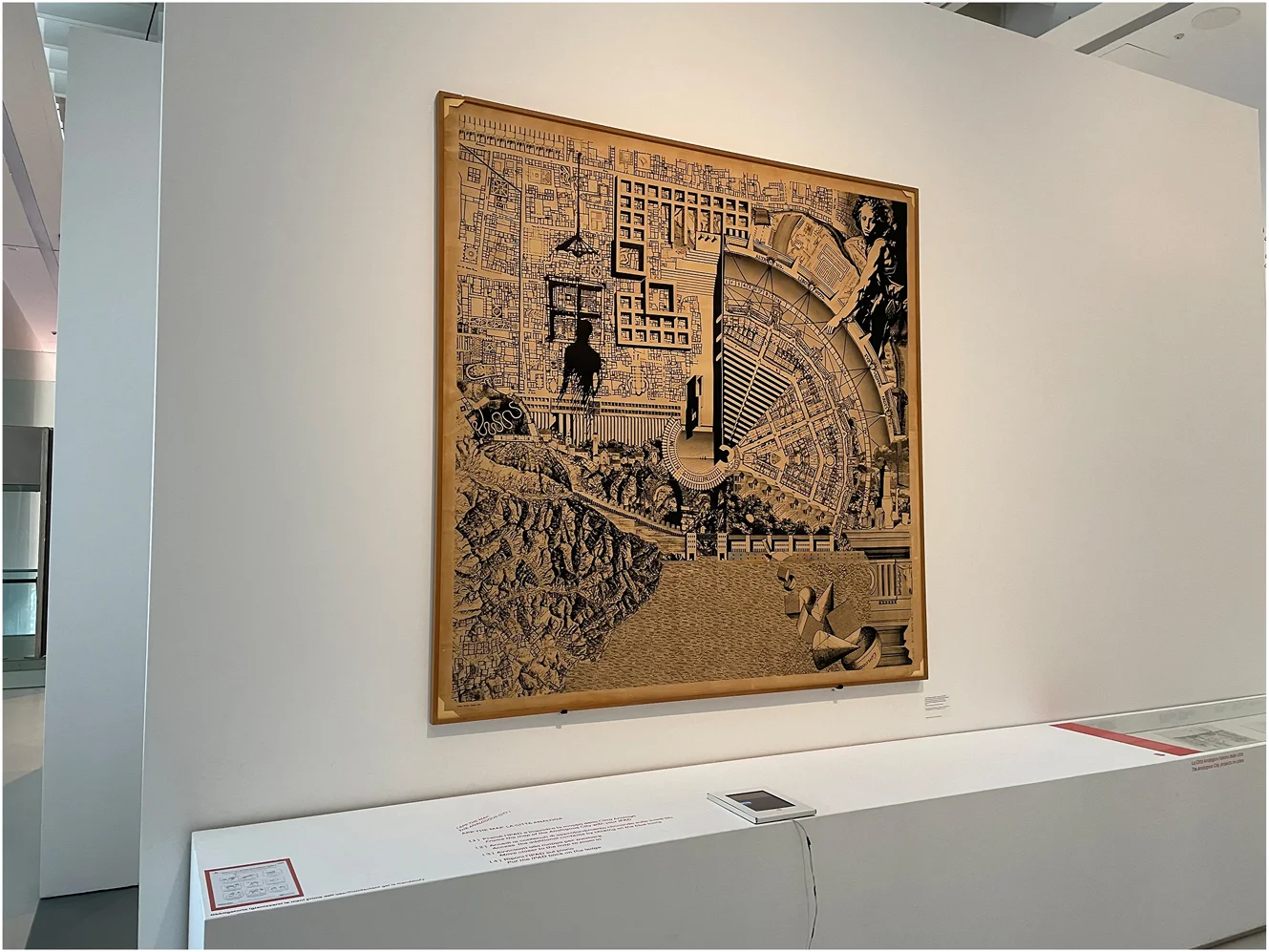
Installations provide a way to engage with Aldo Rossi’s Analogous City as an open and evolving space of interpretation. First conceived for the 1976 Venice Biennale with Eraldo Consolascio, Bruno Reichlin, and Fabio Reinhart (Ghirardo 2019, 16–23), the large collage combines drawings, references, and imagined architectural forms into a single, poetic composition. It is neither a plan nor a project in the traditional sense but rather a cartographic exploration shaped by resonance and association. Over time, the Analogous City has been studied and reproduced as a key expression of Rossi’s architectural imagination. However, when adapted as an installation, it reveals additional layers. Moving beyond its two-dimensional form, the work becomes an environment — something visitors can navigate physically and conceptually. These spatial versions invite engagement with its analogies, layers, and juxtapositions through movement in space. Instead of simply reproducing the collage, the installation opens new paths of interpretation, making the act of viewing itself part of the work’s meaning.
The Map of the Analogous City (Rodighiero 2015) was developed at EPFL as part of an exhibition at the Bonnefantenmuseum in Maastricht (Celant and Huijts 2015). It revisits Rossi’s collage through a curatorial and editorial approach focused on spatial reasoning. The project began with a close study of Rossi’s visual and textual references, including fragments from his notebooks, sketches, photographs, and publications. These elements were identified, collected, and assembled into a large-format printed map that expands and reframes the original panel. In this version, the Analogous City becomes an open archive — a network of references and associations. The editorial design emphasized the collage’s associative structure, enabling new relationships to emerge across its parts. Through its layout and visual clarity, the map invites viewers to explore the city’s logic as something fluid rather than fixed — encouraging reflection with Rossi’s ideas rather than about them. As Fabio Reinhart noted, the map is “an interpretation of the picture panel, a sort of re-invention within the framework of a new social and cultural reality” (Reinhart 2015). In this way, the Map of the Analogous City acts as a curatorial tool that renders architectural memory accessible through spatial exploration, while retaining the openness of the original work.
The Map of the Analogous City was also developed in digital form, enabling it to be presented in multiple exhibition contexts (Rodighiero 2022). At MAXXI, it appeared in the exhibition Aldo Rossi. L’architetto e le città (MAXXI 2021), where an interactive version allowed visitors to explore its internal network of references. Using touch-based navigation, viewers could follow visual links and recurring motifs drawn from Rossi’s notebooks and drawings. A year later, the digital installation was adapted for Aldo Rossi Digital, the museum’s online exhibition (MAXXI 2022), offering remote access and encouraging a slower, more reflective form of engagement. In both settings, the digital map transformed the collage into an exploratory environment, where viewers could navigate fragments, connections, and layered meanings. Instead of substituting for the physical installation, the digital version expanded its potential — inviting new forms of interaction while preserving the complexity and ambiguity at the core of the Analogous City.
Rossi’s installations invite interpretation rather than prescribe a single meaning. As Umberto Eco argues in The Open Work, some artworks derive their value from their capacity to support multiple readings, with meaning unfolding through the viewer’s active engagement (Eco 1989). John Dewey offers a complementary view: in Art as Experience, he describes how art becomes alive when it forms a unified event that reorganizes perception and draws the viewer into an active encounter (Dewey 1980). The Map of the Analogous City reflects these approaches. Its composition of drawn fragments — both real and imagined — does not offer a fixed narrative. Instead, it invites viewers into a process shaped by their own associations, memories, and spatial understanding. Each experience becomes a form of reconstruction, where meaning emerges through navigation and reflection. This openness aligns with Rossi’s view of architecture as a poetic and interpretive discipline. As Eco writes, open works “are brought to their conclusion by the performer at the same time as he experiences them on an aesthetic plane” (Eco 1989, 3). In this context, the performer is the visitor, who reads the map not as a finished object but as a space for ongoing interpretation.
The continuing reinterpretation of the Analogous City — across exhibitions, formats, and audiences — shows how installations can activate cultural heritage by reshaping how it is experienced. Whether printed, constructed, or digital, the work continues to evolve through each new presentation. These variations do not diminish Rossi’s legacy; they expand its relevance. Instead of fixing the past in place, the Analogous City keeps it in motion, creating a space where historical imagination, curatorial practice, and public engagement intersect. In this way, the installation functions not only as a site of preservation but as a space for reactivation. Rossi’s work thus contributes to a broader perspective on heritage — as something dynamic, negotiated, and performed over time.
Discussion
Understanding Aldo Rossi’s heritage requires attention to how it is continually shaped — through archival processing, curatorial design, and installation practice. These mediations do not simply preserve; they reconfigure. Rossi’s work has remained culturally resonant not because it was stabilized but because it was continually opened up to new readings and audiences. In what follows, we reflect on three modalities of mediation — archival, curatorial, and performative — drawing on theoretical perspectives that help us grasp the interpretive nature of heritage-making. Rather than isolating these modes, we consider how they interact and contribute to a dynamic process of cultural transmission.
The archive of Aldo Rossi, particularly the work done by MAXXI in structuring and cataloguing his materials, exemplifies how institutional memory is constructed. Drawing on Paul Ricoeur’s notion of refiguration, we can see this archival process not as passive preservation but as an active recomposition of meaning. The inventory of Rossi’s papers and drawings is not merely a finding aid — it is a narrative structure. Through choices about inclusion, categorization, and description, the curators at MAXXI shaped how Rossi’s intellectual world would be encountered. This editorial work mediates between raw traces and historical understanding, offering a curated map of Rossi’s legacy that remains open to reinterpretation.
Exhibitions, as shown in L’architetto e le città (2021) and its digital counterpart Aldo Rossi Digital (2022), move Rossi’s legacy from the archive into public view. Bruno Latour’s concept of mediation helps frame this transition. Exhibitions are not neutral stages — they transform the meanings of the materials they present. The scenography, thematic structure, and even navigation paths all contribute to how Rossi’s work is made legible to new audiences. The exhibitions at MAXXI created environments where visitors do not merely observe but engage, constructing their own paths through Rossi’s concepts and images. These curatorial acts do not simplify the work — they amplify its interpretive depth by situating it in contemporary discourse.
Installations, especially those involving the Analogous City, extend this curatorial logic into participatory space. Here, Umberto Eco’s theory of the open work becomes relevant. Rossi’s ideas are not transmitted in a closed form but made available for interaction and recomposition. Whether experienced in the museum or online, the installations invite audiences to navigate spatially and intellectually. Each engagement is different, shaped by the viewer’s background, interest, and movement. These works do not fix Rossi’s meaning; they activate it, allowing the past to resonate through acts of reading, walking, and interpretation.
Together, the archival, curatorial, and performative mediations of Aldo Rossi’s work demonstrate that heritage is not a matter of fixing meaning but of enabling its rearticulation. Each mode engages memory differently: the archive organizes and reframes, the exhibition composes and translates, and the installation activates and invites. Through these layered practices, Rossi’s legacy remains in motion — open to reconfiguration without losing its integrity. This dynamic view of heritage challenges traditional distinctions between conservation and interpretation. Instead of treating mediation as a secondary layer, we see it as constitutive of meaning itself. Rossi’s case reveals how cultural memory is shaped by those who curate, design, and experience it. Far from diminishing the past, these mediations expand its reach. They suggest a model of heritage not as a closed inheritance but as a collective, ongoing work of reactivation.
Conclusions
Aldo Rossi’s legacy endures through the ongoing work of mediation. From archival reconstruction to curatorial framing and spatial installation, each mode of engagement reshapes how his work is understood, accessed, and remembered. The archive, carefully cataloged and made public, offers more than a resource — it becomes a structure of thought. Exhibitions and installations extend this structure into embodied and digital spaces, creating encounters that are interpretive rather than didactic.
What emerges from these practices is not a singular portrait of Rossi but a living body of work open to reconfiguration. His architecture, deeply reflective and formally poetic, lends itself to this openness. As this study has argued, heritage does not reside in preservation alone. It is sustained through acts of reactivation — through choices made by archivists, curators, and viewers alike.
These reflections speak more broadly to the work of heritage institutions and digital curatorship. As collections move across physical and digital environments, the process of meaning-making becomes more visible and more distributed. Institutions are asked to design settings where memory can be assembled, mediated, and interpreted with care, while digital formats open new paths for participation and access. Rossi’s case suggests directions for future research, inviting further attention to how digital tools shape curatorial practice, how audiences engage with hybrid forms of display, and how mediation can support more open and adaptive understandings of the past.
In this light, the past is not simply kept — it is made present, again and again, through thoughtful engagement and creative interpretation.
References
- Burdick, Anne, Johanna Drucker, Peter Lunenfeld, Todd Presner, and Jeffrey Schnapp. 2012. Digital_Humanities. Cambridge, MA: MIT Press.
- Cameron, Fiona, and Sarah Kenderdine, eds. 2007. Theorizing Digital Cultural Heritage: A Critical Discourse. Cambridge, MA: MIT Press.
- Celant, Germano, and Stijn Huijts, eds. 2015. Aldo Rossi: Opera Grafica: Etchings Lithographs Silkscreen Prints. Cinisello Balsamo: Silvana Editoriale.
- Dewey, John. (1934) 1980. Art as Experience. New York: Perigee Books.
- Eco, Umberto. 1989. The Open Work. Translated by Anna Cancogni with David Robey. Cambridge, MA: Harvard University Press.
- Eisenman, Peter. (1966) 1982. “The Houses of Memory: The Texts of Analogy.” In The Architecture of the City. Cambridge, MA: MIT Press.
- Ghirardo, Diane. 2019. Aldo Rossi and the Spirit of Architecture. New Haven: Yale University Press.
- Latour, Bruno. 2005. Reassembling the Social: An Introduction to Actor-Network-Theory. Oxford: Oxford University Press.
- MAXXI. 2002. “Centro Archivi di Architettura.” MAXXI.
- ———. 2004. “Aldo Rossi. L’Archivio Personale.” MAXXI.
- ———. 2021. “Aldo Rossi: L’Architetto e la città.” MAXXI.
- ———. 2022. “Aldo Rossi Digital.” MAXXI.
- ———. 2023. “Collezione di architettura.” MAXXI.
- Nora, Pierre. 1989. “Between Memory and History: Les Lieux de Mémoire.” Representations 26: 7–24.
- Paul, Christiane. 2015. Digital Art. 3rd ed. London: Thames & Hudson.
- Reinhart, Fabio. 2015. “From Picture Panel to City-Map.” In The Analogous City, the Map. Lausanne: EPFL Archizoom.
- Ricœur, Paul. 1977. Memory, History, Forgetting. Translated by Kathleen Blamey and David Pellauer. Chicago: University of Chicago Press.
- Rodighiero, Dario. 2015. The Analogous City, the Map. Lausanne: EPFL Archizoom.
- ———. 2022. “Extending Museum beyond Physical Space: A Data-Driven Study of Aldo Rossi’s Analogous City as a Mobile Museum Object.” International Journal for Digital Art History 6: 3.34–3.47. https://doi.org/10.11588/DAH.2021.6.77681.
- Rossi, Aldo. (1966) 1982. The Architecture of the City. Translated by Diane Ghirardo and Joan Ockman. Edited by Peter Eisenman. Cambridge, MA: MIT Press.
- ———. 1999. I Quaderni Azzurri. Edited by Francesco Dal Co. Milano: Electa Editrice.
- Smith, Laurajane. 2006. Uses of Heritage. 1st ed. London: Routledge.
- UNESCO. 1972. Convention Concerning the Protection of the World Cultural and Natural Heritage.
- ———. 2009. “Charter on the Preservation of the Digital Heritage.”
- Zhara Buda, Carla, Veronica Vignoli, Angela Parente, and Caterina Torrini. 2020. L’archivio Aldo Rossi nelle collezioni del MAXXI architettura: L’Inventario. Roma: MAXXI.