Collective Care: VISAP ’25 Catalog
Çay, Damla, Dario Rodighiero, Weidi Zhang, Martina R. Fröschl, Peter Mindek, and Beatrice Gobbo. 2025. Collective Care: VISAP ’25 Catalog. IEEE VIS Conference, Vienna. https://visap.net/2025/downloads/visap-2025-booklet.pdf.
Care is easy to recognize on a personal level, especially when it appears in the small, attentive gestures woven into daily life. We see it when someone nurses a sick friend, tends a garden, or stitches a quilt by hand. Each act is marked by presence, patience, and a quiet commitment expressed through attention. It takes form through deliberate actions that often go unnoticed yet carry enduring meaning. But what does care look like when it scales up across complex systems where the risks are greater, the people more dispersed, and the consequences harder to trace?
This year at VISAP, we ask what it means to approach visualization not only as an academic and professional practice, but as an act of collective care.1 How can we design visualizations that not only represent but protect, nurture, and respect the environments and communities woven into datasets? What practices emerge when we visualize data with empathy, thoughtfulness, and intention? In a time when data shapes public perception, national policy, and personal identity, centering care in our visual methods is not merely desirable but essential.
In the world of data visualization, “care” is not a term we use often. We tend to speak of clarity, insight, and impact. We use words that suggest objectivity and utility. Yet as datasets expand to encompass our communities and algorithms increasingly shape our societies, visualization itself becomes a cultural and ethical act. It determines how we see one another and the systems surrounding us. In this light, the role of the designer reaches beyond aesthetics or communication, demanding a deeper engagement with social consequence and ethical responsibility. Acknowledging this role means accepting that visual choices can influence narratives, reinforce or challenge bias, and shape collective understanding in enduring ways.
In contemporary digital culture, data no longer stands as a static artifact but as a living archive that holds memory, identity, and collective history. Biometric scans, environmental sensors, and geotagged images, nearly every facet of human life is now captured and transformed into data. Giorgia Lupi reminds us that working with data can reveal more than patterns; it can expose the human connections that shape them. Her approach asks us to see data not as detached or abstract, but as something deeply rooted in the stories, emotions, and lived experiences of individuals and communities.
Within this context, data visualization is not merely a cosmetic tool but a critical process of reinterpretation, contextualization, and communication. It becomes a way to narrate our datafied collective histories and to shape how communities become legible. Professionals working with data act as communicators and storytellers. Through visual, sonic, spatial, or even olfactory forms, they translate abstraction into experience, something we can sense, question, and connect with. In doing so, they turn datasets into living archives and visualizations into spaces for reflection, empathy, and care.
Maria Puig de la Bellacasa describes this orientation as “matters of care,” a call to move beyond surface concern into the dense, affective work of maintenance, repair, and relationality. It invites us to care for our practices as we care for one another, not efficiently, but attentively and critically. Within this framework, care is not sentimental; it is relational, collective, and ethical. It asks us to take responsibility for the data we engage with and to honor the lives, communities, and ecosystems it represents. To visualize with care is to visualize with empathy, to expose environmental harm, surface silenced narratives, reveal shared experiences, and confront the structural biases that persist unseen.
Building on this understanding of visualization as a relational and embodied practice, we imagine a future where data visualization serves as a process of restoration, connection, and long-term social resilience. This vision invites us to treat data as a space for healing, resistance, and belonging. It calls for visual practices that sustain the well-being of both environments and the communities most affected by them. These same values must also shape how we collaborate with emerging technologies, especially as we co-create meaning with algorithmic systems and AI, shaping how data is interpreted, narratives are generated, and decisions are informed by machine learning tools. Such collaborations raise urgent questions about authorship, agency, and ethics: Whose data is used? Whose voices are amplified or silenced? A care-centered approach to AI foregrounds transparency, accountability, and relational design, prioritizing systems that are socially responsible and culturally attuned.
The selected papers presented at VISAP ’25 embody Collective Care through distinct yet interwoven approaches to visualization. Psychomare translates psychoanalytic theory into an immersive experience, turning nightmares into symbolic data that invite emotional reflection and empathy. In Tides of Memory, digital mourning becomes a spatial monument, preserving collective grief drawn from ephemeral traces on social media. The Knowledge Cosmos reimagines scientific literature as a navigable universe, fostering curiosity and cross-disciplinary discovery as acts of epistemic care. Simulacra Naturae entwines biological computation with generative ecosystems, decentering human agency and emphasizing care for nonhuman intelligences. You Only Have Seven Seconds reframes participatory data as an intimate archive, transforming whispered recollections into shared memory through AI-driven imagery. Finally, Living Library of Trees maps the Arnold Arboretum as a living archive of environmental and curatorial labor, positioning visualization as both analytical method and ecological ethics. Together, these works illuminate care as a methodological, emotional, and ecological principle, reshaping how visualization connects people, data, and the worlds they inhabit.
The selected pictorials at VISAP ’25 expand the idea of Collective Care through sensory, material, and participatory design. Winds Through Time turns paleoclimate data into a tactile landscape, merging physicalization and visualization to make the ancient dynamics of wind and ice perceptible through touch and play. Rejecting Colonial Practices in Data Storytelling challenges dominant epistemologies in data journalism, advancing decolonial visualization practices grounded in local vernaculars and collective authorship. Kaleidoscope of Thoughts translates cognitive turbulence into an immersive audiovisual environment, weaving multilingual voices and mirrored projections into a shared meditation on emotion, resilience, and empathy. AI-Generated Images for Representing Individuals explores how portraiture in data communication exposes the ethical tensions between empathy and representation, prompting reflection on the affective power of visual design. Balaton Borders reimagines ecological data as ceramic tableware, transforming environmental monitoring into the ritual of shared meals where care becomes an embodied practice. Finally, The Fire We Share reconfigures wildfire data as a living archive, layering ecological, political, and emotional narratives into plant-inspired data forms that evoke repair and remembrance.
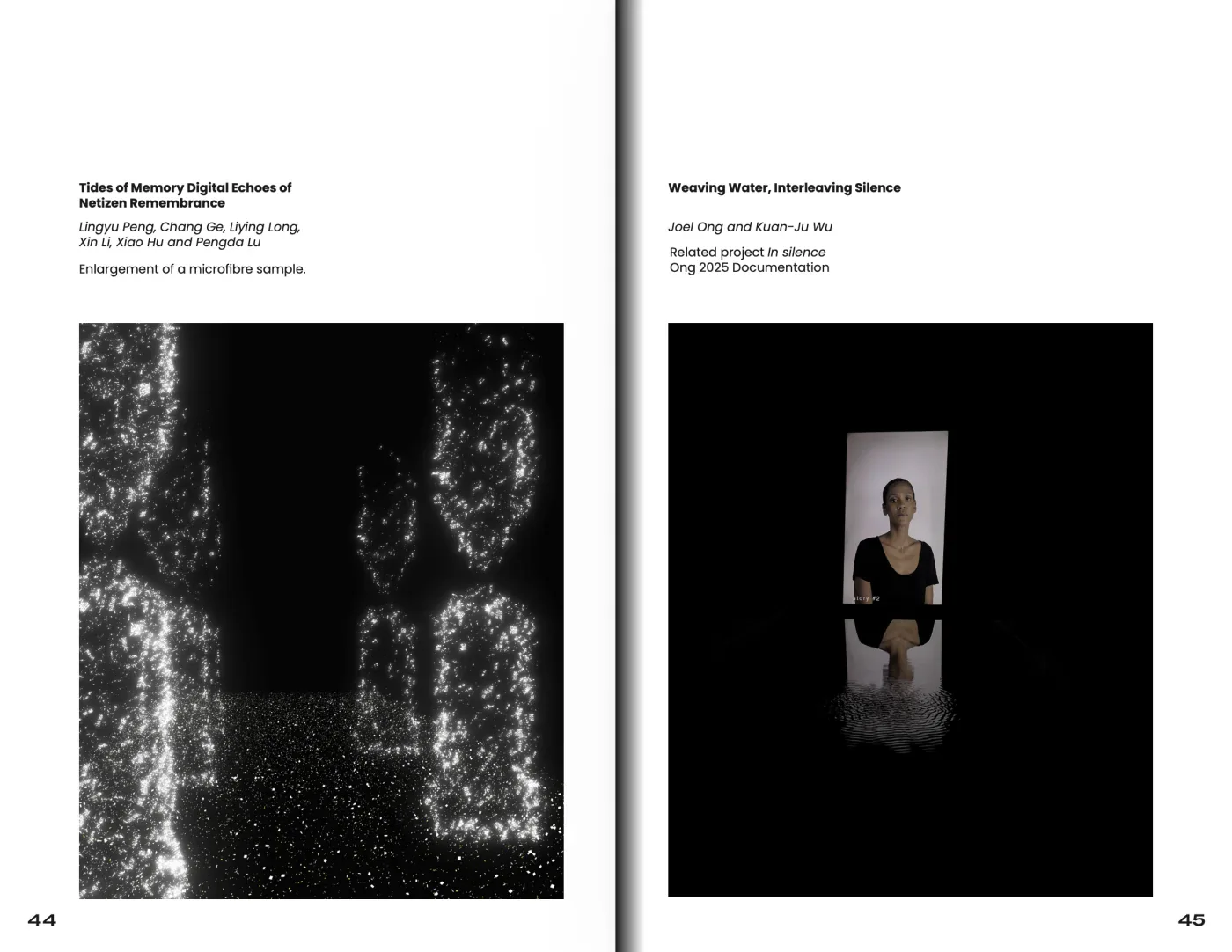
The selected artworks extend Collective Care into lived, participatory spaces where data becomes touch, ritual, and relation. Tides of Memory materializes online mourning as walkable monuments that weave personal authorship with collective remembrance. Damaged Leaf Herbarium and Dataset reframes pest-scarred foliage as a cared-for dataset, turning acts of preservation, scanning, and algorithmic labeling into gestures of shared custodianship. Knowledge Cosmos stages discovery as embodied navigation, inviting participants to traverse a universe of seventeen million papers. Simulacra Naturae entwines brain organoid signals with agent ecologies, composing a hybrid environment that shifts attention from human control to multispecies attunement. The Secret Life of Collective Plastic Microfibre Traces transforms microfiber evidence into collective sensing and mapping, linking garments to planetary residue. Empathic Growth connects human GSR data with plant biosignals to prototype cross-species empathy. A Walled City turns personal images into a dense, evolving architecture of memory and relation, while You Only Have Seven Seconds gathers whispered recollections into a cinematic archive of shared remembrance. Polyurethane, cellulose… urea-formaldehyde performs a chemopoetics of fabrication residue, sonifying SEM micrographs to reveal invisible exposures. Distance Unknown weaves currency into a physical visualization of migration costs, linking policy discourse with individual testimony. FeltSight reorients perception from vision to touch through haptic, mixed-reality sensing, while Weaving Water, Interleaving Silence uses water to explore the ethics and limits of affect recognition. Finally, Balaton Borders Tableware brings ecological data to the table, where disruptions in use become cues for reflection and care.
This year’s selection approaches Collective Care as an evolving act of holding memory, tending to the more-than-human world, and creating spaces for empathy through sensory and affective experience. They question how we represent others, cultivate relational practices, and sustain accountability within complex systems. Across these varied approaches, care becomes a shared lens, one that sustains connection between data, beings, and the worlds they represent.
This catalog reissues the curatorial statement of VISAP ’25 as it accompanies the exhibition during the IEEE VIS Conference in Vienna. In revisiting the text, we recognize how Collective Care continues to resonate, not only through the selected papers, pictorials, and artworks, but also through the shared effort that sustains them. From the labor of students and organizers to the generosity of institutions, this exhibition embodies care as collaboration, attention, and presence. Our gratitude extends to the IEEE VIS conference and organizing committee, to the University of Applied Arts Vienna for hosting, to the Moholy-Nagy University of Art and Design for their support, and to the many contributors whose dedication made VISAP ’25 possible.
As we gather in Vienna, this year’s theme, Collective Care, reminds us that data visualization is not only a tool for analysis but a gesture of attention, empathy, and shared responsibility. We invite you to engage with this exhibition as an act of care: attentive, relational, and deeply human.
General Chairs
Damla Çay, Moholy-Nagy University of Art and Design
Dario Rodighiero, University of Groningen
Weidi Zhang, Arizona State University
Exhibition Chairs
Martina R. Fröschl, University of Applied Arts Vienna
Peter Mindek, Nanographics GmbH
Design Chair
Beatrice Gobbo, Politecnico di Milano
-
This is an extended edition of a text that appeared in Nightingale in June 2025: Çay, Damla, Dario Rodighiero, and Weidi Zhang. 2025. “Visualizing as a Form of Collective Care.” Nightingale, June. https://nightingaledvs.com/visualizing-as-a-form-of-collective-care/. ↩