Peirce Interprets Peirce: Digitization, Automation, and Interpretation in Charles Peirce’s Manuscripts
Adamou, Alessandro, Sebastian Feil, Davide Picca, Carlo Teo Pedretti, Dario Rodighiero, and Lorenzo Zangari. 2026. “Peirce Interprets Peirce: Digitization, Automation, and Interpretation in Charles Peirce’s Manuscripts.” In AIUCD.
This paper presents a workflow-oriented approach to interpreting Charles S. Peirce’s manuscripts through computational methods. Building on recent high-resolution digitization of the Peirce archive, it combines probabilistic transcription, text analysis, semantic modeling, and data visualization to examine how automation reshapes archival access and interpretive practice. Rather than treating computation as a means of producing static objects, the workflow frames digital archives as mediating research infrastructures that expand the interpretive space while preserving scholarly judgment. By approaching Peirce’s manuscripts as multimodal objects—integrating text, diagrams, and revisions—the paper reflects on philosophical patterns, continuities, and tensions that become visible only at corpus scale. The contribution situates itself within current Digital Humanities debates on openness, mediation, and interpretive accountability, and argues that digitization and automation function as enabling conditions for shared, reflexive interpretation.
Introduction
Charles S. Peirce’s philosophy has exerted a lasting influence across a wide range of disciplines, underscoring his foundational role in American pragmatism and scientific methodology (Atkin 2013; Sheriff 1989; Liszka 2021; Mazur and Sticksel 2021; Cristalli 2022; Strand 2022; Burch 2021; Zhang 2019; Jariah et al. 2022). While Peirce’s published writings have been extensively studied, a large body of his unpublished manuscripts, vital for a complete picture of his thought, remains comparatively underexplored.
The comparatively limited engagement with Peirce’s manuscripts is not due to a lack of scholarly interest but rather to long-standing challenges related to organization and access. Foundational efforts such as Richard Robin’s catalog and the work of the Peirce Edition Project and the Institute for Studies in Pragmaticism provided essential tools for navigating such an extensive corpus (Robin 1967; Peirce Edition Project 2021). These initiatives—together with later work, among others (e.g., Bella et al. 2016; Keeler 2020b; Keeler and Kloesel 1997)—established a scholarly infrastructure that remains indispensable. Given the sheer volume of Peirce’s manuscripts, however, these approaches were somewhat constrained by publishing technologies and formats that were not designed to support large-scale comparison or exploratory analysis.
An important step toward broader access was John Deely’s 1994 digitization of the eight-volume Collected Papers of Charles S. Peirce, which enabled full-text search and digital consultation of Peirce’s published corpus (Peirce 1994). Despite its significance, this effort inherited the editorial and structural limitations of the Collected Papers, including the non-chronological and selective thematic organization of Peirce’s writing, and media constraints resulting from the fact that in its original edition as a CD-ROM for the MS-DOS operating system, the edition omitted aspects of the visual content (including the use of color) found in the manuscripts. As a result, the content of manuscripts—many of which contain diagrams, revisions, marginalia, and color-coded reasoning—remains only partially accessible.
Recent developments in technologies open up new possibilities for engaging with Peirce’s manuscripts. High-resolution re-digitizations of original documents address the material issues related to deteriorating paper and insufficient earlier scans, particularly with respect to diagrammatic and chromatic features (Everett 2021; Harvard University, n.d.; Keeler 2020a). At the same time, advances in Natural Language Processing (NLP) allow Peirce’s corpus to be studied at a scale and level of complexity previously unattainable through automated transcription, annotation, and Large Language Models (LLMs).
Building on the aforementioned developments, this paper proposes a workflow-oriented approach to Peirce’s manuscript corpus. By combining machine-assisted transcription, semantic structuring, data visualization, and the ability of LLMs to generalize across heterogeneous tasks, the text reflects on how current technologies reshape archival workflows and open new interpretive perspectives on Peirce’s work within the framework of a four-year funded research project. In doing so, the paper situates itself within current Digital Humanities debates on openness, mediation, and interpretive accountability, and argues that digitization and automation should be understood not as endpoints, but as conditions for the enhancement of thorough philosophical inquiry.
Background
Scholarship on Charles S. Peirce has long emphasized the centrality of his semiotic theory, particularly his Universal Categories and triadic sign relations—icon, index, and symbol—as foundational to his philosophical and scientific thought (Peirce 1955; Peirce 1960, 1977). Extensive work in semiotics and philosophy has explored these concepts as key to understanding perception, reasoning, and meaning-making processes (Pape 1990, 2015; Liszka 1996; Nöth 2016; Sonesson 2013; Stjernfelt 2007; Farias and Queiroz 2017; Feil 2024). Within this literature, Peirce’s emphasis on diagrammatic reasoning—including diagrams and existential graphs—has been recognized as a distinctive feature that foregrounds the material and visual dimensions of thought.
In addition, several recent studies have addressed the multimodal character of Peirce’s work, highlighting the analytical relevance of diagrams, graphical structures, and non-linear reasoning (Roberts 2009; Engel et al. 2012; Bateman 2018; Pflaeging et al. 2021). Research in semiotics and Digital Humanities has further shown how diagrams function as complex semiotic resources, enabling forms of reasoning that cannot be fully captured through linear text alone (Hiippala and Bateman 2022; Bellucci and Pietarinen 2024). Despite these advances, most analyses remain grounded in close reading or theoretical interpretation, with comparatively limited application of computational methods to large manuscript corpora.
In parallel, Digital Humanities has developed a wide range of computational approaches for the analysis of historical corpora, demonstrating their capacity to identify stylistic patterns and conceptual recurrences across large collections (Jockers 2013; Underwood 2019). Yet approaches that combine such methods with an explicit semiotic framework remain uncommon, particularly when applied to heterogeneous manuscript corpora that integrate textual, graphical, and material features (Ciula et al. 2023). In the case of Peirce, large-scale computational studies that engage directly with both his semiotic theory and his manuscript corpus remain scarce, as existing work tends to privilege either theoretical interpretation without computational mediation or computational analysis without sustained engagement with Peirce’s conceptual apparatus.
Taken together, the state of the art points to a structural gap. While Peirce’s semiotic theory and diagrammatic reasoning have been extensively studied, and while computational methods in Digital Humanities have matured, few approaches integrate these strands within a coherent methodological workflow. Addressing this gap calls for frameworks that treat digitization, modeling, and visualization not as endpoints, but as enabling conditions for interpretive openness, capable of supporting relational inquiry across complex and multimodal manuscript corpora.
Methods
This section presents the project workflow as a methodological framework for engaging with large, heterogeneous manuscript corpora. Rather than a sequence of technical steps, the workflow is understood as a set of research decisions that shape how Peirce’s manuscripts become legible, comparable, and interpretable. Digitization, automation, and visualization are treated as mediating practices that condition inquiry (see Figure 1). The workflow builds on the recent large-scale digitization of Peirce’s manuscripts at Harvard’s Houghton Library, accessible via HOLLIS and IIIF services, providing a high-resolution corpus anchored in archival sources.
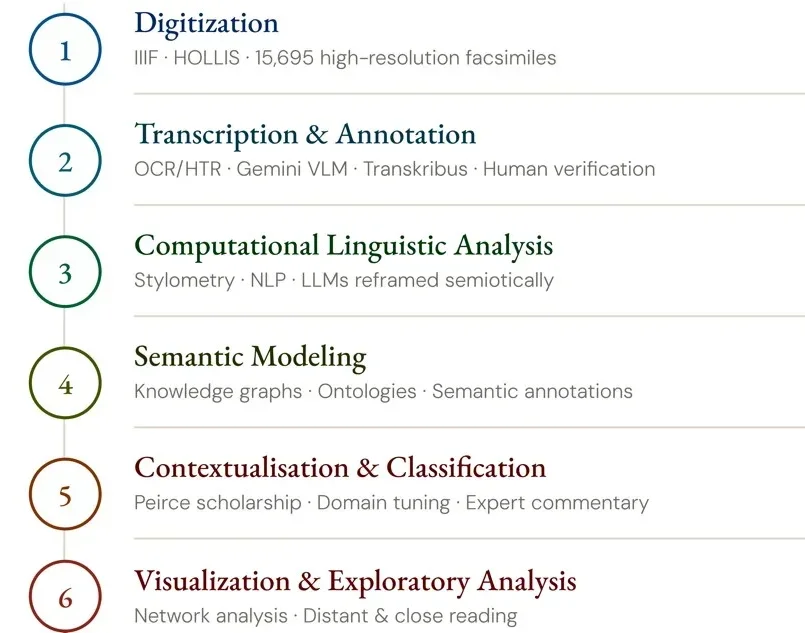
Automatic transcription and annotation. Transcription and annotation are approached as interpretive processes rather than neutral conversions. The recognition of characters (OCR) and of handwritten text (HTR) are treated as probabilistic techniques producing provisional texts that require human verification, particularly given the presence of revisions, marginalia, diagrams, and heterogeneous writing practices. Annotation and metadata creation actively structure the corpus, shaping how manuscripts can be queried and compared. Exploratory analyses at this stage focus on semantic and thematic regularities, while acknowledging the evolving nature of the data.
Computational linguistic analysis. Computational linguistic methods are employed as heuristic instruments for exploring Peirce’s writings at scale. Building on earlier stylometric work, the workflow combines frequency analysis, syntactic parsing, and machine-learning–based representations to surface recurring concepts. These methods are not used for exhaustive classification, but to generate hypotheses and points of attention. Computational abstractions are explicitly aligned with Peirce’s semiotic framework, ensuring continuity with concepts such as representamina and sign relations. Furthermore, we aim to reframe LLMs from a semiotic perspective, shifting the focus from performance to underlying sign processes. This enables a two-way analysis: examining how such models engage with Peirce’s philosophical vocabulary, and exploring how Peirce’s triadic framework can inform their generative capabilities.
Semantic modeling and knowledge representation. Semantic modeling structures emerging insights through relational representations rather than fixed taxonomies. Knowledge graphs are used to articulate connections among concepts, manuscripts, and semiotic categories. Ontologies will be adapted to accommodate Peirce’s distinctions while remaining open to revision. Semantic annotations link textual and graphical elements across the corpus, supporting traversal and comparison among them.
Contextualization and classification. Machine-generated output from all stages of the project is contextualized and assessed relative to the existing body of published material and the current state and requirements of Peirce scholarship. This entails the tuning of machine-generated output according to established knowledge about major Peircean themes, as well as the preliminary commentary on established knowledge within the Peirce community according to material made available by and findings generated in the project.
Visualization and exploratory analysis. Visualization is treated as an exploratory interpretive practice rather than an explanatory endpoint. Techniques from cultural analytics and network analysis provide orientation within the corpus, making patterns and anomalies perceptible while preserving access to manuscript sources. Visualizations support movement between distant and close reading, with design choices emphasizing transparency, legibility, and traceability. In this sense, visualization complements textual and semantic analysis as a mediating scholarly tool, without claiming interpretive authority.
Preliminary Results
Six months into the project, the exploratory work conducted demonstrates the feasibility and scholarly value of integrating semiotic theory with computational analysis for the study of Peirce’s manuscripts. An earlier pilot stylometric study based on a selected subset of manuscripts transcribed using Transkribus showed that automated methods can reliably surface recurring conceptual and rhetorical patterns across heterogeneous documents (Kahle et al. 2017). In particular, the analysis highlighted Peirce’s recurrent use of concepts such as “habit” and characteristic configurations of abductive reasoning, while maintaining a low transcription error rate (Picca et al. 2023). These results indicate that probabilistic transcription and text-based modeling can support large-scale exploration of Peirce’s corpus while remaining sensitive to his philosophical vocabulary and argumentative structures.
Building on this pilot, the full set of Peirce manuscripts digitized by Harvard’s Houghton Library has since been processed through the project transcription pipeline. From the IIIF Manifests of 233 manuscript items made available via the Harvard HOLLIS system, 15,695 high-resolution facsimiles were retrieved, after automatically excluding blank pages.
A targeted evaluation was conducted on approximately 200 manuscript pages sampled across five Peircean manuscripts of different periods and content types. On a shared 20-page test set, Gemini was compared with a Transkribus PyLaia model fine-tuned on 80 manually transcribed pages of the same hand. Gemini reached 2.36% CER and 4.41% WER (strict), while the fine-tuned PyLaia model reached 4.98% CER and 13.95% WER. The gap between character-level and word-level accuracy for PyLaia indicates that even a dedicated fine-tuned HTR system produces locally plausible but lexically unstable output on Peirce’s handwriting, whereas the VLM maintains consistency at word level. These results position zero-shot VLMs as a reasonable production route for large-scale transcription of the archive, while preserving the need for philological verification on contested passages.
The manuscript pages were then transcribed zero-shot with Google Gemini Flash 3. In a post-processing phase, an inline diplomatic markup scheme for TEI P5 has been employed, with the goal of preserving authorial revisions (deletions, insertions, substitutions). The resulting machine-generated corpus now provides a homogeneous basis for corpus-scale analyses across Peirce’s archive.
Subsequent studies extended this line of inquiry to the visual and multimodal dimensions of the manuscripts. Computational pipelines developed within the project enabled the extraction and evaluation of visual features from Peirce’s diagrams, with a particular focus on Existential Graphs (Pedretti et al. 2025, forthcoming). Using Vision–Language Models, this work assessed the capacity of contemporary systems to recognize diagrammatic forms and visual regularities.
Peirce claimed that “all necessary reasoning is diagrammatic” (CP 5.162) and described his visual logic system, the Existential Graphs, as “moving pictures of thought” (CP 4.8). His manuscripts embody this conviction in pages where text and visual elements intertwine, employing as many as four colors to make critical logical distinctions (Keeler 2020a). The manuscript page is a single semiotic surface that conventional printed editions have rendered only partially (Keeler 2020b). On the full digitized corpus, a CLIP-based classifier trained on 1,317 manually annotated pages identified 1,519 pages (9.7%) containing visual elements, concentrated in the Logic and Mathematics categories; the density peaks in the 1895–1899 period, with 50.6% of Logic pages and 92.3% of Mathematics pages containing diagrams, in correspondence with Peirce’s intensive development of the Existential Graphs (Pedretti et al. 2025).
Machine-generated outputs (transcriptions, diagram detections, classifications) are anchored on the IIIF canvas of each manuscript page through the Web Annotation Data Model. Each bounding box produced by YOLOv8m layout segmentation becomes an annotation linking a canvas region to a semantic class; 1,139 diagram and 874 text-block boxes were annotated across 443 pages for training (see Figure 2). The IIIF Manifest thus becomes an editorial surface where diagrams, logical notation, sketches, and other visual elements sit alongside the transcription, without altering the underlying facsimile.
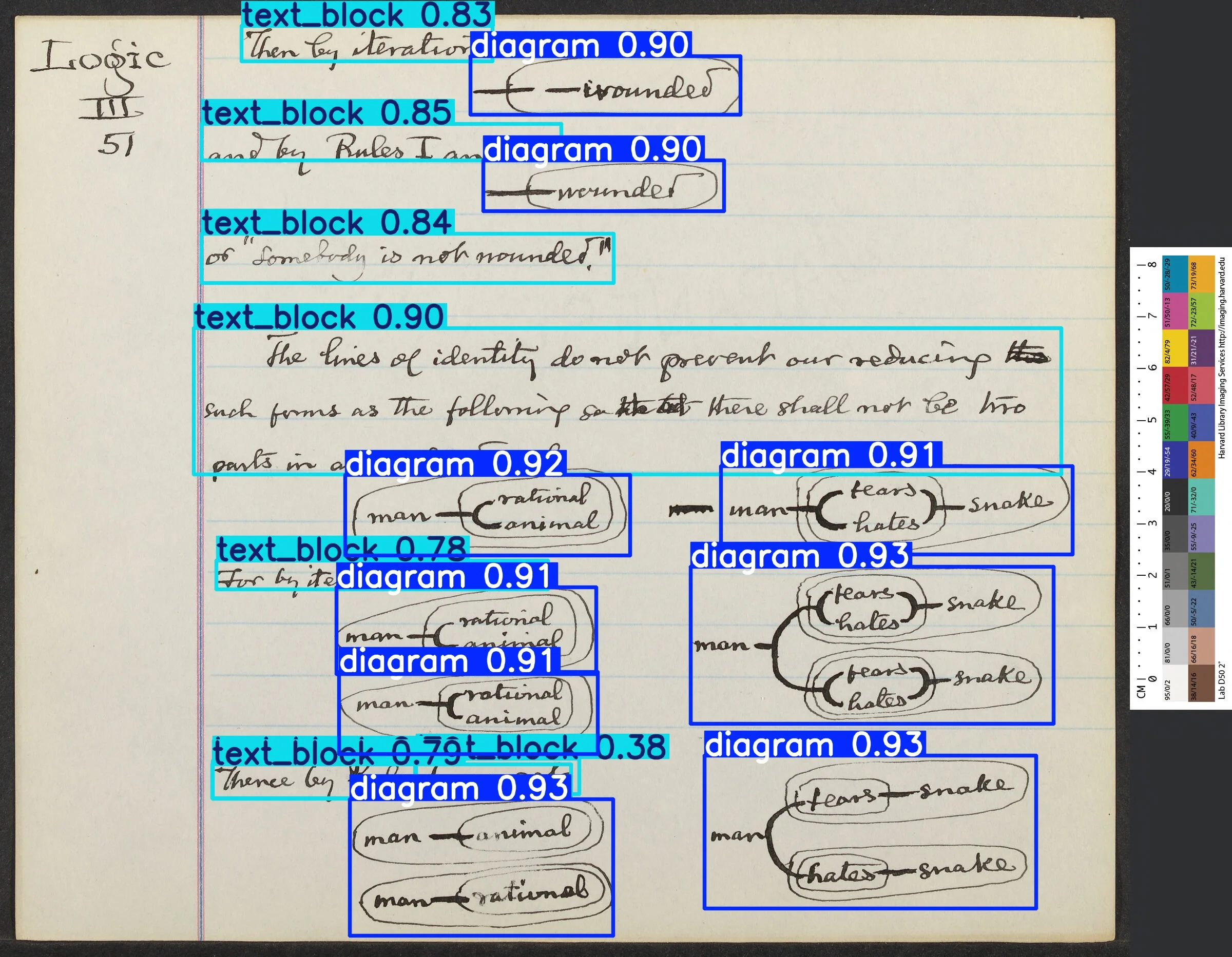
Moreover, testing five Vision–Language Models on 27 manually annotated Existential Graphs covering Alpha and Beta variants, the results show strong performance at the morphological level (counting cuts, lines, spots) and at the relational level (containment, connection), but systematic failure at the representational level, where the diagram must be read as a logical formula (Pedretti et al., forthcoming). Even when prompts stated Peirce’s endoporeutic (from the outside to the inside) reading procedure, the models produced errors of scope and negation, reading “Some man is not wounded” as “No man is wounded” or collapsing ∃y∀x into ∀x∃y.
This empirical gap is further clarified by theoretical work examining the relationship between semiotics and large language models (Picca and Zangari, forthcoming). That analysis situates contemporary AI systems within a semiotic perspective, showing how their pattern-based operations intersect with, but remain distinct from, Peirce’s account of sign processes and reasoning. Read together, the results suggest that computational systems can effectively support the organization, comparison, and exploration of Peirce’s manuscripts, while interpretive reasoning remains anchored in semiotic analysis and philosophical judgment.
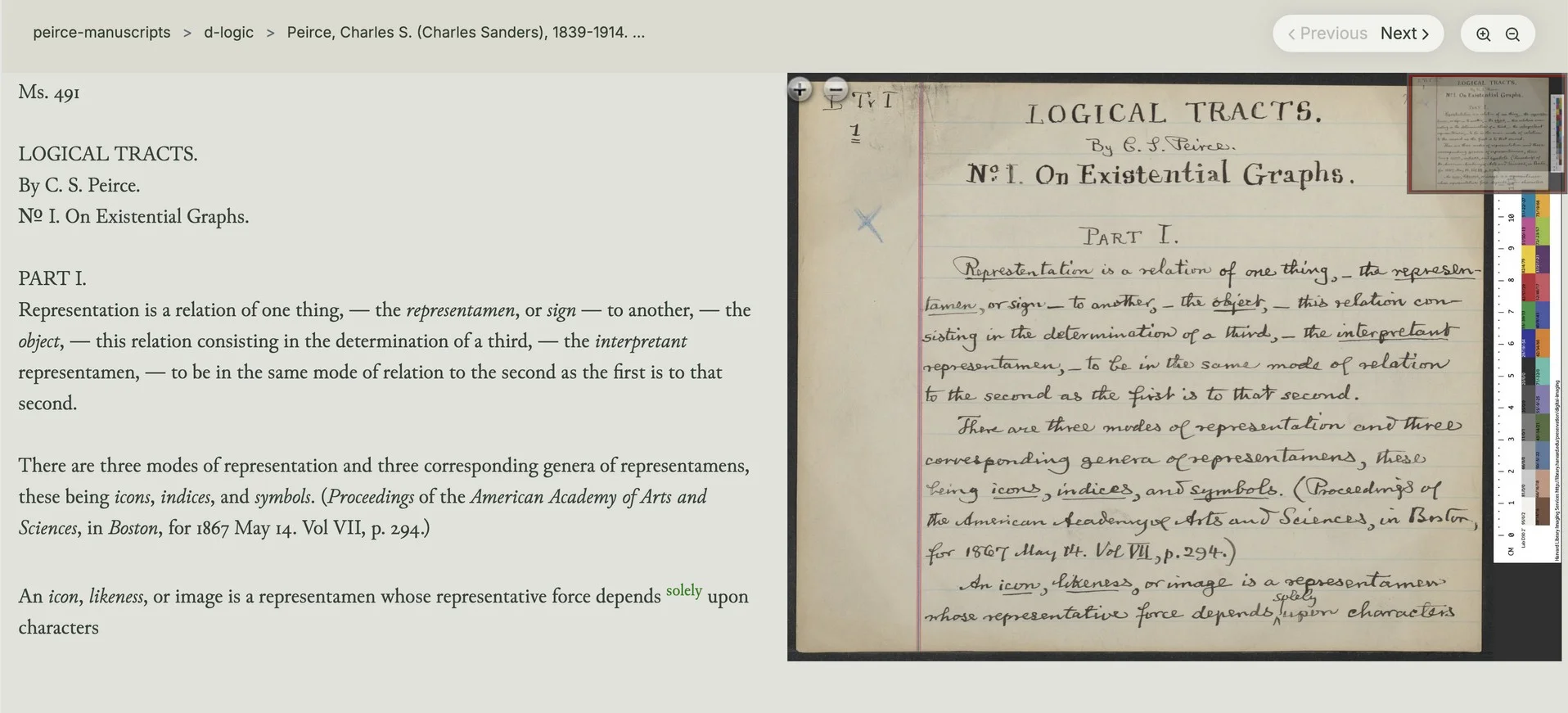
A first public prototype of the resulting digital edition1 has been developed using TEI Publisher v10 as a platform. Each manuscript page is rendered alongside its IIIF facsimile, with authorial revisions resolved interactively from the underlying TEI markup (see Figure 3). The prototype serves a double purpose: as a scholarly access point to the transcribed corpus, and as a testbed for further layers—e.g., critical apparatus and ontology-driven annotations linking textual and diagrammatic elements—that will be integrated in the subsequent phases of the project. Moreover, by making the edition available at this intermediate stage the transcribed material is exposed as an object of scholarly verification rather than as a black-box output, allowing domain experts to inspect, annotate, and eventually correct this baseline.
Discussion
This project addresses a scholarly public composed of researchers, students, editors, and advanced readers engaged with Peirce’s work. Public engagement is understood here as the creation of shared research infrastructures that enable exploration, comparison, and critical dialogue. By emphasizing access to manuscript materials, traceability of analytical transformations, and openness of methodological choices, the workflow supports forms of engagement grounded in reuse and collective interpretation.
The workflow also brings into view a set of methodological conditions that shape interpretation. Automated transcription produces variable results across manuscript types, handwriting styles, and material conditions, leading to differentiated data quality within the corpus. Computational models highlight recurring and statistically prominent patterns, while less frequent or ambiguous elements require careful interpretive attention. Framing LLMs as semiotic machines (Picca 2025) shifts us away from an intentional-stance view that treats them as quasi-psychological agents (Shanahan 2024). Instead, it allows us to describe them as systems that model sign relations, rather than as devices that merely recombine surface linguistic forms through statistical regularities. In a Peircean context, this shift motivates the development of semiotic-informed LLMs (explicitly aligned with triadic sign relations), and it frames their outputs as operational support for archival inquiry (e.g., chronological dating, while leaving interpretive judgment anchored in the manuscripts). Semantic modeling and visualization organize relations through formal structures and visual abstractions, which guide reading by foregrounding certain connections. These characteristics situate interpretation within an iterative process, where analytical results remain connected to manuscript sources and open to revision.
Within this framework, machine learning models contribute to archival inquiry by supporting classification and dating practices. Model-assisted clustering and comparison offer new perspectives on existing manuscript classifications, including those established by Robin, by revealing affinities and structural regularities across the corpus. Stylometric, semantic, and contextual signals provide additional evidence for situating manuscript pages in time, enriching historical and philological analysis. In these applications, AI serves as a tool for orienting scholarly investigation, extending the range of questions that can be asked while remaining embedded in interpretive practice.
Conclusion
This paper has proposed a workflow for engaging with large, heterogeneous manuscript corpora that integrates digitization, modeling, and visualization as mediating research practices. Designed around interpretive openness and traceability, the workflow is intended to be transferable to similar archival contexts in which textual, visual, and material features intersect. In the second phase of the project, training language models on manuscript-level evidence to support the interpretation of Peirce’s published writings offers a promising direction for exploring how computational methods can extend, rather than replace, scholarly reading.
References
- Atkin, Albert. 2013. “Peirce’s Theory of Signs.” In The Stanford Encyclopedia of Philosophy, edited by Edward N. Zalta. https://plato.stanford.edu/entries/peirce-semiotics/
- Bateman, John. 2018. “Peircean Semiotics and Multimodality: Towards a New Synthesis.” Multimodal Communication 7.
- Bella, Michela, Giovanni Maddalena, and André De Tienne. 2016. “What Is Happening to the Peirce Project?” European Journal of Pragmatism and American Philosophy 8 (2). https://doi.org/10.4000/ejpap.664
- Bellucci, Francesco, and Ahti-Veikko Pietarinen. 2024. “Existential Graphs: History and Interpretation.” In The Oxford Handbook of Charles S. Peirce (online), edited by Cornelis de Waal. Oxford: Oxford Academic. https://doi.org/10.1093/oxfordhb/9780197548561.013.16
- Burch, Robert. 2021. “Charles Sanders Peirce.” In The Stanford Encyclopedia of Philosophy (Summer 2022), edited by Edward N. Zalta. Stanford: Metaphysics Research Lab, Stanford University. https://plato.stanford.edu/archives/sum2022/entries/peirce/
- Ciula, Arianna, Øyvind Eide, Cristina Marras, and Patrick Sahle. 2023. Modelling Between Digital and Humanities: Thinking in Practice. Cambridge: Open Book Publishers. https://doi.org/10.11647/OBP.0369
- Cristalli, Claudia. 2022. “Unconscious Inferences in Perception in Early Experimental Psychology: From Wundt to Peirce.” Journal of the History of the Behavioral Sciences 58 (4): 432–448. https://doi.org/10.1002/jhbs.22211
- Engel, Franz, Moritz Queisner, and Tullio Viola, eds. 2012. Das bildnerische Denken: Charles S. Peirce. Berlin: Akademie Verlag.
- Everett, Daniel. 2021. “Charles Sanders Peirce Was America’s Greatest Thinker.” Attention to the Unseen, September 26. https://attentiontotheunseen.com/2021/09/26/charles-sanders-peirce-was-americas-greatest-thinker
- Farias, Priscila, and João Queiroz. 2017. “Visualizing Triadic Relations: Diagrams for Charles S. Peirce’s Classifications of Signs.” Information Design Journal 23 (2): 127–147.
- Feil, Sebastian. 2024. Pragmatismus als Theorie der Vorbegrifflichkeit. Paderborn: Brill. https://doi.org/10.30965/9783846768945
- Harvard University. n.d. Harvard Library. https://hollis.harvard.edu/
- Hiippala, Tuomo, and John Bateman. 2022. “Semiotically-Grounded Distant View of Diagrams: Insights from Two Multimodal Corpora.” Digital Scholarship in the Humanities 37: 405–425. https://doi.org/10.1093/llc/fqab063
- Jariah, Ratu Ainun, Fathu Rahman, and M. Amir P. 2022. “Social Problems in Drama 13 Reasons Why: Peirce Semiotics Approach.” TEKSTUAL 20: 48. https://doi.org/10.33387/tekstual.v20i1.4508
- Jockers, Matthew L. 2013. Macroanalysis: Digital Methods and Literary History. Urbana: University of Illinois Press. https://doi.org/10.5406/illinois/9780252037528.001.0001
- Kahle, Philip, Sebastian Colutto, Günter Hackl, and Günter Mühlberger. 2017. “Transkribus: A Service Platform for Transcription, Recognition and Retrieval of Historical Documents.” In Proceedings of the 14th IAPR International Conference on Document Analysis and Recognition (ICDAR), 19–24. https://doi.org/10.1109/ICDAR.2017.307
- Keeler, Mary. 2020a. “Pragmatically Improving Access to Peirce’s Archive.” Chinese Semiotic Studies 16 (1): 167–187. https://doi.org/10.1515/css-2020-0009
- Keeler, Mary. 2020b. “The Hidden Treasure of C. S. Peirce’s Manuscripts.” Chinese Semiotic Studies 16 (1): 155–166. https://doi.org/10.1515/css-2020-0008
- Keeler, Mary, and Christian Kloesel. 1997. “Communication, Semiotic Continuity, and the Margins of the Peircean Text.” In Margins of the Text, edited by David Greetham. Ann Arbor: University of Michigan Press. http://conceptualgraphs.org/revelator/web/papers/keelermargins1997.pdf
- Liszka, James Jakób. 1996. A General Introduction to the Semiotic of Charles Sanders Peirce. Bloomington: Indiana University Press.
- Liszka, James Jakób. 2021. Charles Peirce on Ethics, Esthetics and the Normative Sciences. London: Routledge. https://doi.org/10.4324/9781003160892
- Mazur, Lucas, and Ida Sticksel. 2021. “An Empirical Study of Psychology and Logic: Abduction and Belief as Normalizing Habits of Positive Expectation.” New Ideas in Psychology 63: 100874. https://doi.org/10.1016/j.newideapsych.2021.100874
- Nöth, Winfried. 2016. “Habits, Habit of Change, and the Habit of Habit Change According to Peirce.” In Consensus on Peirce’s Concept of Habit, edited by Donna E. West and Myrdene Anderson, 35–63. Cham: Springer.
- Pape, Helmut. 1990. “Charles S. Peirce on Objects of Thought and Representation.” Noûs 24 (3): 375–395.
- Pape, Helmut. 2015. Charles S. Peirce zur Einführung. 2nd ed. Hamburg: Junius.
- Pedretti, Carlo Teo, Davide Picca, and Dario Rodighiero. 2025. “Moving Pictures of Thought: Extracting Visual Knowledge in Charles S. Peirce’s Manuscripts with Vision-Language Models.” In Anthology of Computers and the Humanities, vol. 3, edited by Taylor Arnold, Margherita Fantoli, and Ruben Ros, 1454–1467. https://doi.org/10.63744/fkFGJ6wSzDPV
- Pedretti, Carlo Teo, Davide Picca, Dario Rodighiero, Sebastian Feil, and Alessandro Adamou. Forthcoming. “Moving Pictures of Thought: Evaluating Vision-Language Models on Peirce’s Existential Graphs.” Journal of Digital History.
- Peirce, Charles S. 1955. “Logic as Semiotic: The Theory of Signs.” In Philosophical Writings of Peirce, edited by Justus Buchler, 98–105. New York: Dover Publications.
- Peirce, Charles S. 1960. Collected Papers of Charles Sanders Peirce, Vol. I: Principles of Philosophy and Vol. II: Elements of Logic. Edited by Charles Hartshorne and Paul Weiss. Cambridge, MA: The Belknap Press of Harvard University Press.
- Peirce, Charles S. 1977. Semiotic and Significs: The Correspondence between Charles S. Peirce and Victoria Lady Welby. Edited by Charles S. Hardwick. Bloomington: Indiana University Press.
- Peirce, Charles S. 1994. The Collected Papers of Charles Sanders Peirce. Edited by John Deely. Cambridge, MA: Harvard University Press.
- Peirce Edition Project. 2021. Peirce Edition Project.
- Pflaeging, Jana, Janina Wildfeuer, and John Bateman, eds. 2021. Empirical Multimodality Research: Methods, Applications, Implications. Berlin: De Gruyter. https://doi.org/10.1515/9783110725001-001
- Picca, Davide. 2025. “Not Minds, but Signs: Reframing LLMs through Semiotics.” arXiv. https://arxiv.org/abs/2505.17080
- Picca, Davide, Antonin Schnyder, Eri Kostina, Alessandro Adamou, Dario Rodighiero, and Jeffrey Schnapp. 2023. “Orchestrating Cultural Heritage: Exploring the Automated Analysis and Organization of Charles S. Peirce’s PAP Manuscript.” In Proceedings of the 34th ACM Conference on Hypertext and Social Media. https://doi.org/10.1145/3603163.3609066
- Picca, Davide, and Lorenzo Zangari. Forthcoming. “Framing Large Language Models through Semiotics: A Review.”
- Roberts, Don D. 2009. The Existential Graphs of Charles S. Peirce. Berlin: Mouton de Gruyter.
- Robin, Richard S. 1967. Robin Catalog.
- Shanahan, Murray. 2024. “Talking about Large Language Models.” Communications of the ACM 67 (2): 68–79.
- Sheriff, John. 1989. The Fate of Meaning: Charles Peirce, Structuralism, and Literature. Princeton: Princeton University Press. https://doi.org/10.1515/9781400859979
- Sonesson, Göran. 2013. “The Natural History of Branching: Approaches to the Phenomenology of Firstness, Secondness, and Thirdness.” Signs and Society 1 (2): 297–325.
- Stjernfelt, Frederik. 2007. Diagrammatology: An Investigation on the Borderlines of Phenomenology, Ontology, and Semiotics. Dordrecht: Springer.
- Strand, Torill. 2022. “A Semiotic Model of Learning.” Chinese Semiotic Studies 17: 153–162.
- Underwood, Ted. 2019. Distant Horizons: Digital Evidence and Literary Change. Chicago: University of Chicago Press. https://doi.org/10.7208/chicago/9780226612973.001.0001
- Zhang, Yuping. 2019. “A Semiotic Study on Print Advertisements of Luxury Perfume Brands for Women.” Asian Journal of Social Sciences Studies 4 (1). https://doi.org/10.20849/ajsss.v4i1.540
-
The digital edition is available at peirce.humanitiesconnect.net. ↩