Digital Habitus or Personalization without Personality
Romele, Alberto, and Dario Rodighiero. 2020. “Digital Habitus or Personalization without Personality.” HUMANA.MENTE 13 (37): 98–126. https://doi.org/10.5281/zenodo.3950030.
This article aims to offer an original framework to understand the ontological structure of digital media and technologies, along with their effects of subjectivation. In the first section, we confront Bourdieu’s and Latour’s social theories. Indeed, Latour and Bourdieu offered two almost opposite social theories, and both of them can be used to understand digital media and technologies. Our hypothesis is that the digital of today is less Latourian than Bourdieusian. In the second section, we introduce the concept of digital habitus. In particular, we contend that digital machines such as algorithms of machine learning are habitus machines. Although their results present a greater granularity with respect to the standard techniques of the past, these algorithms still reduce individuals to categories, general trends, classes, and behaviors. Such a reduction has flattening effects on the individuals’ self-understanding, especially in terms of identity and interaction with the social world. This is the phenomenon described as the “personalization without personality.” In the third section, we look for proof of our previous insights through a qualitative and comparative analysis between three kinds of data and information visualization. More specifically, we show that contemporary techniques for data visualization with machine learning algorithms are closer to Bourdieu’s use of correspondence analysis (CA) and multiple correspondence analysis (MCA) than to Latour-inspired network visualizations.
Introduction
This article aims at offering an original framework to understand the ontological structure of digital media and technologies, along with their effects of subjectivation. In particular, we introduce the notion of digital habitus. This concept is inspired by the sociology of Bourdieu.
In recent years, researchers in communication and media studies have shown great interest in Bourdieu’s social theory. Ignatow and Robinson have offered an exhaustive account of the existing literature (2017). For them, the Bourdieusian notions of the field, capital, and habitus are at the heart of one of the key subfields in digital sociology: digital inequality. They cite Van Dijk who defines the “information capital” as the financial resources to pay for computers and networks, technical skills, evaluation abilities, information-seeking motivation, and the capacity for implementation (Ignatow and Robinson 2017, 952). Robinson, furthermore, individuates two forms of “information habitus” in information and communication technologies (ICTs) used among low- and middle-income families in an agricultural belt of California. In upper-middle-income families, the use of ICTs is encouraged as a form of “serious play”; for disadvantaged youths from low-income families, it is task-oriented and falls within what Bourdieu called the “taste for the necessity” (Ignatow and Robinson 2017, 954).
While these studies have been generally attentive to the use social actors qua members of a social group makes of ICTs, they also ended up treating ICTs as if they were transparent. In other words, ICTs became mere mirrors of social distinctions whose ultimate reason lies elsewhere — mostly in the economic, social, or cultural capital at disposal. We call this perspective “Bourdieu outside the digital,” in the sense that it does not address the question of what the digital is, both as a technological ensemble and sociocultural milieu.
The notion of digital habitus is rather related to a different perspective that we call “Bourdieu inside the digital.” According to Sterne, while Bourdieu never devoted any specific attention to technology, “his work is ‘friendly’ to technological scholars” (2003, 369). For him, indeed, technologies can be seen as “little crystallized parts of habitus” (Sterne 2003, 377). In this article, we propose to go a step further. Digital machines are not only crystallized parts of habitus but also habitus producers and reproducers. In other words, we contend that digital machines are habitus machines.
The article is organized in three sections. In the first section, we argue that the digital today is less Latourian than Bourdieusian. Latour and Bourdieu have been influential representatives of two antagonist approaches in social theory. The former focused on social actors or actants while the latter on general classes and tendencies. Our hypothesis is that what Latour and Bourdieu said about social reality can be used to understand the digital. The main difference between them is that while Latour clearly considered the presence of the digital in our societies and the potential of digital technologies and methods for social theory, Bourdieu died a few years before the broad spread of digital media and technologies.
In the second section, we introduce the notion of digital habitus. For Bourdieu, habitus is what makes the single decision, action, desire, and taste of each member of a social class or group resemble each other. The habitus concerns individuals but is infra- or supra-individual as it regards subjects as mere representatives of a social class or group. Our hypothesis is that today the digital is a habitus (re)generator, especially through big data and algorithmic practices of analysis and prediction. The singularities of social actors are reduced to aggregates of decisions, actions, desires, and tastes. It is precisely this phenomenon that we call “personalization without personality,” referring to the Simondon who stated that personality is the principle that gives unique style to each human process of individualization.
The study of the internal structure of a machine learning algorithm can be a very hard task, especially for those who do not have any specific competence in the field. However, we believe that the analysis of some of its externalizations or manifestations can give at least a hint of what is inside such a black box. For this reason, in the third section we are going to look for proof of our hypotheses by qualitatively confronting three examples of data visualization: network visualizations, correspondence analysis visualizations, and visualizations when it comes to dimensionality reduction with unsupervised machine learning.
In particular, we insist on the resemblance between the visualizations related to dimensionality reduction in machine learning with what Bourdieu did between the 1960s and 1970s through correspondence analysis (CA) and multiple correspondence analysis (MCA) (Blasius and Schmitz 2014). Our approach is based on an externalist perspective which is somehow close to the emerging field of study called “machine behavior” (Rahwan et al. 2019), but also to the study of the “surface language” of animals and plants in the comprehensive biology of Adolf Portmann.1
In the conclusion, we stress the difference between Bourdieu’s emancipating goal and the “Dark Bourdieu” at work in most contemporary algorithmic practices.2
The Digital from Flatland to Spaceland
Bourdieu’s few references to Latour’s work regard the specific context of the sociology of science.3 For instance, in his last course at the Collège de France, at the beginning of 2001, Bourdieu takes position against the anti-realist and “textist” perspective developed by Latour and Woolgar. Even Latour’s later insistence on the “missing masses” remains for Bourdieu a “mere literary game,” which consists of fictionally placing humans and non-humans on the same footing.4 In what specifically concerns the sociology of science, Bourdieu defends the idea of a relative autonomy of the scientific field. He rejects Latour’s description of the scientific world as “a universe in which results are won by the power of rhetoric and professional influence.”5
Latour’s critique of Bourdieu does not only concern the sociology of science, but more broadly his conception of social reality as such. As observed by Lynch, Latour’s main sociological goal is to resolve the classic antinomy between social structure and individual agency (Lynch 1996). According to Latour, “there is in all sociological theories a gulf between the (framed) interaction of naked bodies and the structural effects that impinge on them in the matter of a transcendent destiny that no one has willed” (1996, 232). For him, such a gulf can be found in different forms in authors as diverse as Goffman, Boudon, Dupuy, Hobbes, Durkheim, and Bourdieu. And yet, it is no more than an illusion and an artifact mainly due to the poor methodologies that plagued the social sciences for a long time.
In the same article, Latour criticizes interactionism, which has a main limitation of considering human societies as if they were societies of simians, in which actors are studied in their face-to-face actions whose dynamic depends continuously on the reaction of others (1996, 229). In other words, interactionism neglects the way humans crystallize social dynamics in institutions, materialities, techniques, and technologies. On the one hand, Latour appreciates that human interactions transcend the level of the immediate and the empirical. On the other hand, however, he seeks for a “material transcendentality,” which is different from the Bourdieusian “symbolic transcendentality.” Social symbolic forms are not durable enough, Latour contends, to be considered as the matter in which social interactions are embedded.6
Latour’s social reality is by consequence “flat” and two-dimensional. In the words of the French sociologist, “it’s as if we had to emulate in social theory the marvelous book Flatland, which tries to make us 3-D animals live inside a 2-D world only made up of lines. It might seem odd at first, but we have to become the Flat-Earthers of social theory” (Latour 2005, 171–172).
It is precisely this flat perspective on social reality that Latour applies to the digital. Latour is not a digital sociologist, but his considerations on the digital had a significant impact on several related fields. One might think that Latour’s proverbial attention to matter would have led him to pursue an attentive analysis of the materiality of new media, such as cables, data farms, computers, and slow connections. This seems to be the direction in which his considerations on the virtual go in one of the first talks he gave on the subject in 1998 at Brunel University: “Whenever you get near computers, whenever you get near this digitality, you get cables, masses of cables […] some myopia is necessary to counterbalance the hype around virtuality” (Latour 1998).
However, Latour’s interests in the digital are above all related to what the digital shows of society. From an ontological perspective, the digital is for him a paradigm of the social reality as an actor network. From an epistemological point of view, the digital offers new opportunities to study the social reality “as it is.” Latour affirms, for example, that what the network revolution does is “truly amazing: it dissolves entirely the individual versus society conundrum that has kept social theorists and political theorists busy for the last two hundred years” (2010). In other words, the digital enables overcoming the epistemological gulf he had denounced for a long time. The digital provides more and more fine-grained data (“digital traces,” he calls them; Latour 2007) as well as new and better methods to treat them. Social sciences can finally fill the gap with harder sciences. They can also aspire at following social reality in action, without approximations and simplifications. One of the clearest and most enthusiastic statements of Latour (and one of his collaborators) concerning the digital and its potential for sociology is probably the following one:
Thanks to digital traceability, researchers no longer need to choose between precision and scope in their observations: it is now possible to follow a multitude of interactions and, simultaneously, to distinguish the specific contribution that each one makes to the construction of social phenomena. Born in an era of scarcity, the social sciences are entering an age of abundance. In the face of the richness of these new [digital] data, nothing justifies keeping old distinctions. Endowed with a quantity of data comparable to the natural sciences, the social sciences can finally correct their lazy eyes and simultaneously maintain the focus and scope of their observations (Venturini and Latour 2010).
There is a strong analogy between the social reality and the digital, which has ultimately discredited Durkheim and given reason to his rival Tarde: “It is this experience of clicking our way through platforms such as Flickr™, Academia.edu™ or MySpace™, of surfing from document to document, encountering people and exploring communities without ever changing level that we wish to use as an occasion to rethink social theory” (Latour et al. 2012, 592).
Two sorts of criticisms can be made for these statements. The first one concerns the specific position the digital, digital methods, and digital sociology occupy within such a flat social reality. It can be external or internal, but both are problematic from Latour’s perspective. If external, it would permit the existence of a second level in social reality. This is probably why Latour and his colleagues speak of a “1.5 standpoint,” which sounds as bizarre as the seventh floor and half in Being John Malkovich (Latour et al. 2012, 604). If internal, it would mean recognizing that the materialized version of the actor network suffers from the same limitations of perspective from which the other visions suffer.7
The second one concerns, more specifically, the digital in its structure and effects. When Latour proposes a homology between his actor-network theory and the digital or digital methods, he is influenced by the network imaginaries related to the Web 2.0. His imagination has been equally stimulated by the techniques and technologies employed at the Médialab of Sciences Po Paris through tools for web crawling and network visualization like Hyphe8 and Gephi.9 In sum, Latour understands the digital as a social network or a series of networks.
We contend that this no longer corresponds to the dominant aspect of the digital today. For sure, the digital has never been flat: the flatness is rather the result of an illusion mainly due to the interfaces that usually mask — for the digital as for many other technological ensembles — the existence of a multitude of layers. But it seems fair to say that in the past, at least from a user perspective, what lay behind the interfaces were economically, socially, and culturally less relevant. Much of this changed when private corporations and public institutions started collecting and efficiently analyzing data about users and consumers. According to Cheney-Lippold, the “Data Wars” began precisely on April 13, 2007, when Google acquired targeted-advertising company DoubleClick for $3.1 billion in cash. From that moment, data itself became the business and the central commodity for digital capital (2017, 53).
We have witnessed then to what can be called a “big datafication” and “algorithmization” of the digital. Consequently, a “digital superstructure” has emerged which plays an affirmative role in our digital economy, culture, and society. It is precisely this third dimension that Latour’s flat perspective ignores and instead might play a central role in a Bourdieusian approach to the digital. The digital has become a Spaceland — in Flatland, this is the name of the world where A Sphere comes from.
Digital Habitus
The Bourdieusian notion of habitus has a twofold origin. The first one is in Panofsky’s Gothic Architecture and Scholasticism (1976). Bourdieu translated this text in French in 1967 and wrote an afterword to it. In his turn, Panofsky uses the expression “mental habit” (1976, 54) referring to Aquinas and the Scholastic tradition of the late twelfth and thirteenth centuries, which recovered the Nicomachean Ethics by Aristotle. Habitus is, indeed, the Latin translation of the Greek “hexis.”10
In the Nicomachean Ethics, Aristotle affirms that virtue must not be confused with a single moral act or a series of acts. Being virtuous is not merely doing what is good but doing so as a result of a well-formed moral character or a set of moral habits. The stability of virtue is not the consequence of natural inheritance, but the result of a continuous exercising regulated by moral education. Thomas Aquinas, refers in particular to the habitus for the acquisition of Christian virtues as durable dispositions in the quaestiones 49–54 of the Summa Theologiae. The habitus is what distinguishes human beings from God, who is pure act, and from animals, which cannot overcome their first nature. In Aquinas, the habitus is a theological concept, as far as salvation is at stake, but also because it concerns the flourishing of each human person according to his or her nature in a universe whose order is more or less pre-established.11
While it is contended whether Bourdieu had really read Aquinas on habitus, Rist shows several parallelisms between some passages of the two authors (1984). There is, however, a fundamental difference. For Aquinas, the virtuous ones are disposed by a certain quality of the soul to act according to the Good, for Bourdieu there is no Good as such. It is rather a specific habitus that determines what humans consider as good and beautiful within a culture and society (Grange 2009).
Such culturally oriented perspective is borrowed from Panofsky, according to whom, Bourdieu says in his afterword, by means of the habitus “the creator [i.e. the artist, the philosopher, etc.] partakes of his community and time, and guides and directs, unbeknownst to him, his apparently most creative unique acts” (2005, 226). The habitus is, in other words, a system of internalized schemes that generate all thoughts, actions, desires, and perceptions within a given culture (Bourdieu 2005, 233).
Panofsky is strongly influenced by Cassirer’s post-Kantian philosophy of symbolic forms as well as by Mannheim’s idea of the “worldview” (Weltanschauung), that is the unitary interpretation of the world during a certain period, and the means of its transmission.12 Over the years, Bourdieu sociologizes this perspective by fragmenting the habitus. The habitus is for him foremost that of a specific social class or group. But one could also argue that the general rules of distribution of the multiple habitus between the social classes or groups still correspond to a unitary world picture. In other words, the habitus of a single social class or group depends on the public recognition and roles which are attributed to this class or group within a specific culture or society.
The second origin of the Bourdieusian notion of habitus is related to Mauss and Merleau-Ponty.13 In Panofsky, while actualized in materialities such as texts structure and churches, the habitus is mainly a mental entity. In his afterword, Bourdieu seems in fact inclined to adopt the same perspective. But in other texts, some of which precede this publication, he insists on the embodied character of the habitus. In the quaestion 50 of the Summa, Aquinas argues that the body cannot be habituated, since its natural qualities are determined to a single mode of operation. In The Peasant and His Body Bourdieu speaks instead of the “bodily habitus” or the “motor habits” which betray the “lumbering peasant”: “Peasants in the old days,” said an old villager, “always walked with their legs bowed, as if they had crooked knees, with their arms bent” […]. To explain this attitude, he evoked the posture of a man wielding a scythe. The critical observation of the urbanites, always quick to spot the habitus as a synthetic unity, stresses the slowness and heaviness of the gait.14
The expression “techniques of the body,” borrowed from Mauss, is used several times in the same article. On many occasions, Bourdieu insists on the fact that the habitus is not only cognitively embedded, but also embodied. He refers to Merleau-Ponty’s “body schema” for example in Distinction, when he says that “a sport is more likely to be adopted by a social class if it does not contradict that class’s relation to the body at its deepest and most unconscious level, i.e. the body schema, which is the depository of a whole world view and a whole philosophy of the person and the body” (Bourdieu 1984, 217–218).
The embodied aspect of the Bourdieusian habitus is particularly interesting for our purposes, because it brings forward the fact that while the habitus is more than the sum of its actualizations, these actualizations are its main (if not the only) form of manifestation. This means that our intention of bringing “Bourdieu inside technology” is faithful to Bourdieu’s intentions. This also means that between Latour’s flat perspective and his caricatural presentation of all social theories (but his own, of course) there is room for a third path, the one that has been followed precisely by Bourdieu.
For the sake of argument, we retain five aspects of the Bourdieusian habitus: (1) the habitus is what makes the individual decisions and actions of each member of a social group or class resemble each other. Bourdieu defines the habitus as a “conductorless orchestration which gives regularity, unity, and systematicity to the practices of a group or class, and this even in the absence of any spontaneous or externally imposed organization of individual projects” (1977, 80); (2) it forges not only actions, but also desires and aspirations. To put it differently, the habitus is what makes us desire what society (our recognized role into it) allows us to have; (3) it impacts the kind of relation we have with each other: “‘Interpersonal’ relationships, are never, except in appearance, individual-to-individual relationships”; “the truth of the interaction is never entirely contained in the interaction” (Bourdieu 1977, 81). The meaning of an interaction transcends, in other terms, the interaction itself and the individuals involved in it: it lies in the relation between the habitus the individuals incarnate; (4) it is not only cognitively embedded, but also embodied, in gestures, postures, movements, accents, etc.; (5) its reproduction mainly depends on institutions such as family and school.
The moment has come to import Bourdieu’s habitus into ICTs. Bourdieu defined television as a “formidable instrument for maintaining the symbolic order” (1998, 16). For him, “all the fields of cultural production today are subject to structural pressure from the journalistic field […]. In other words, this journalistic field, which is more and more dominated by the market model, imposes its pressures more and more on other fields” (Bourdieu 1998, 56).
This is all the more true, we believe, in the case of ICTs. It can be said that today there is a “digital field,” with its own specific capital that exercises a particularly strong pressure on all other fields — not only the cultural ones. According to a “Bourdieu inside the digital” approach similar to ours, Fourcade and Healy introduced the notion of “übercapital”:
In Bourdieu’s analytical framework, individuals accumulate intangible forms of symbolic capital from their social position and social trajectory. We suggest that they may also accrue “übercapital,” a form of capital arising from one’s position and trajectory according to various scoring, grading and ranking methods. We use the term “über” to denote the meta-, generalized or transcendent nature of this capital. It is partly derivative of traditional forms identified by Bourdieu (e.g. economic, cultural, social, symbolic), and partly autonomous from them. The various forms of übercapital are bestowed upon individuals algorithmically, often in a manner opaque to them. Ubercapital is routinely understood and mobilized as an index of superiority (an example would be the use of credit reports by employers or apartment owners as an indicator of an applicant’s “trustworthiness,” for instance). As a consequence, übercapital can have strongly reactive or performative effects on individual behavior […].15
The concept of digital habitus we introduce in this article aims at integrating this perspective. Its goal is to show how the digital, in particular, as an ensemble of big data analytics and algorithmic practices, is like television but with a higher degree of effectiveness, a means for maintaining or even reinforcing the existing symbolic order, that is to say, the dynamics of distinction and exclusion of our cultures and societies. Digital services are becoming more and more personalized. Algorithmic curation, that is, the automated information selection and presentation, is an example among many others. One could also name the recommendation algorithms of Amazon, Netflix, and Spotify, or the algorithmic timelines of Facebook and Twitter. Yet such personalization is made by reducing the social actors to mere agglomerations or clusters of preferences, tendencies, and expected behaviors with respect to specific objects, products, or situations. For this reason, we contend that the digital as it is today is indifferent to personalities.
The term “personality” is understood here as intended by Simondon.16 The French philosopher distinguished between individuation, individualization, and personality. Individuation and individualization are two forms of the differentiation performed by beings from their environment. The former concerns all beings, while the latter is specific to human beings. Personality is what gives each individualization its specific coherence, style, and orientation (Château 2008, 61–64). Big data analytics and algorithmic practices are indifferent from personalities because they operate at both a sub- and super-personal level: on the one hand, they dismember personalities in tendencies, tastes, etc.; on the other hand, they reassemble them into clusters.
Certainly, digital classifications are much more layered and fine-grained than the Bourdieusian classifications of social classes. Cheney-Lippold opportunely speaks of “intersectional identities” and “protocategorial perspective” (2017, 76–79). However, this softer way of sorting out things and persons must not be confused, we believe, with the guarantee of a greater freedom in the expression of self. Firstly, because it maximizes the indifference to the ways individuals account for themselves. Secondly, because it is much more adaptive over time. The main consequence is that individuals are always flattened on their present and expected behaviors.
For instance, let us briefly consider the digital habitus of Tinder. Until recently, the Elo score played an important role for the dating app. In the world of chess, the term is used to rate players according to their skills; in Tinder, a rating system, called “Elo score” by company insiders, parsed users to facilitate better matches between users having a similar score of desirability. As depicted in the social habitus by Bourdieu, the digital habitus of Tinder makes you desire only what (or better, in this case who) you can, according to your status, have access to. Indeed, Tinder does not present the same profiles in the same order to people in the same geographical area at the same moment. Users are distributed among categories and levels, based on how many people have swiped right on desirable profiles. This is not the only parameter: users, for instance, are also categorized on a photographic level, and probably the basis of the education and career information voluntarily stated in the profile, messages, and so on.
Recently the company affirmed that “Elo is old news at Tinder. It’s an outdated measure and our cutting-edge technology no longer relies on it.”17 According to an article that appeared in The Verge, “it sounds a lot like Tinder is relying on something similar to the Gale-Shapley algorithm,” which is briefly explained as follows: “If I like one guy, and so does another woman on the platform, she and I might have the same matching taste. If she’s liked someone on the platform that I haven’t seen yet, Tinder could show me that profile in the hopes that I might like it, too.”18 While more complicated than a large voting system, it can be said that Tinder’s algorithm promotes contact between people who resemble each other, not only physically but also and especially socially. The French journalist Judith Duportail told on The Guardian the story of how she asked and obtained from Tinder a document of eight hundred pages collecting all sorts of data about her activities on the platform. She said that “Tinder is often compared to a bar full of singles, but it’s more like a bar full of single people chosen for me while studying my behavior, reading my diary and with new people constantly selected based on my live reactions.”19
Visualizing Social Reality
In this section, we are going to seek for a “visual proof” of our hypothesis according to which the digital, as it stands today, is less Latourian than Bourdieusian. The study of the internal structure of digital machines such as machine learning algorithms can be a hard task, especially without any specific competence in the field. However, we believe that the analysis of some of their externalizations or manifestations can give at least a hint of what is inside these black boxes.
In other terms, our perspective is externalist, in the sense that instead of exploring the inner structure of similar techniques and technologies, we contend to observe their manifestations. Two sources inspire this approach — which does not mean, of course, that it is totally compatible with them. The first one is Adolf Portmann’s comprehensive biology, which is focused on the “surface language” of plants and animals. Portmann’s works, especially from the mid-fifties of the last century, bring about the “sense of manifestation” or “appearance” (der Sinn der Erscheinung) of the living form, that is, its expressive (Ausdruckswert) or (re)presentative (Darstellungswert) value (Gens 2008, 190–193). The second one is the emerging field of study called “machine behaviour”,20 which is concerned with the study of intelligent machines, not as engineering artifacts, but as a class of actors with particular behavioral patterns and ecology. This approach has the double advantage of avoiding, at least in part, the problem of opacity characterizing most of artificial intelligence agents nowadays, and of extending the study of these agents to the environments in which they are implemented and operate.
Bourdieu and Latour are well-known in the scientific community to have designed two different social frameworks. Bourdieu’s is based on the notions of capital, field, and habitus, while Latour relies on the idea of a network of human and non-human actors. In this section, the focus is not on these frameworks directly but rather on the relative images and imaginaries that the scientific community has accepted and use. We believe that Bourdieu and Latour, with their respective theories, stimulated not only a scientific discussion but also introduced specific ways to represent works through data visualizations.
If this is true, what are the images that Bourdieu and Latour left behind? Are these images representative of a certain type of technology? And finally, do these imaginaries adapt to present social reality? To answer these questions, we compare Bourdieu and Latour’s views on society using their data visualizations and algorithms, implying that technology covered an important role in defining the imaginaries. This analysis is mainly focused on the article’s main hypothesis, which for us is to demonstrate that the digital, as it stands today, is more Bourdieusian than Latourian. The demonstration is time-based and starts by looking at Bourdieu’s use of data visualization.
Bourdieu’s work with data is related to his friendship with Jean-Paul Benzécri, which started when they were friends at the university. The friendship became a collaboration when both were employed at the École normale supérieure in Paris. Although Bourdieu was enrolled at the Faculty of Humanities and Benzécri at the Faculty of Science, they had a common interest in statistics.21 Benzécri, indeed, was among the first scholars in France to work on automated visualization systems, becoming famous for his studies on data analysis. Bourdieu was interested in applying statistical methods to confirm his theories.22
In 1973, Benzécri published a two-volume textbook on data analysis, whose second volume is dedicated to the correspondence analysis, hereinafter CA (Benzécri et al. 1973). Bourdieu’s Distinction appears only three years later, not by chance, in 1976. Blasius and Schmitz bring attention to Bourdieu’s interest for computational analysis since the studies that he conducted in Algeria at the beginning of the 1960s (2014). There, he transferred around 1,500 interviews into a system of punched cards as it was a practical way to manage them. He was able to extract tabular information from this system, which was a big step in sociological analysis. However, there was a further step in such analysis that he discovered through Benzécri: information could be visualized.
The collaboration between Bourdieu and Benzécri brought the use of CA and MCA, multiple correspondence analysis, in social science. CA and its extension, MCA, intended for larger datasets, are techniques for graphically reducing multi-categorical variables in a two-dimensional space (Nenadić and Greenacre 2007). These techniques, much like the visual methods employed in data visualization, aim to represent datasets in a visual manner in order to make figures visually understandable; reductionism, in this sense, has to be intended as a transformation from a tabular form to a visual one, which is usually conceived to be displayed on bi-dimensional, flat screens. Bourdieu immediately noticed the potential of visualizing data, especially his interviews that could be translated from many pages in a unique image; since that moment, his approach to sociology grew in strict relation with these visual methodologies.23
Latour’s trajectory in data visualization is different. He contributed to the so-called actor-network theory, also known through the acronym ANT, when he was a professor at the École des Mines in Paris. Actor-network theory is the result of a large discussion with Michel Callon, John Law, Madeleine Akrich, Andy Barry, Annemarie Mol, Antoine Hennion, and many others within the domain of science and technology studies (STS). Although Latour has always been aware of the potential of data visualization,24 ANT was developed independently from network visualization.25 Only when Latour was appointed professor at Sciences Po Paris in 2006, he started his inquiry into network visualizations by creating the Médialab. The Médialab of Science Po Paris is a laboratory where social scientists, computer scientists, and designers are invited to collaborate. Although opinions about its heritage after more than ten years are contrasting,26 we can all agree that the foundation of the Médialab corresponded to the emergence of a visual imaginary that the ANT did not have before.
Bourdieu- and the Latour-inspired visual methods present two different approaches to the spatialization of information. Bourdieu keeps a positional approach, in which elements are placed in the space without visible connections between them. Over the years, the Médialab instead has developed a visual model based on a relational visual grammar where the same elements are connected to each other. Furthermore, while the Latour-inspired visualizations stress the individuality of social actors through their connectivity, the Bourdieusian representations neglect the social connectivity in favor of social clustering.
Figure 1 shows a data visualization published in the French version of Distinction.27 Bourdieu’s correspondence analysis places a series of tastes as black dots in the space. Tastes can be represented by artists such as Raphael or Dalì, or by musical compositions such as Ravel’s Concerto pour la main gauche. Using the correspondence analysis, tastes are arranged according to the lifestyle of those interviewed. It is important to notice how individuals are not represented in spatial analysis, preferring to abstract them in general categories based on social habitus. These categories are made visible through Cartesian axes. The vertical axis represents the social capital, the horizontal axis represents the economic and cultural capital. Furthermore, social groups are identified using geometrical forms.
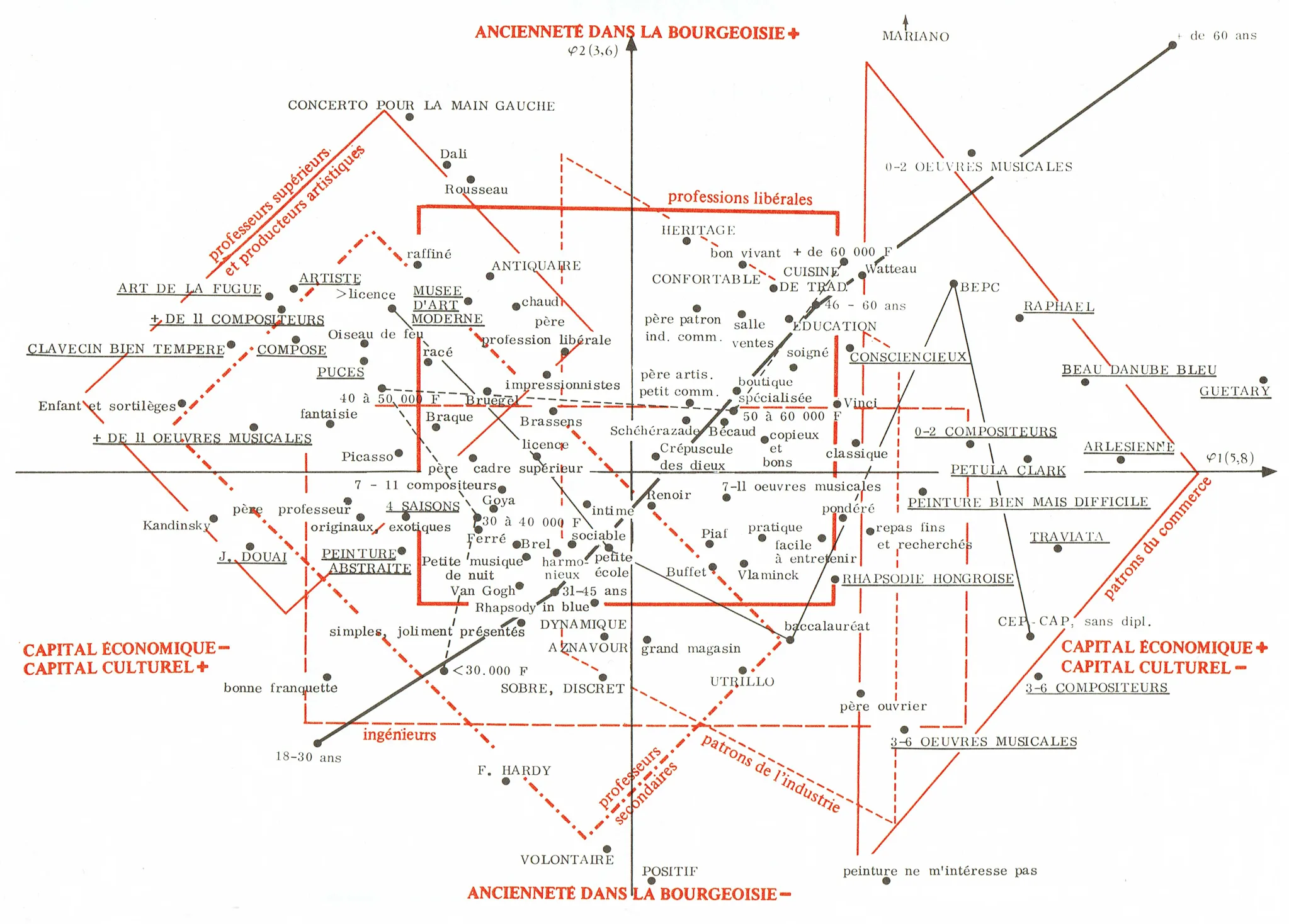
Figure 2 shows a complex data visualization created at the Médialab28 using Gephi, an application for analyzing and visualizing networks. The figure relies on a query run on Web of Science using the keyword “self-organization” in a time window between 2006 and 2010. The network is characterized by four types of nodes: institutions, authors, keywords, and articles, which are characterized by color (type) and size (number of appearances in articles). Nodes are connected by edges, whose force of attraction gives the global configuration. Such kind of connectivity and spatialization is a typical example of network imaginary produced in the Médialab, which has been associated with actor-network theory.
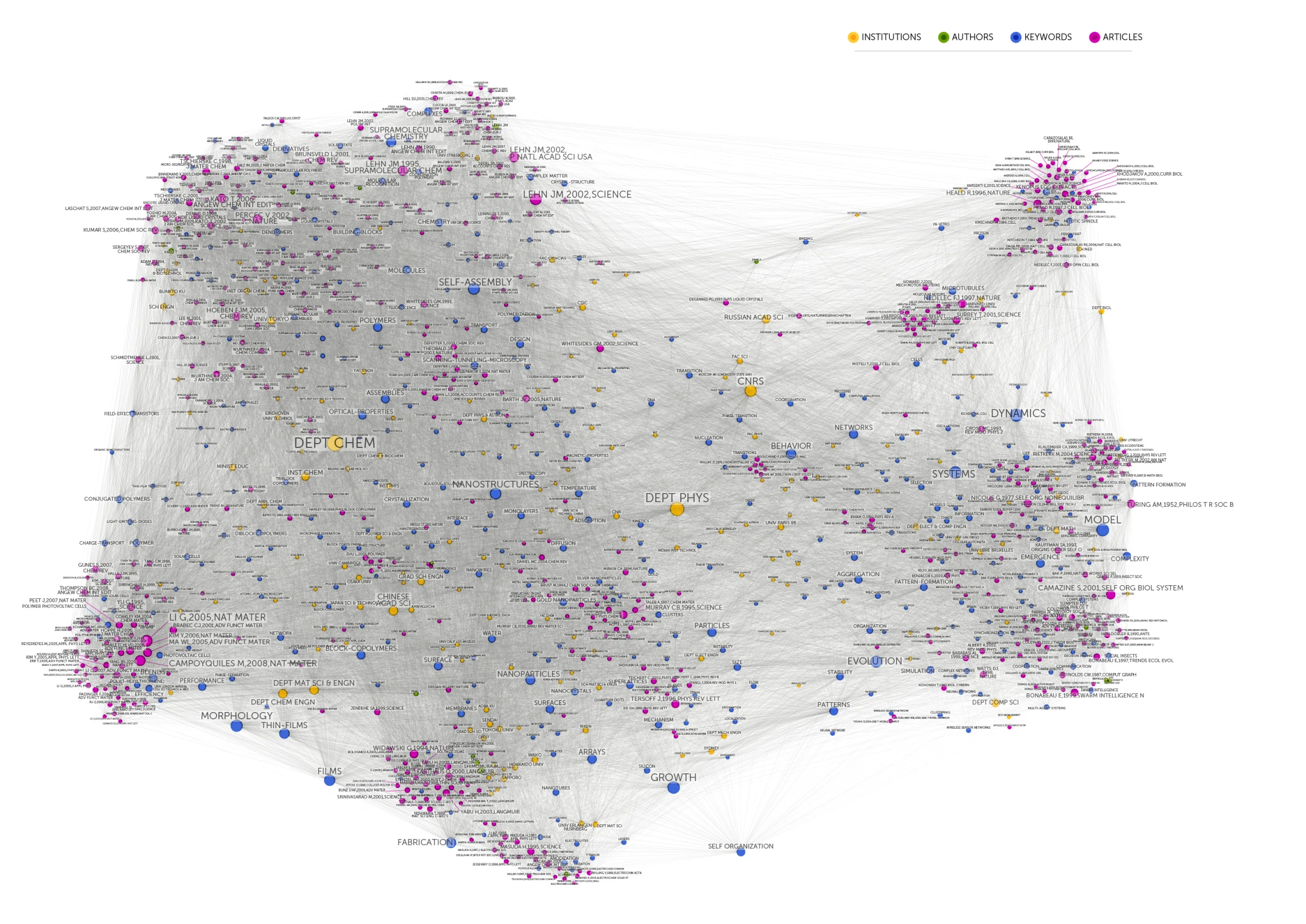
Comparing Bourdieu and Latour’s relationship through data visualization has helped us identify some interesting insights. Their visual grammar is similar but noticeably different despite the thirty years that divide the two experiences. If both place dots in the Cartesian coordinate system, the Latourian space is deeply relational while the Bourdieusian one is not. As a result, the former relies on a strong relational connectivity that draws a sort of background, and the latter in terms of social grouping.
Bourdieu makes abundant use of visualization techniques in his studies. He is not afraid of resorting to them to support his own hypotheses about social reality, but he never explicitly discussed his point of view on them. It can be said that his use of visualization is part of his scientific rhetoric, but it lacks transparency in the construction of CA and MCA (see Blasius and Schmitz 2014, 214). On the contrary, Latour devoted time to think about data visualization and design (Latour 1986, 2008), but he never employed data visualizations in his books or articles, with rare exceptions of co-authored works we have already considered. As strange as it might sound, the “prince of networks” (Harman 2009) never drew a network in his career.
Over the years, Latour’s social theory became a stimulus to contemporary data visualization. For example, Dörk studied monadic explorations intended as “a new approach to interacting with relational information spaces that challenges the distinction between the whole and its parts,” which was inspired by Latour’s interpretation of Tarde’s sociology.29 Furthermore, Latour’s theories played an important role in the development of “digital methods” (Rogers 2013) also through the collaboration between the universities of Amsterdam and Paris.
Bourdieu did not have the same influence on the field. However, Ignatow and Robinson insist on the existence of a Bourdieusian digital sociology. The Bourdieusian notions of habitus, field, and capital are used by scholars developing new social research methods based on data derived from the digital traces left by individuals’ activities online. Among others, they highlight the use of CA and MCA, and other recently developed digital visualization tools that are multidimensional in orientation (Ignatow and Robinson 2017, 956–958). In a recent article, Boelaert and Ollion stress the continuity between contemporary machine learning techniques and some of the classic techniques in quantitative social sciences. Machine learning techniques are divided into two categories: supervised and unsupervised. In supervised learning, the goal is to predict the values of an outcome variable y, based on the values of a set of predictor variables x. In unsupervised learning, there are no y values to predict, and instead the focus is on the detection of regularities in a set of x variables. Unsupervised learning can be divided into two subtasks, clustering and dimensionality reduction. According to the authors, “some classic unsupervised algorithms are already part of the standard toolset of quantitative social science: hierarchical clustering and k-means on the clustering side, factorial analysis (correspondence analysis such as it was developed by Benzécri and popularized by Bourdieu) for dimensionality reduction” (2018, 479). This seems to suggest that there is a continuity between Bourdieu, his methods, and contemporary big data analytics and algorithmic practices. Such “family resemblance,” we believe, can also be verified from a visual perspective.
Figure 3 shows two data visualizations created with UMAP and t-SNE (McInnes, Healy, and Melville 2018, 26). These images are examples of how machine learning can be used to reduce multidimensional data on a flat surface. Elements are situated in a non-relational visual space where visual organization does not rely on a structure with edges. Insights come from proximity and distance as it occurs in a Bourdieusian visualization.

One might be tempted to see resemblance with networks, but as Venturini, Jacomy, and Jensen recently observed (2019), this would be a mistake. Despite superficial similarities, force-vector algorithms of network visualization work very differently from dimensionality reduction. Techniques like correspondence analysis are much closer to UMAP and t-SNE than network visualization. Force-vector layouts are isotopic (i.e. the same in every direction), removing meaning from concepts such as “bottom/up” or “North/South/East/West”. For this reason, polarization is generally not coherent across different clusters: the same variable might spread left-to-right in one cluster and top-down in another.
We can argue that social actors (humans and non-humans) have a prominent role in network visualizations à la Médialab. The primary goal of such visualizations is to observe what a social actor does within and to the network, how its forces play in terms of attraction and repulsion. Incidentally, that is the reason why the possibility of zooming back and forth, and the respective metaphor, have been so important in the field. Indeed, zooming back and forth corresponds to the opportunity of following every single actor without losing sight of the entire network (Latour 2017). In the Bourdieusian correspondence analysis as well as in the case of unsupervised machine learning visualizations like the one we have presented, relations among actors, and the role of each actor are neglected. Social actors do not matter in their relations with each other, but rather their being part of a certain category/tendency or not. Individuals do not actually relate to each other, but to the categories to which they belong.
Conclusion
In this article, we introduced the concept of digital habitus. In the first section, we argued that the digital as it stands today is less Latourian than Bourdieusian. On several occasions, Latour proposes an analogy between his version of the ANT and the networks of the Web 2.0. However, we contended that this flat perspective no longer corresponds to the dominant aspect of the digital. In the past years, we have assisted to a “big datafication” and “algorithmization” of the digital: a digital superstructure has emerged under which all relations and interactions through digital media and technologies are subsumed.
In the second section, we presented the digital habitus as an algorithmic process of clusterization of our relations, actions, and tastes that predicts our future behaviors. We spoke of “personalization without personality”: when digital media and technologies personalize their services more, the unique style of an individual is decreasingly distinguished from those who resemble her.
In the third section, we were looking for a “visual proof” of our hypothesis. We have argued that contemporary data visualizations with machine learning are closer to Bourdieu’s visualizations based on CA and MCA than to the Latour-inspired network visualizations. In particular, we have insisted on the fact that the visual space is not, properly speaking, relational in visualizations created by Bourdieu and through machine learning techniques.
In conclusion, we would like to stress the difference between Bourdieu’s goals, and the “Dark Bourdieu” of the digital habitus. Bourdieu has often been accused of social determinism. Indeed, for him, the dominant has all interests in maintaining the status quo, while the dominated internalizes and applies to themselves the dominating discourses of the dominants. The notion of habitus ends up reducing the supposedly most authentic actions and intentions of a social actor to those of all other members of her dominating or dominated social group. One could even say that social actors do not exist qua actors, but only as manifestations of their social group. According to such a framework, no room for individual freedom or social change seems possible. This is precisely the case of digital media and technologies. Corporations like Facebook and Google do not want to change society, neither for good nor for bad. They rather want to have knowledge of social reality as it is to offer better products.
Bourdieu’s sociology, however, can also be understood as a “martial art” for both self and collective defense.30 We might distinguish here between a short and a long route to emancipation. The short route, which is most often individualistic and elitist, and hence largely ineffective, consists in performing a heroic gesture of, so to say, authenticity. Let us consider perspectives as different as Heidegger and Sartre’s existentialism, or Butler’s parodic performances. In the case of digital media and technologies, let us consider phenomena like digital hacking, digital abstinence, etc.
The long route is made of two steps. The first one consists in offering, “thought about the social conditions of thought which offers thought the possibility of genuine freedom with respect to those conditions” (Bourdieu 2000, 118). In other words, the more we give thought to our social determinations, the more we analyze, qualitatively and quantitatively, and clarify them, the more we increase our possibilities and capacities of understanding, and negotiating with these determinations. We might say that the same holds true for digital media and technology: the more we know, the more we analyze, explain, and reflect on algorithms and all sorts of digital “black boxes,” the more we can hope to be able to understand and deal with them. This is what we have attempted in this article as well. The fact is that freedom is like “the improvisations of the pianist or the so-called free-style figures of the gymnast [which] are never performed without a certain presence of mind, as we say, a certain form of thought or even of practical reflection” (Bourdieu 2000, 162).
However, as the short route’s individualism is naive, so it would be naive to pretend that a scientific publication, like those of Bourdieu or, more modestly, like this article, can raise collective awareness about the consequences and risks of social or technological determinations. The second step in the long route, both in what concerns social and technological determinations, would consist in undertaking a strictly political mobilization, which would open for us the possibility of a collective action of resistance, oriented toward legal and political reforms.31
References
- Benzécri, J.-P. 2006. “L’Analyse des Données: Histoire, Bilan, Projets, …, Perspective.” Modulad 35: 1–5.
- Benzécri, J.-P., et al. 1973. L’analyse des données. 2 vols. Paris: Bordas.
- Blasius, J., and A. Schmitz. 2014. “Empirical Construction of Bourdieu’s Social Space.” In Visualization and Verbalization of Data, edited by J. Blasius and M. Greenacre, 205–22. Boca Raton: CRC Press.
- Boelaert, J., and E. Ollion. 2018. “The Great Regression: Machine Learning, Econometrics, and the Future of Quantitative Social Sciences.” Revue française de sociologie 59 (3): 475–506.
- Boullier, D. 2018. “Médialab Stories: How to Align Actor Network Theory and Digital Methods.” Big Data & Society 5 (2). https://doi.org/10.1177/2053951718816722.
- Bourdieu, P. 2005. “Postface to Erwin Panofsky, Gothic Architecture and Scholasticism.” In The Premodern Condition: Medievalism and the Making of Theory, by B. Holsinger, 221–242. Chicago: The University of Chicago Press.
- Bourdieu, P. 2004. The Bachelors’ Ball: The Crisis of Peasant Society in Béarn. Chicago: The University of Chicago Press.
- Bourdieu, P. 2001. Science of Science and Reflexivity. Cambridge: Polity Press.
- Bourdieu, P. 2000. Pascalian Meditations. Stanford: Stanford University Press.
- Bourdieu, P. 1998. On Television. New York: The New Press.
- Bourdieu, P. 1998b. Masculine Domination. Stanford: Stanford University Press.
- Bourdieu, P. 1984. Distinction: A Social Critique of the Judgment of Taste. Cambridge, MA: Harvard University Press.
- Bourdieu, P. 1979. La Distinction: Critique Sociale du Jugement. Paris: Les Éditions de Minuit.
- Bourdieu, P. 1977. Outline of a Theory of Practice. Cambridge: Cambridge University Press.
- Château, J.-Y. 2008. Le vocabulaire de Gilbert Simondon.
- Cheney-Lippold, J. 2017. We Are Data: Algorithms and the Making of Our Digital Selves. New York: New York University Press.
- Colish, M. L. 1993. “Habitus Revisited: A Reply to Cary Nederman.” Traditio 48: 77–92.
- Culp, A. 2016. Dark Deleuze. Minneapolis: Minnesota University Press.
- Desrosières, A. 2008. Pour une sociologie historique de la quantification. Paris: Presses des Mines.
- Durkheim, E., and M. Mauss. 1967. Primitive Classification. Chicago: The University of Chicago Press.
- Fourcade, M., and K. Healy. 2017. “Seeing Like a Market.” Socio-Economic Review 15 (1): 9–29.
- Gens, J.-C. 2008. Éléments pour une herméneutique de la nature. Paris: Éditions du Cerf.
- Grange, J. 2009. “L’habitus, de la philosophie à la sociologie et retour.” In Pierre Bourdieu, un philosophe en sociologie, edited by M.-A. Lescouret, 35–64. Paris: Presses Universitaires de France.
- Harman, G. 2009. Prince of Networks: Bruno Latour and Metaphysics. Melbourne: re.press.
- Hart, J. 1993. “Erwin Panofsky and Karl Mannheim: A Dialogue on Interpretation.” Critical Inquiry 19 (3): 534–566.
- Ignatow, G., and L. Robinson. 2017. “Pierre Bourdieu: Theorizing the Digital.” Information, Communication & Society 20 (7): 950–966.
- Kale-Lostuvali, E. 2016. “Two Sociologies of Science in Search of Truth: Bourdieu Versus Latour.” Social Epistemology 30 (3): 273–296.
- Latour, B. 2017. “Anti-Zoom.” In Scale in Literature and Culture, edited by M. T. Clarke and D. Wittenberg, 93–101. London: Palgrave.
- Latour, B. 2010. “Networks, Societies, Spheres: Reflections of an Actor-Network Theorist.” Keynote speech for the International Seminar on Network Theory: Network Multidimensionality in the Digital Age, February 19, 2010, Annenberg School for Communication and Journalism, Los Angeles. https://www.bruno-latour.fr/sites/default/files/121-CASTELLS-GB.pdf.
- Latour, B. 2008. “A Cautious Prometheus? A Few Steps Toward a Philosophy of Design (with Special Attention to Peter Sloterdijk).” In Networks of Design: Proceedings of the 2008 Annual International Conference of the Design History Society, edited by F. Hackney, J. Glynne, and V. Minton, 2–10. Boca Raton: Universal Publishers.
- Latour, B. 2007. “Beware, Your Imagination Leaves Digital Traces.” Times Higher Literary Supplement, April 6, 2007. https://www.bruno-latour.fr/sites/default/files/P-129-THES-GB.pdf.
- Latour, B. 2005. Reassembling the Social: An Introduction to Actor-Network Theory. Oxford: Oxford University Press.
- Latour, B. 1998. “Thought Experiments in Social Science: From the Social Contract to Virtual Society.” 1st Virtual Society Annual Public Lecture, April 1, 1998, Brunel University. http://www.artefaktum.hu/it/Latour.htm (archived).
- Latour, B. 1996. “On Interobjectivity.” Mind, Culture, and Activity 3 (4): 228–245.
- Latour, B. 1986. “Visualisation and Cognition: Thinking with Eyes and Hands.” In Knowledge and Society: Studies in the Sociology of Culture Past and Present, edited by H. Kuklick, 1–40. Vol. 6. Jai Press. https://www.bruno-latour.fr/sites/default/files/21-DRAWING-THINGS-TOGETHER-GB.pdf.
- Latour, B., et al. 2012. “The Whole Is Always Smaller Than Its Parts: A Digital Test of Gabriel Tarde’s Monads.” The British Journal of Sociology 63 (4): 590–615.
- Lebaron, F. 2009. “How Bourdieu Quantified Bourdieu: The Geometric Modelling of Data.” In Quantifying Theory: Pierre Bourdieu, edited by K. Robson and C. Sanders, 11–29. Basingstoke: Springer.
- Lynch, M. 1996. “DeKanting Agency: Comments on Bruno Latour’s ‘On Interobjectivity’.” Mind, Culture, and Activity 3 (4): 246–251.
- Marres, N. 2015. “Why Map Issues? On Controversy Analysis as a Digital Method.” Science, Technology, & Human Values 4 (5): 655–686.
- McInnes, L., J. Healy, and J. Melville. 2018. “UMAP: Uniform Manifold Approximation and Projection for Dimension Reduction.” https://arxiv.org/abs/1802.03426.
- Morizot, B. 2016. Pour une théorie de la rencontre: Hasard et individuation chez Gilbert Simondon. Paris: Vrin.
- Nederman, C. J. 1989–1990. “Nature, Ethics, and the Doctrine of ‘Habitus’: Aristotelian Moral Psychology in the Twelfth Century.” Traditio 45: 87–110.
- Nenadić, O., and M. Greenacre. 2007. “Correspondence Analysis in R, with Two- and Three-Dimensional Graphics: The ca Package.” Journal of Statistical Software 20 (3): 1–13.
- Ollion, E., and A. Abbot. 2016. “French Connections: The Reception of French Sociologists in the USA (1970–2012).” European Journal of Sociology 57 (2): 331–372.
- Panofsky, E. 1976. Gothic Architecture and Scholasticism. New York: New American Library.
- Papilloud, C. 2018. Sociology Through Relation: Theoretical Assessments From the French Tradition. London: Palgrave.
- Rahwan, I., et al. 2019. “Machine Behaviour.” Nature 568: 477–486.
- Reigeluth, T. 2019. “Connaissances du transindividuel. Sur une convergence possible de Simondon et Bourdieu.” Klesis 44. https://www.revue-klesis.org/pdf/klesis-44-varia-Reigeluth-Connaissances-transindividuel-convergence-possible-Simondon-Bourdieu.pdf.
- Reigeluth, T. 2018. “La prédiction algorithmique comme activité sociale.” Réseaux 5 (211): 35–67.
- Rist, G. 1984. “La notion médiévale d’‘habitus’ dans la sociologie de Pierre Bourdieu.” Revue européenne des sciences sociales 67 (22): 201–212.
- Rogers, R. 2013. Digital Methods. Cambridge, MA: The MIT Press.
- Romele, A. 2019. “Towards a Posthuman Hermeneutics.” Journal of Posthuman Studies 3 (1): 45–59.
- Sadowsky, J. 2019. “When Data Is Capital: Datafication, Accumulation, and Extraction.” Big Data & Society. https://doi.org/10.1177/2053951718820549.
- Schinkel, W. 2007. “Sociological Discourse of the Relational: The Cases of Bourdieu and Latour.” The Sociological Review 55 (4): 707–729.
- Schmauss, W. 2004. Rethinking Durkheim and His Tradition. Cambridge: Cambridge University Press.
- Sparrow, T., and A. Hutchinson, eds. 2013. A History of Habit: From Aristotle to Bourdieu. Lanham: Lexington Books.
- Sterne, J. 2003. “Bourdieu, Technique and Technology.” Cultural Studies 17 (3/4): 367–389.
- Venturini, T., M. Jacomy, and P. Jensen. 2019. “What Do We See When We Look at Networks.” https://arxiv.org/pdf/1905.02202.pdf.
- Venturini, T., et al. 2017. “An Unexpected Journey: A Few Lessons From Sciences Po Médialab’s Experience.” Big Data & Society 4 (2). https://doi.org/10.1177/2053951717720949.
- Venturini, T., and B. Latour. 2010. “The Social Fabric: Digital Traces and Quali-Quantitative Methods.” https://medialab.sciencespo.fr/publications/Venturini_Latour-The_Social_Fabric.pdf.
-
On the notion of “surface language” and its possible use for approaching digital machines, see Romele, 2019. ↩
-
Culp, 2016, distinguished between a Joyous and a Dark Deleuze. Indeed, while Deleuze can be seen as an affirmative thinker of connectivity, his thought is more and more used to explain the perversity of decentralized forms of control and surveillance. In this context, the expression “Dark Bourdieu” refers to the fact that digital machines usually lack the emancipative intention that ultimately characterizes Bourdieu’s social theory. Moreover, the notion refers to the fact that in this context we are voluntarily ignoring the ways users can positively contribute to the framing of their own digital habitus. ↩
-
Bourdieu rarely referred to the sociology of Latour, probably because of their difference in age. When Latour published his first book with Woolgar, Laboratory Life, Bourdieu was already the most influential sociologist in France, and the most influential French sociologist in the US, second only to Durkheim. Ollion and Abbot, 2016, p. 342, table 3 showed that Durkheim, Bourdieu, and Latour are the three most cited sociologists in 34 prominent journals in US sociology for the period 1970–2012, with an important gap between the first two and the third one (Durkheim 2,018 citations; Bourdieu 1,863; Latour 662). ↩
-
Bourdieu, 2001, p. 29–30. This criticism is relevant to our purposes as it supposes a dissymmetry between humans and non-humans. Bourdieu is closer to the social constructivism in science and technology (SCOT) of authors like Bijker and Pinch than to the Latourian actor-network theory (ANT). Bourdieu is not anti-materialist, rather the opposite; yet for him humans are and have something more than non-humans, namely the symbolic dimension in which their actions, decisions, and desires are embedded. ↩
-
Bourdieu, 2001, p. 54. Kale-Lostuvali, 2016, p. 19 resumes the difference between Bourdieu and Latour concerning the sociology of science as follows: “Bourdieu calls for autonomy while Latour calls for association. […] Bourdieu embraces rationalism […] Latour rejects all epistemologies.” Schinkel, 2007, p. 722 proposes a sociological interpretation of the confrontation between the two authors: “What is at stake in such a struggle between a consecrated scientific star such as Bourdieu (‘priest’) […] and a new vanguard headed by Latour (‘prophet’), would be scientific capital as symbolic capital.” ↩
-
Latour, 1996, p. 235. Papilloud, 2018, p. 185 stresses that Bourdieu’s work contains a concept that Latour particularly likes — the concept of habitus. But for Latour this concept is interesting only when it is freed from its social theory. While in Bourdieu the habitus works as the interface (the schema) between the cognitive dimension and the social structure, in Latour it shows that “human and non-human actors stem from groups of other humans and non-humans, of which they represent one particular association developing other associations.” ↩
-
This is certainly the reason why several earlier enthusiastic disciples of Latour, who applied his theories to digital sociology and methods have, more recently, brought forward some limitations and risks of this approach. ↩
-
https://hyphe.medialab.sciences-po.fr/. Last retrieved November 25, 2019. ↩
-
https://gephi.org/. Last retrieved November 25, 2019. ↩
-
According to Nederman, 1989–1990, the language and concepts associated with habitus were already in wide circulation by the early twelfth century. Based on other Aristotelian sources, mainly the Organon, and Latin authors like Cicero and Boethius, twelfth century philosophers such as Abelard and John of Salisbury resorted to habitus for articulating a fundamentally anthropocentric perspective on moral theory. The notion of habitus allowed them indeed to free moral theory from both theological considerations and naturalistic foundations. For a critique of Nederman’s perspective, see Colish, 1993. ↩
-
For a detailed presentation of the Aristotelian hexis and Aquinas habitus, see chapters 1 and 3 of Sparrow and Hutchinson, 2013. ↩
-
On the relation between Panofsky’s iconological method and Mannheim’s interpretation of the Weltanschauung, see Hart, 1993. ↩
-
Mauss himself is not extraneous to the socially and culturally-oriented post-Kantism, especially via his collaboration with Durkheim on the primitive classification. See Durkheim and Mauss, 1967. On Durkheim “socialization” of the Kantian categories, see Schmauss, 2004. Incidentally, the notion of habitus is already present in the works of Durkheim and Weber, in particular in The Evolution of the Educational Thought, and in Economy and Society. ↩
-
The article, originally published in 1962 with the title Célibat et condition paysanne, has been later included in Bourdieu, 2004, p. 81–93. The reference is at page 82. ↩
-
Fourcade and Healy, 2017, p. 14. See also Sadowsky, 2019, np, who coins the term “digital capital”: “I suggest a better framing of data is as a form of capital that is distinct from, but has its roots in, economic capital. Data capital is more than knowledge about the world, it is discrete bits of information that are digitally recorded, machine processable, easily agglomerated, and highly mobile. Like social and cultural capital, data capital is convertible, in certain conditions, to economic capital. But, as the next section ‘Deriving value from data capital’ shows, not all value derived from data is necessarily or primarily monetary. Data capital is institutionalized in the information infrastructure of collecting, storing, and processing data; that is, the smart devices, online platforms, data analytics, network cables, and server farms.” ↩
-
For a confrontation between Simondon’s individuation and Bourdieu’s habitus, see Morizot, 2016, p. 187–209. Morizot is both right and wrong on his predilection for Simondon’s individuation over the Bourdieusian habitus. He is right, insofar as Simondon’s individuation (and this is all the more true for personalization) says something of the subject that the habitus lacks to say. He is wrong, however, because there is no ultimate intention in Bourdieu’s social theory to reduce the subject to her habitus. For this reason, in the conclusion we propose to distinguish between Bourdieu’s social theory, and the “Dark Bourdieu” which is the work in digital media and technologies today. Morizot’s criticism, we believe, can be applied only to the latter, which is a sort of incomplete version of Bourdieu’s social theory. ↩
-
https://blog.gotinder.com/powering-tinder-r-the-method-behind-our-matching/. Last retrieved November 25, 2019. ↩
-
https://www.theverge.com/2019/3/15/18267772/tinder-elo-score-desirability-algorithm-how-works. Last retrieved November 25, 2019. ↩
-
https://www.theguardian.com/technology/2017/sep/26/tinder-personal-data-dating-app-messages-hacked-sold. Last retrieved November 25, 2019. ↩
-
Rahwan et al., 2019. There is no room for such a reflection in this context, but it would be interesting to confront the notion of machine behaviour with Simondon’s theory of mechanization that regards machines from a “psychological” perspective. On this point, see Reigeluth, 2018. Incidentally, the author often compares Simondon and Bourdieu in this article. An extensive comparison between the two authors — although very different from the one we propose in this article — is offered in Reigeluth, 2019. ↩
-
Benzécri reminds us that “knowledge cannot be sectioned” (Benzécri, 2006, p. 1). ↩
-
On Bourdieu and statistics, see also Desrosières, 2008, p. 291–299. ↩
-
On Bourdieu’s methods, see also Lebaron, 2009. ↩
-
See the article titled Visualisation and Cognition: Thinking with Eyes and Hands (Latour, 1986). ↩
-
The same holds true for mapping controversies (MC). The project MACOSPOL (mapping controversies on science for politics) was launched in 2007. MC was born as an innovative pedagogic model and ended up being also a scientific methodology. On the relation between ANT, MC, and digital methods for social research, see, for instance, Marres, 2015. ↩
-
See the critiques of the former member of the Médialab Boullier, 2018. The criticism is addressed in particular toward Venturini et al., 2017. ↩
-
Bourdieu, 1979, p. 296. In Bourdieu, 1984, the figure is at page 262. ↩
-
The figure has been retrieved from https://medialab.sciencespo.fr/publications/monads/. Last retrieved November 25, 2019. A zoom of this visualization is available in Latour et al., 2012, p. 594. ↩
-
https://mariandoerk.de/monadicexploration/. Last retrieved November 25, 2019. This project has been inspired by a speech Latour gave at CHI2013 (the 2013 conference on human factors in computing systems) on Tarde’s monads. ↩
-
Sociology is a Martial Art, https://vimeo.com/92709274. Last retrieved November 25, 2019. ↩
-
These are the terms used by Bourdieu, 1998b, p. viii discussing Butler in the introduction to the English edition of Masculine Domination. He speaks of “strictly political mobilization, which would open for women the possibility of a collective action of resistance, oriented towards legal and political reforms.” Such mobilization, he says, “contrasts both with the resignation that is encouraged by all essentialist (biological or psychoanalytical) visions of the difference between the sexes and with a resistance that is reduced to individual acts or the endlessly recommenced discursive ‘happenings’ that are recommended by some feminist theoreticians – these heroic breaks in the everyday routine, such as the ‘parodic performances’ favored by Judith Butler, probably expect too much for the meagre and uncertain results they obtain.” ↩