Stock Images of Artificial Intelligence: Ontological, Ethical, and Aesthetical Implications
Romele, Alberto, and Dario Rodighiero. 2022. “Stock Images of Artificial Intelligence: Ontological, Ethical, and Aesthetical Implications.” In From Wisdom to Data: Philosophical Atlas on Visual Representations of Knowledge, edited by José Higuera Rubio, Alberto Romele, Dario Rodighiero, and Celeste Pedro. Porto: University of Porto Press.
Science communication makes abundant use of stock images of AI, bought from agencies such as Getty Images and Shutterstock. These images are full of clichéd and kitschy subjects: humanoid robots touching computer screens, brains half made of electrical circuits, zeros and ones falling from the sky, and, of course, hundreds of human-robot variations on Michelangelo’s The Creation of Adam. Most criticism of these images focuses precisely on their subjects. But what if the real ethical problem lay not in the subjects but in the background? What if a major ethical issue were, for instance, the pervasive use of blue in the backgrounds of these images? This is the thesis we discuss here.
Our research has focused on images of AI for some time now. What interests us in particular are stock images of AI, the kind that can be bought on sites like Getty Images and Shutterstock. Researchers usually ignore stock images, dismissing them as the “wallpaper” of our consumer culture. Yet they are everywhere. Stock images of emerging technologies such as AI (but also quantum computing, cloud computing, blockchain, and so on) are widely used in science communication and marketing: conference announcements, book covers, advertisements for master’s programs. There are at least three reasons to take these images seriously.
The first reason is “ontological.” Over the last thirty years, the philosophy of technology (the discipline of one of us) has been shaped by what is called its “empirical turn” (Brey 2010).1 The name refers to the way a new generation of philosophers of technology, in the 1980s and 1990s, began to criticize how older generations talked about technology. Authors such as Martin Heidegger, in the 1950s, criticized modern technology without knowing anything about it, without ever having visited a factory or a research laboratory, or discussed technology with the engineers who built it. Heidegger’s statement that “the essence of technology is by no means anything technological” is famous in this regard. But is that really so? Is it possible to talk about technology, and to criticize it, without knowing how it works, or at least without asking the experts? The new philosophers of the empirical turn became interested “in the things themselves,” that is, in concrete technologies. Against the “macro” perspective of the previous generation, they preferred a “micro” one. Our thesis, however, is that they threw the baby out with the bathwater: by focusing on what is visible “up close,” they kept themselves from looking at things “from afar.” Our aim, of course, is not to return to the old philosophy of technology, but to combine attention to the micro with attention to the “conditions of possibility” within which the micro of technology (technology as a mere artifact) always already finds itself (Romele 2021). These conditions of possibility are of at least three orders: techno-scientific, socioeconomic, and linguistic-cultural.
As for the first order, it is almost trivial to say that a smartphone would not be what it is, indeed would not exist at all, without other phones to call, satellites, undersea cables, antennas, information theory, behavioral studies, design, ergonomics, and so on. For the second order, the list simply grows longer: contracts with phone companies, Google, Apple, and above all us, as users of technology, consumers of services, and producers of data. As for the third order, every technology is bound up with a “cultural atmosphere.” This means, first, that a culture absorbs it: think of how smartphone use has adapted over time to national habits, such as the “noisy” way Italians use the telefonino, as they call it. It also means that, in being absorbed, technologies like the smartphone transform the culture in turn; no culture is immune to the technologies it appropriates. Finally, it means that a culture, in order to cope with specific technologies, produces representations of them. These representations are not simple copies of technological reality but, above all, crystallizations of the expectations and imaginaries that a culture holds about those technologies.
It is precisely this linguistic-cultural order, and within it the theme of representations, expectations, and imaginaries, that interests us. Our “ontological” claim about AI is that any definition of AI must include this level, just as it cannot exclude the other conditions of possibility. AI is not only a technological fact but also a cultural one. Cultural representations of AI are not mere phantasmagoria detached from technological reality; they play an active role in processes of technological innovation.
This brings us to the second reason for our interest in stock images of AI, which is “ethical-political” (Romele, forthcoming). Even the most careful AI ethicists, remarkably, pay little attention to how AI is represented and communicated, in scientific and popular contexts alike. The Oxford Handbook of Ethics of AI, for instance, a volume of more than 800 pages, contains no chapter on the representation and communication of AI, textual or visual; yet its cover image comes from iStock, a company owned by Getty Images. Its subject is a classic androgynous face made of “digital particles” that turn into a printed circuit board. The most interesting thing about the image, however, is not its subject (its figure, as art historians would say) but its background. We take this focus on background rather than figure from the French philosopher Georges Didi-Huberman (2005), and in particular from his analysis of Fra Angelico’s painting.

Didi-Huberman devotes some admirable pages to Fra Angelico’s use of white in the Annunciation, the fresco he painted around 1440 in the convent of San Marco in Florence. This white, present between the Madonna and the Archangel Gabriel, spreads not only across the entire painting but through the whole cell in which it was painted. Didi-Huberman’s thesis is that this white is not a lack, an absence of color and detail. It is rather the presence of something that, by its very essence, cannot be given as pure presence, but only as a “trace” or a “symptom”: the mystery of the Incarnation. Fra Angelico’s white does not invite an absence of thought. It is a sign that “gives rise to thought,”2 just as scholastic philosophy understood the Annunciation not as a unique and incomprehensible event but as a flowering of meanings, memories, and prophecies reaching from the creation of Adam to the end of time, from the simple form of the letter M (Mary’s initial) to the prodigious construction of the heavenly hierarchies.
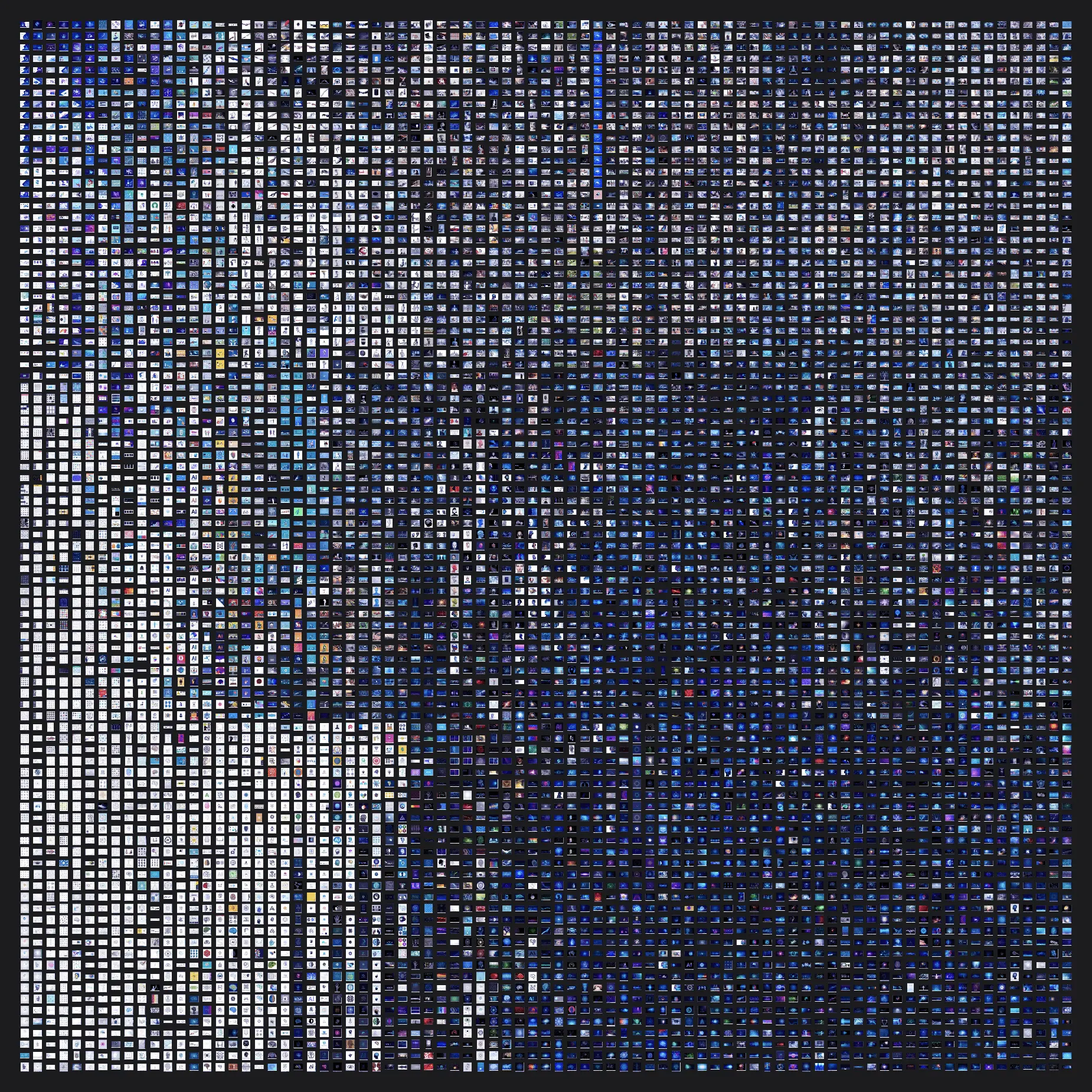
The image above gathers about 7,500 images returned by a search for “Artificial Intelligence” on Shutterstock. It is interesting because, as a kind of “distant viewing,” it lets the background emerge over the figure, and in particular the color of the background. Two colors seem to dominate: white and blue. Our thesis is that these two colors have the diametrically opposite effect of Fra Angelico’s white. If his white “gives rise to thought,” the white and blue of AI stock images do the reverse.
Consider the history of blue as told by the French historian Michel Pastoureau (2001). He distinguishes several phases: a first phase, up to the twelfth century, in which the color was almost entirely absent; an explosion of blue in the twelfth and thirteenth centuries (think of the stained-glass windows of many Gothic cathedrals); a moral and noble phase, in which blue became the color of the Virgin’s robe and of the kings of France; and finally a popularization of blue, beginning with Young Werther and Madame Bovary and ending with Levi’s blue jeans and IBM, known as Big Blue. To this day, blue is statistically the world’s favorite color. According to Pastoureau, its success does not express an impulse, as might be the case with red. Blue seems to be loved, rather, because it is peaceful, calming, and anesthetizing. It is no coincidence that blue is the color of supranational institutions such as the UN, UNESCO, and the European Union, as well as of Facebook and, of course, Meta. In Italy, the police wear blue, which is why policemen are disdainfully called “Smurfs.”
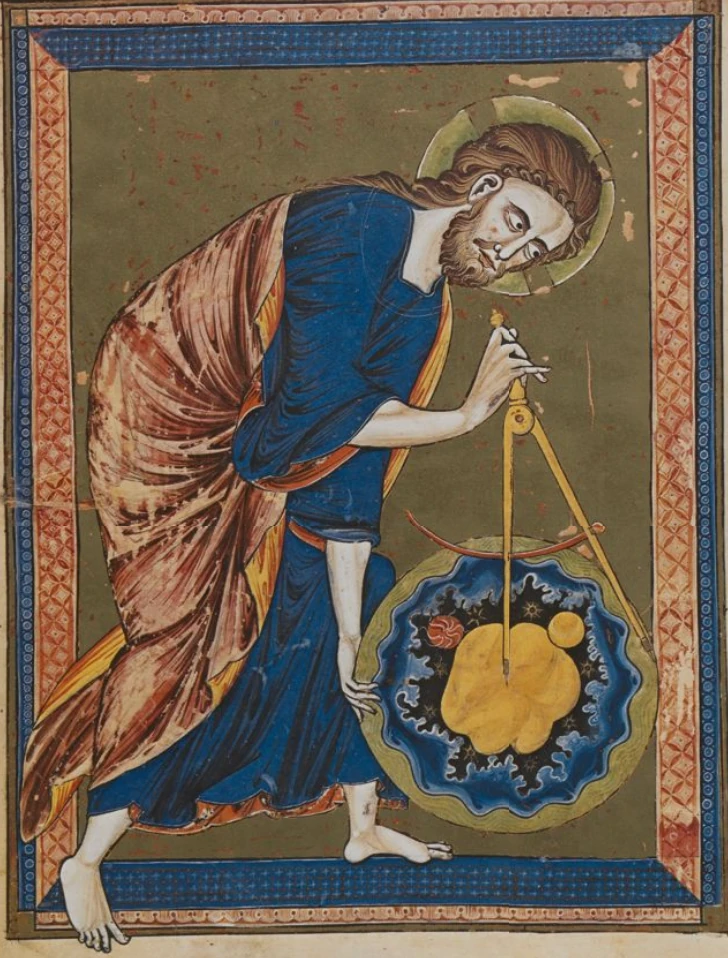
If all this is true, the problem with AI stock images is that, instead of provoking debate and “disagreement,” they lead viewers into acceptance and resignation. Rather than putting experts and non-experts on an equal footing, and encouraging non-experts to weigh in on innovation, they are “screen images,” in the etymological sense of the word “screen”: to cover, cut off, and separate. We take the notion of “disagreement” or “dissensus” (mésentente in French) from another French philosopher, Jacques Rancière (2004), for whom disagreement is far more radical than mere “misunderstanding” (malentendu) or “lack of knowledge” (méconnaissance). These, as the words themselves suggest, are failures of mutual understanding and knowledge that can be overcome if handled in the right way. Much of the literature, tellingly, conceives of science communication precisely as a way to overcome misunderstanding and ignorance. We propose instead an agonistic model of science communication, and of the use of images in it. Images should not soothe; they should foster an agonistic conflict, one that acknowledges the legitimacy of opposing positions without seeking a definitive, peaceful resolution.3 The ethical-political problem with AI stock images, whether in science communication or in popular contexts, is therefore not that they fail to represent the technologies themselves. The problem, if anything, is that while they deal in expectations and imaginaries, they do not encourage individual or collective imaginative variations; they calm and anesthetize them.
This brings us to our third reason for discussing stock images of AI, which is “aesthetic.” The term should be understood here in its etymological sense. Admittedly, these images of half-flesh, half-circuit brains and human-robot versions of The Creation of Adam are ugly and kitschy. But by aesthetics we mean a “theory of perception,” as the Greek word aisthesis, “perception,” suggests. We believe there is a serious problem of perception today, and of visual perception in particular, where AI is concerned. Put simply, AI is objectively difficult to depict, and hence to make visible. This, in our view, explains the proliferation of stock images.
There are, we think, three possible ways to depict AI today (AI being largely synonymous with machine learning). The first is through the algorithm, which can itself take different forms, such as computer code or a decision tree. This is an unsatisfactory solution, first because it is unintelligible to non-experts, and second because representing the algorithm is not representing AI, any more than representing the brain is representing intelligence. The second way is through the technologies in which AI is embedded: drones, autonomous vehicles, humanoid robots. But representing the technology is not, of course, representing AI; nothing tells us that the technology is actually AI-driven rather than an empty box. The third way gives up on representing the “thing itself” and turns instead to expectations, or imaginaries. This is where we would place most stock images and other popular representations of AI.4
Researchers tend to judge images of AI (and of technologies in general) ontologically, ethically, and aesthetically according to whether or not they represent the “thing itself.” Hence the tendency to prefer the first way to the second, and the second to the third. An image is all the more “true,” “good,” and “aesthetically appreciable” the closer, and therefore the more faithful, it is to what it is meant to represent. This is what we call the “referentialist bias.” Yet for the reasons given above, referentialism works poorly for images of AI, since none of them can come close to AI or be faithful to it. Our aim is not to condemn all images of AI but to rescue them, precisely by giving up referentialism. If there is an aesthetics of AI images (which is, of course, also an ethics and an ontology), its goal is not to depict the technology itself. It is rather to “give rise to thought,” through depiction, about the conditions of possibility of AI: its techno-scientific, socioeconomic, and linguistic-cultural implications.
We would like to close this already overlong text with a methodological note. We said at the outset that our challenge is not to return to the old philosophy of technology, the one that criticizes technology without knowing anything about it, but to bring together the “micro” and “macro” perspectives. This is precisely what we try to do with AI stock images: alongside theoretical work like the above, we also conduct empirical research on them. The image shown earlier is the result of one such study. First, we used the web crawler Shutterscrape, which let us download images and videos from Shutterstock in bulk, and obtained about 7,500 stock images for the search “Artificial Intelligence.” Second, we used PixPlot, a tool developed by Yale’s DH Lab. The result is available online.5 The map is navigable: one can select any of the ten clusters the algorithm created, zoom in and out of each, and pick out single images. We labeled the clusters by hand: (1) background, (2) robots, (3) brains, (4) faces and profiles, (5) labs and cities, (6) line art, (7) Illustrator, (8) people, (9) fragments, and (10) diagrams. What interests us in this experiment is that it leaves to an AI algorithm, the one underlying PixPlot, the task of “understanding” its own representations.
Another empirical study, conducted with other colleagues (Marta Severo, Olivier Buisson, and Claude Mussou), goes in the opposite direction. Here we used Snoop,6 a tool developed by INA and INRIA and also based on an AI algorithm. The idea behind Snoop is that researchers, like “turkers” but aware of the goals of their work, can train the algorithm to recognize classes of images within a corpus. Whereas in PixPlot the clusters are chosen automatically, in Snoop the researcher decides the classes and the algorithm finds their members. Snoop allowed us, for example, to distinguish two subclasses within the class of white robots: white female robots and white childlike robots. Finally, there is a small project we are particularly fond of: the Instagram account ugly.ai.7 Inspired by existing initiatives such as the NotMyRobot! Twitter account, ugly.ai monitors the use of AI stock images in science communication and marketing. It also aims to raise awareness, among stakeholders and the public alike, of the problems involved in depicting AI (and other emerging technologies), and in using stock imagery in particular. What we want to stress in conclusion is that these empirical experiments are not external to our theoretical reflection. We are convinced, on the contrary, that it is precisely these empirical works, these “explanations,” that lead us each time to “understand better” the transcendental implications of depicting AI.
References
- Brey, Philip. 2010. “Philosophy of Technology after the Empirical Turn.” Techné: Research in Philosophy and Technology 14 (1): 36–48.
- Didi-Huberman, Georges. 2005. Confronting Images: Questioning the Ends of a Certain History of Art. University Park: Pennsylvania State University Press.
- Pastoureau, Michel. 2001. Blue: The History of a Color. Princeton: Princeton University Press.
- Popa, Eugen Octav, Vincent Blok, and Renate Wesselink. 2020. “An Agonistic Approach to Technological Conflict.” Philosophy & Technology.
- Rancière, Jacques. 2004. Disagreement: Politics and Philosophy. Minneapolis: University of Minnesota Press.
- Ricoeur, Paul. 1967. The Symbolism of Evil. Boston: Beacon Press.
- Romele, Alberto. 2021. “The Transcendental of Technology Is Said in Many Ways.” Foundations of Science.
- Romele, Alberto. Forthcoming. “Images of Artificial Intelligence: A Blind Spot in AI Ethics.” Philosophy & Technology.
-
That a philosopher of technology should speak of images of technology is itself interesting. Images of technology (not the images produced by scientific instruments, of which there are a great many, but images of technology itself) are mostly relegated to the role of idols: deceptive, or at least dangerous, images, because they are copies of the very things to which empirical philosophers of technology want to devote themselves. The job of looking at images of technology is thus left, with grave consequences, to other disciplines. ↩
-
The expression is borrowed from Ricoeur (1967). ↩
-
On the agonistic model in science and technology, inspired by Chantal Mouffe’s philosophy, see Popa, Blok, and Wesselink (2020). ↩
-
Needless to say, this distinction is an idealization: the three levels largely overlap. Algorithm code comes in colors, drones fly over green fields and blue skies that suggest hope and a future for humanity, and stock images often refer, however vaguely, to existing technologies (touch screens, neural networks, and so on). ↩